 exoticsgroup.com
Stop Making Sense: How Carbon-Ceramic Brakes Work, and Why Track Days Cook Them


Rub your hands together hard for ten seconds. Feel that warmth? Congratulations, you just built a brake. Every friction brake on every car does exactly that: it takes the energy of a moving car and turns it into heat by rubbing two things together. Your hands are the pads, the brake disc is the thing being rubbed, and the faster you were going, the more heat you have to get rid of.
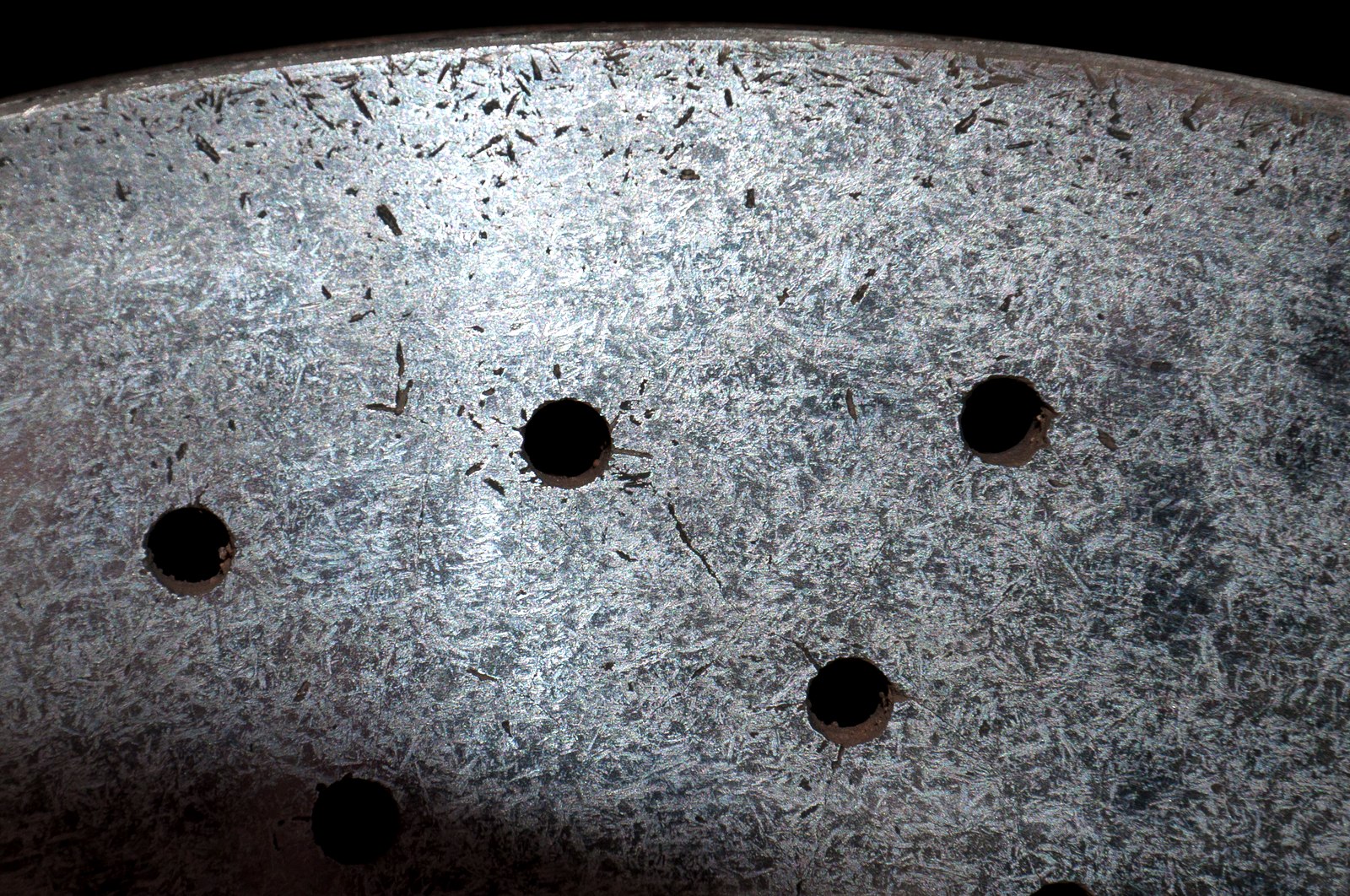
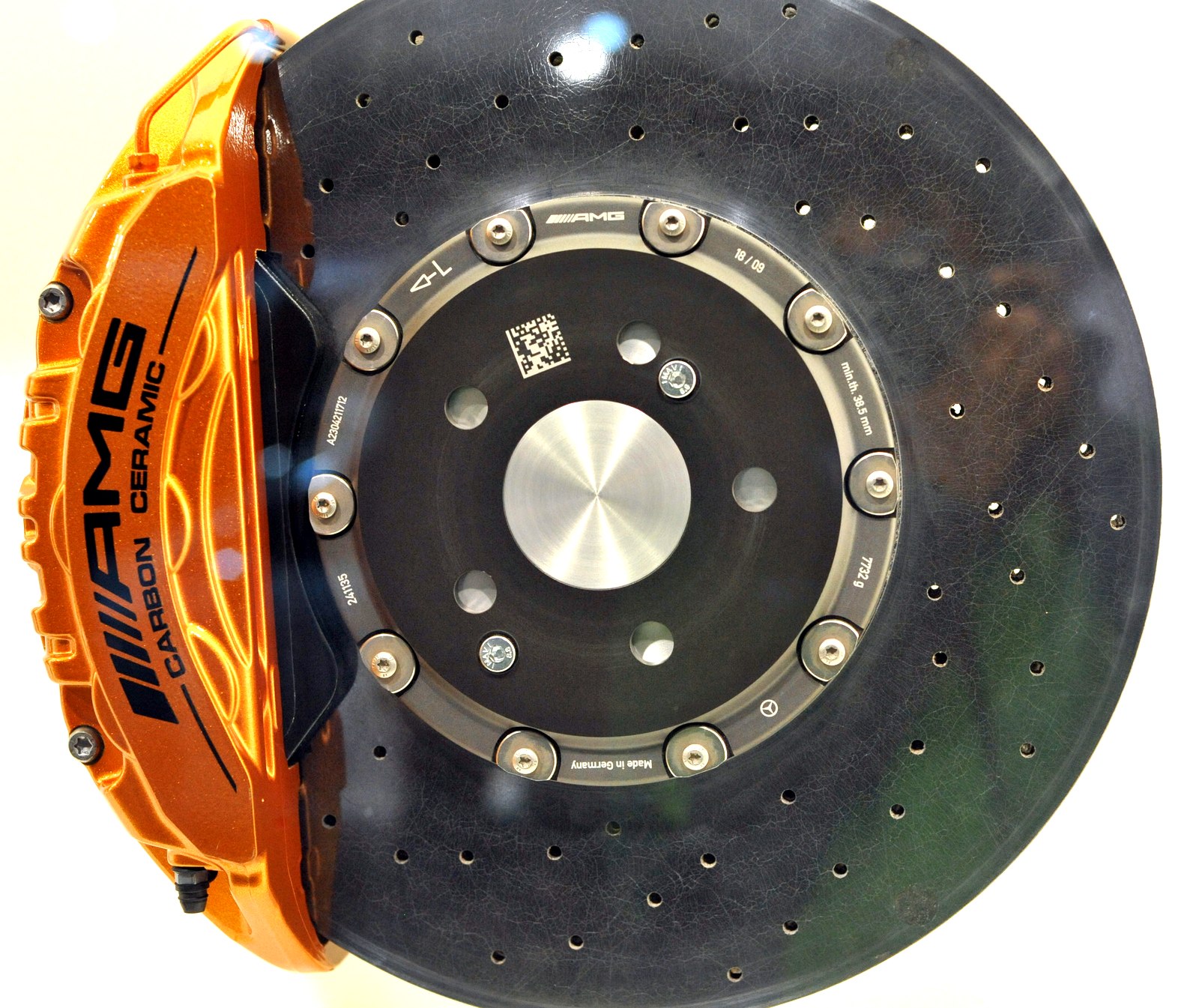
Now picture doing that in a supercar, lap after lap, at the end of a long straight. That is where carbon-ceramic brakes come in, the dinner-plate-sized, polka-dotted gray discs you see behind the wheels of Ferraris, Lamborghinis, McLarens and Porsches with yellow calipers. They weigh about half as much as iron discs, they shrug off heat that would make iron brakes go soft, and they can last a very long time. They also cost as much as a decent used car to replace, they can squeal like a startled parrot in a parking lot, and they have a secret weakness that track days expose. Let's get into it.
Brakes 101: a heat machine with a pedal
A disc brake has three main players. The disc (or rotor) spins with the wheel. The caliper sits over the edge of the disc and holds the pads. When you press the pedal, hydraulic pistons in the caliper squeeze the pads onto both faces of the disc, and friction slows the wheel.
The disc is the heat sponge. It has to soak up a huge burst of energy in a couple of seconds, then shed it to the air before the next corner. Ventilated discs are two friction faces joined by internal vanes, so air pumps through the middle like a fan. When the disc, pads or fluid get hotter than they were designed for, the brakes "fade": hot pads and discs grip less, so the car stops less for the same push, and boiling fluid makes the pedal go soft and long. Either way, your confidence leaves before you do. Porsche puts it plainly: with steel (cast iron) brakes, friction "can vary significantly under heavy use," while its ceramic system is built to keep friction stable through repeated high-speed stops.
What carbon-ceramic actually is
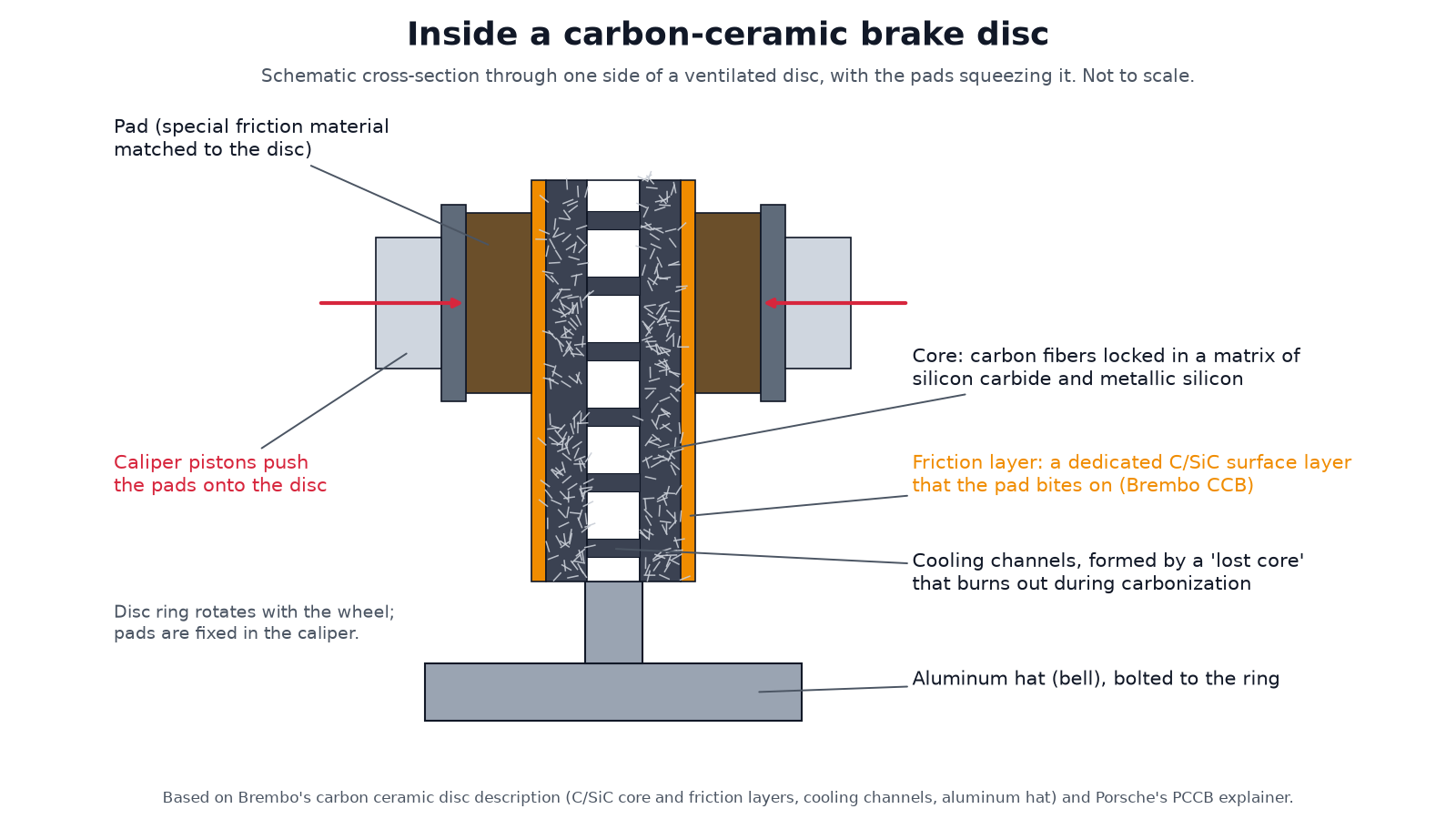
Despite the name, a carbon-ceramic disc is not a dinner plate and not a carbon-fiber body panel. It is a composite. Brembo describes the material as carbon fibers (the reinforcement) locked in a matrix of silicon carbide and metallic silicon. Silicon carbide, the main matrix ingredient, is extremely hard, which gives wear resistance. The carbon fibers give the toughness that stops the disc from shattering like a ceramic mug. Materials engineers call it C/SiC, or carbon-fiber-reinforced silicon carbide.
It is a cousin of the carbon-carbon brakes used in Formula 1, but with a crucial difference. Brembo notes that racing carbon discs "do not begin to perform their braking action until they reach high temperature," which is fine at a Grand Prix and useless when you back out of your driveway on a cold morning. The ceramic version was developed to keep most of carbon's lightness and heat tolerance while working from cold, and to cut the long production time of racing discs.
Brembo SGL Carbon Ceramic Brakes (BSCCB), the joint venture that Brembo and Germany's SGL Carbon formed on June 1, 2009, makes two main road-car versions, CCM and CCB. The CCB discs, according to BSCCB, get an extra step: a dedicated friction layer, typically of specially formulated ceramic materials and silicon carbide, applied to the braking faces to improve grip, modulation and wear resistance.
How you bake a brake disc (siliconization)
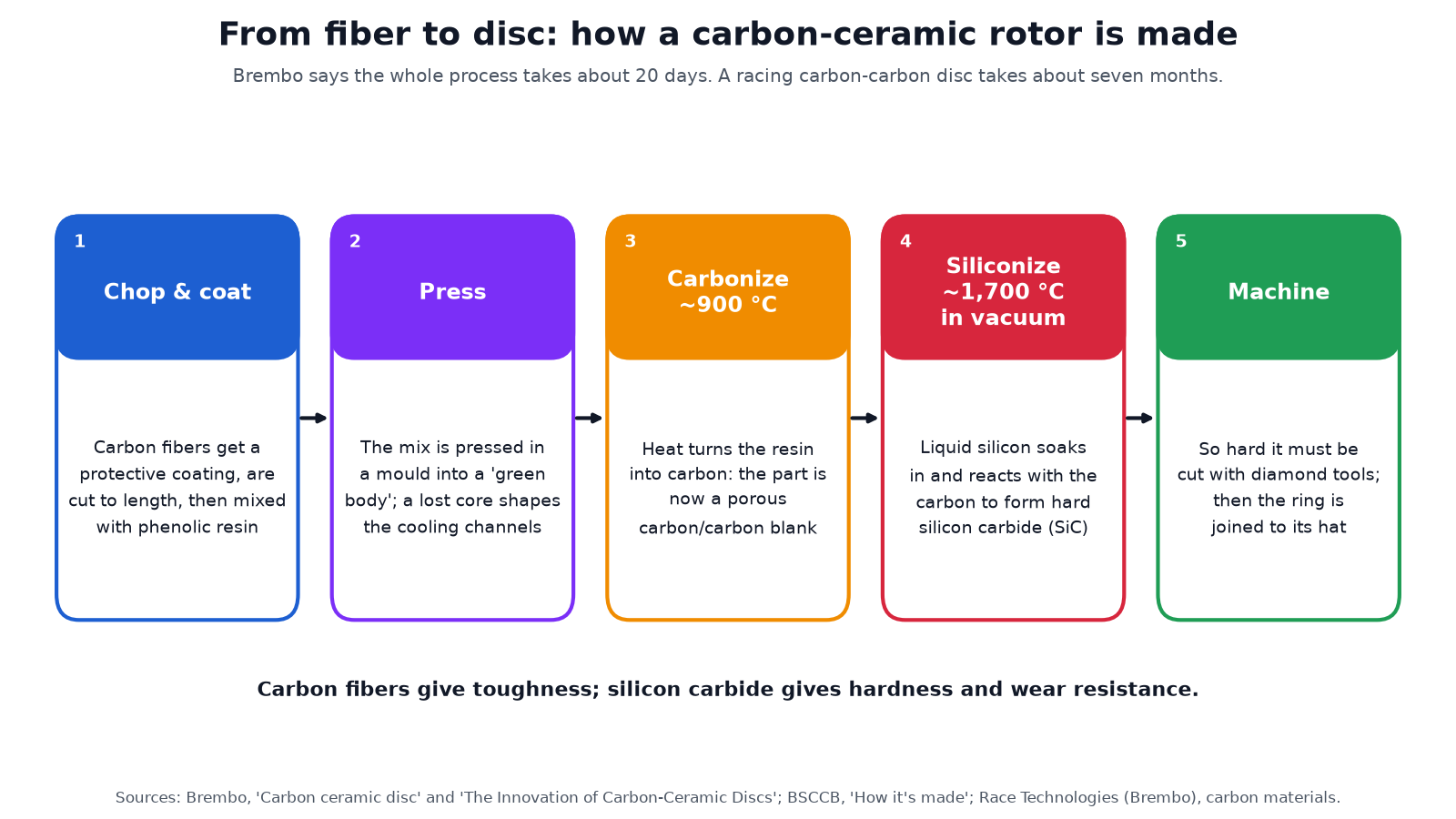
This is the fun part, because making one of these discs is basically high-tech baking. Here is the recipe, as Brembo and BSCCB describe it:
- Chop and mix. Carbon fibers get a protective coating and are cut into short pieces of a defined length and thickness, then mixed with a phenolic resin that acts as a binder.
- Press. The mix is pressed in a mould into a "green body" in the shape of the disc. For the internal cooling channels, Brembo uses a "lost core": a plastic insert that defines the channels and burns out without residue in the next step.
- Carbonize. The part is heated to around 900 °C. The resin turns to carbon, leaving a porous carbon/carbon blank.
- Siliconize. Liquid silicon is infiltrated into the blank at around 1,700 °C in a vacuum. It soaks into the pores and reacts with the carbon to form silicon carbide. This step is called siliconization, or liquid silicon infiltration (LSI).
- Machine. The result is so hard that it has to be machined with diamond tools. The ring is then joined to its hat (also called the bell), which on Brembo's discs is aluminum.
Brembo says the whole process takes about 20 days. For comparison, Race Technologies' Brembo Performance and Brembo Racing tech blog puts a racing carbon-carbon disc at about seven months from start to finish. Brembo's carbon-ceramic disc was striking enough to win Italy's Compasso d'Oro industrial design award in 2004, with the award citation reading, "If it weren't a brake, it would be a sculpture worthy of any modern art museum."
Why they shrug off fade
Iron is a great brake material until it gets very hot. Carbon-ceramics are built for the heat. Brembo says its carbon-ceramic brakes "perform flawlessly even at 600 - 750 °C" and withstand initial peaks close to 1,000 °C, with a friction coefficient that stays steady across a very wide temperature range. On its consumer disc page, Brembo also claims a friction coefficient 25% higher than traditional discs.
Ferrari, when it made carbon-ceramic brakes standard on its whole range from 2008, called their "exceptional fade resistance" one of the most obvious advantages, noting that fade compromises the pedal feel and response that give a driver confidence.
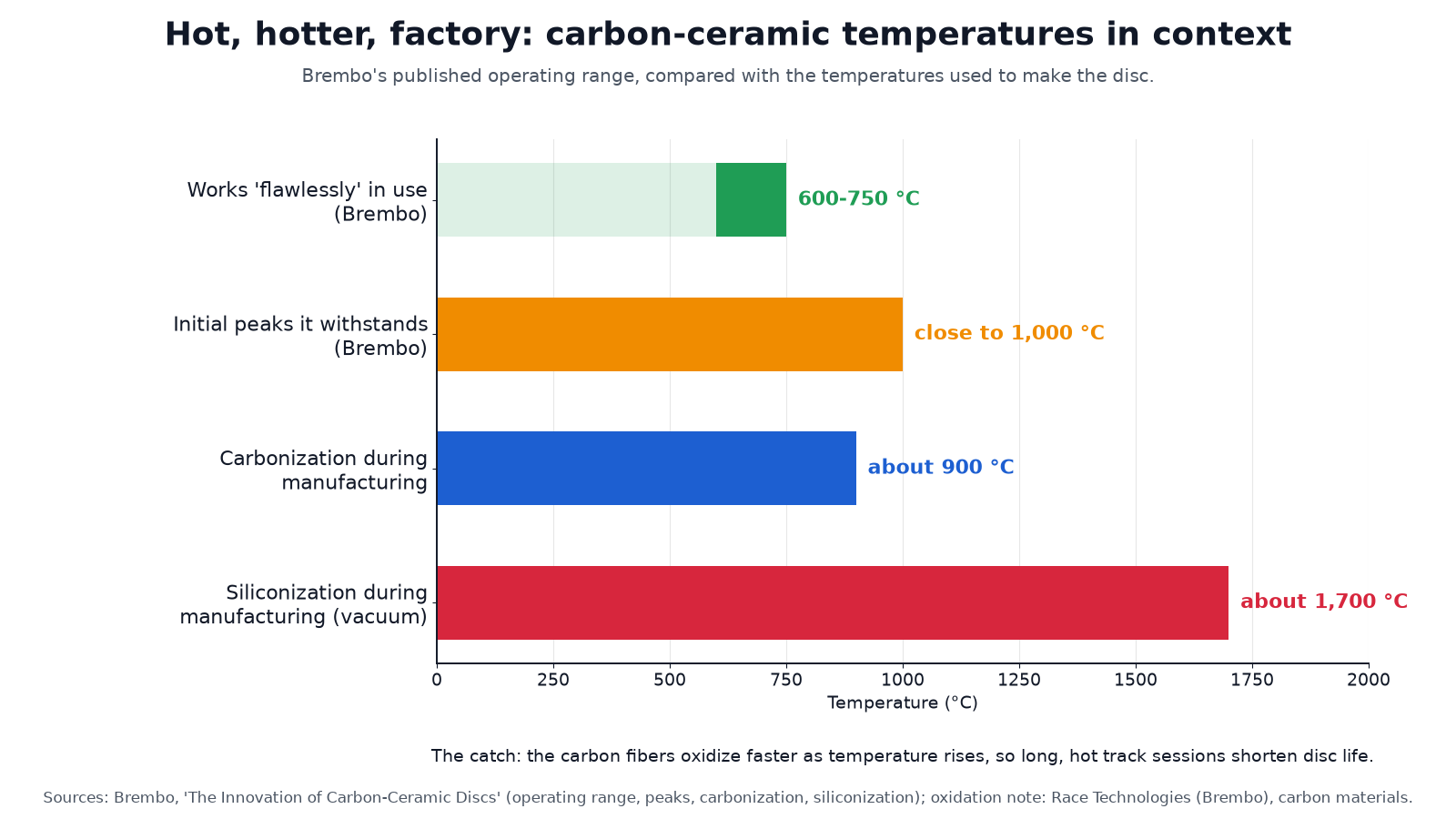
One honest caveat: those temperature numbers describe what the disc tolerates, not a target. As we will see, heat is also what slowly eats a carbon-ceramic disc.
The weight win: unsprung and spinning
The headline number is weight. Porsche says its PCCB discs save around 50% compared with cast iron, which adds up to roughly 20 kg (44 lb) of total vehicle weight depending on the model. Ferrari quoted around 15 kg for its system in 2007. Edmunds found that ticking the PCCB box on a Boxster S cut the car's weight by 34.4 lb.
The Race Technologies blog publishes Brembo's representative weights that make the difference obvious: a 355 x 32 mm cast-iron disc ring weighs 16.5 lb, a 360 x 32 mm CCM-R carbon-ceramic ring weighs 7.5 lb, and a racing carbon-carbon ring weighs just 5.8 lb.
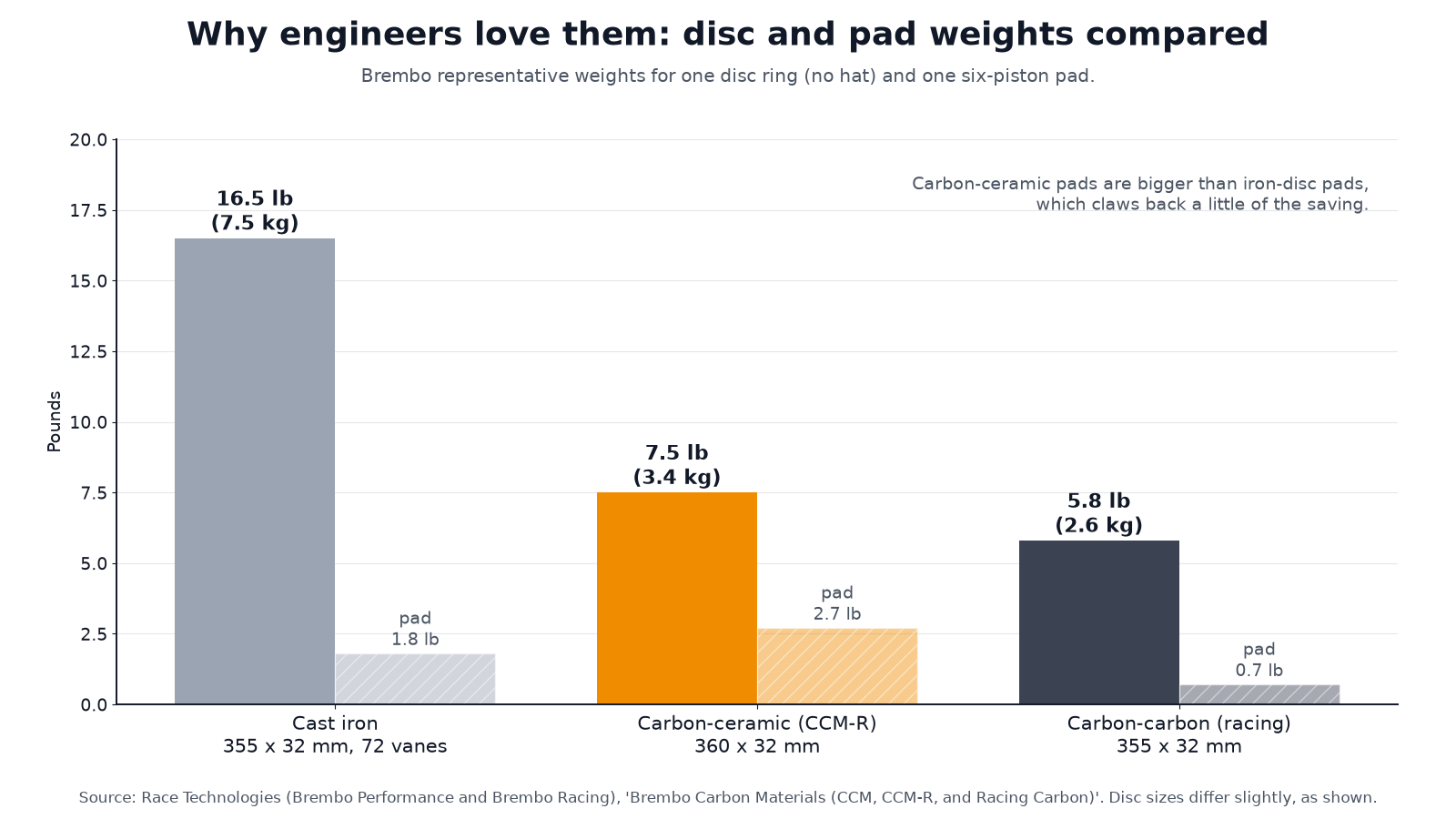
Why does 20 kg matter on a car that weighs well over a tonne? Because this is not just any weight. Brakes are unsprung mass, the stuff on the wheel side of the springs. Less of it lets the suspension keep the tire pressed on the road more easily; Porsche says it helps the suspension "react more quickly and accurately," improving ride and steering feel. Discs are also rotating mass, so they take extra energy to spin up and slow down, which is why Edmunds notes that saving weight there helps acceleration more than the same saving elsewhere in the car. One small asterisk from Race Technologies: carbon-ceramic pads are larger than equivalent iron-disc pads, which claws back a little of the saving.
Who uses them
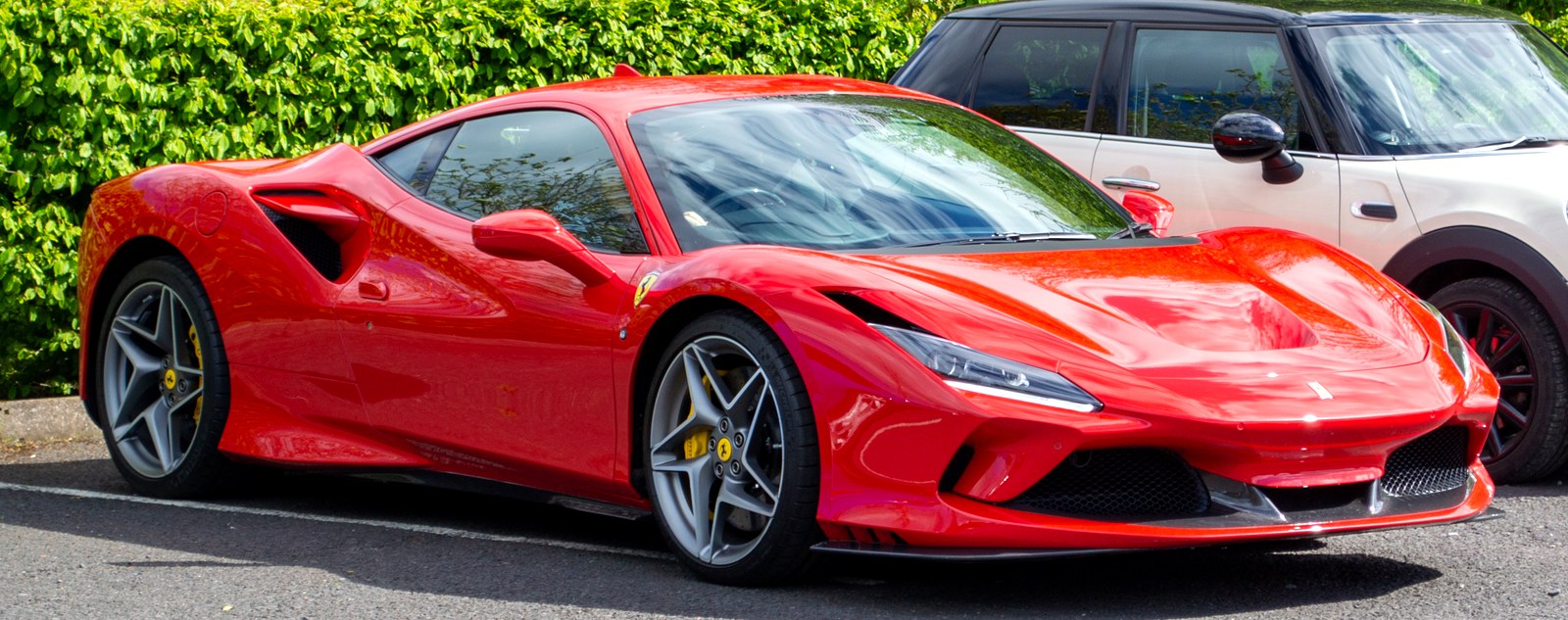
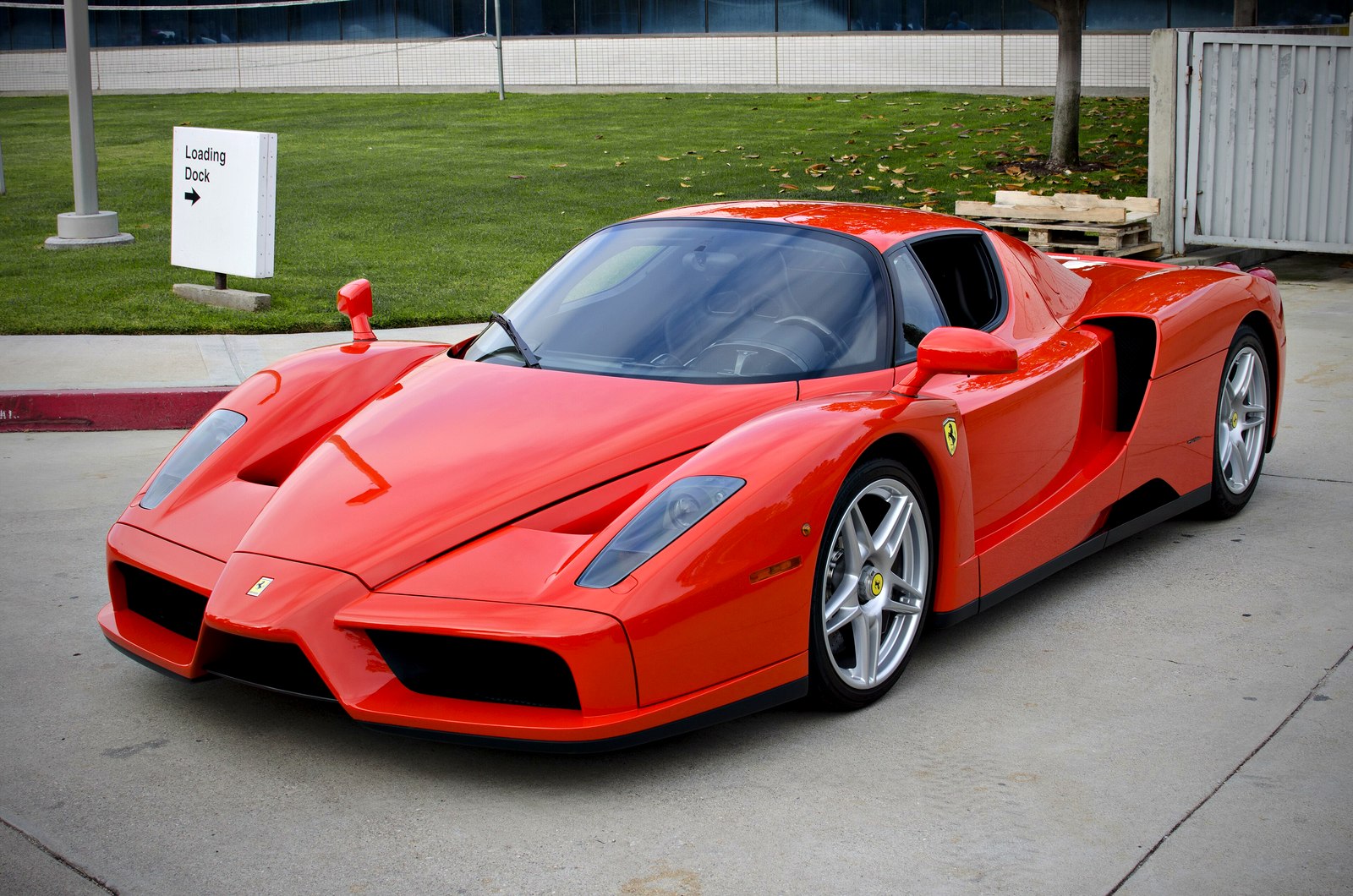
Ferrari was Brembo's launch customer. Brembo says its CCM discs debuted on the Ferrari Enzo, and the market launch came in 2002. In December 2007, Ferrari announced that every car in its range would get CCM brakes as standard from 2008, the first carmaker to do so, adding that customer requests had topped 85% on some models.
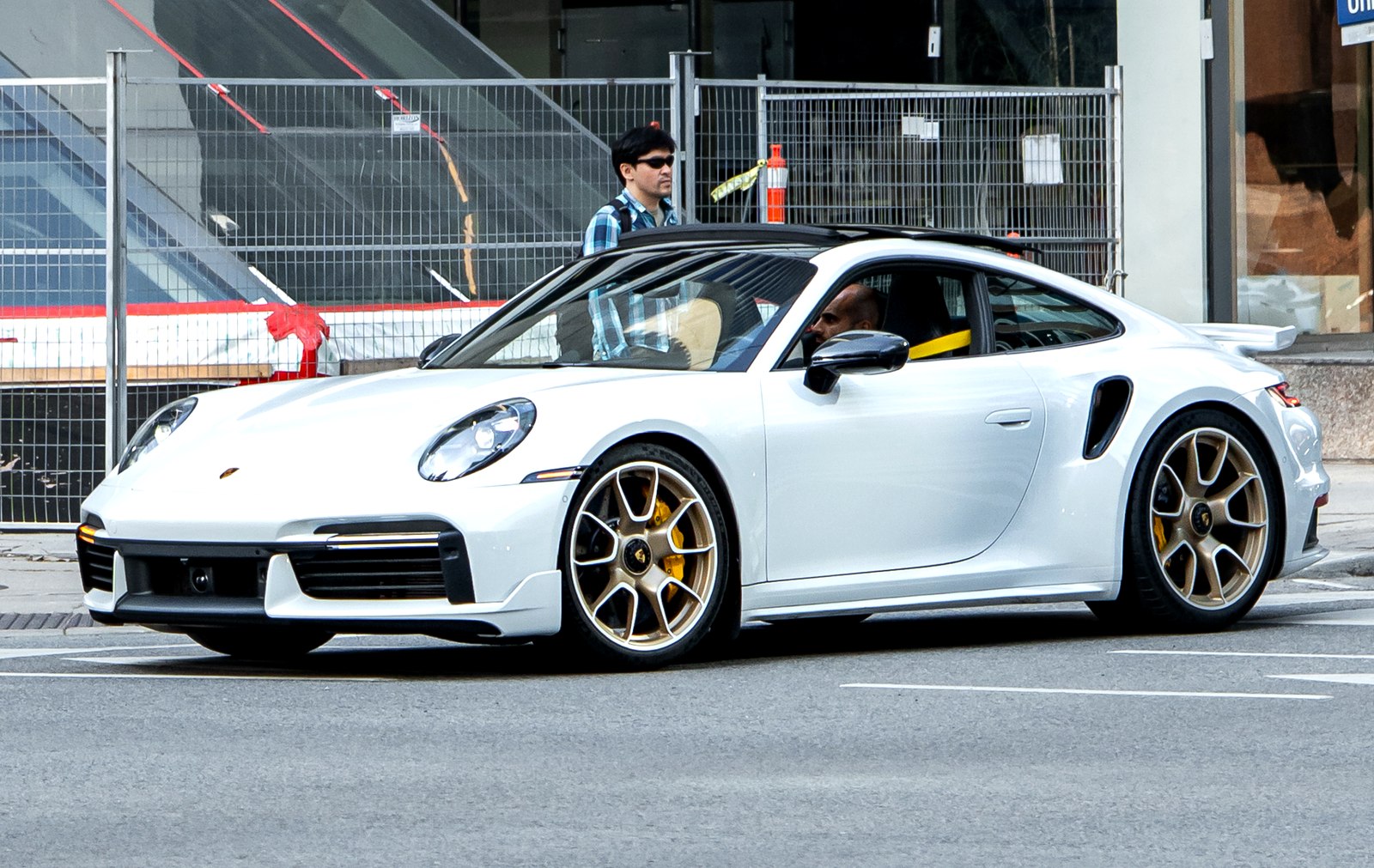
Porsche introduced Porsche Ceramic Composite Brakes (PCCB) in 2000, as an option on the 996-generation 911 Turbo and as standard on the 911 GT2. The disc material in Porsche's original announcement was SGL Carbon's SIGRASIC. Today PCCB is standard on the 992.2 911 Turbo S and Taycan Turbo S and optional across much of the range; the yellow calipers are the giveaway. Porsche also offers a middle ground, the tungsten-carbide-coated Porsche Surface Coated Brake (PSCB), which it says offers the same thermal stability for "a significantly more competitive cost."
Lamborghini fits a CCB Plus (Carbon Ceramic Brakes Plus) system to the Revuelto, with ten-piston front calipers and 410 x 38 mm front discs, up from the 400 x 38 mm discs of the Aventador Ultimae.
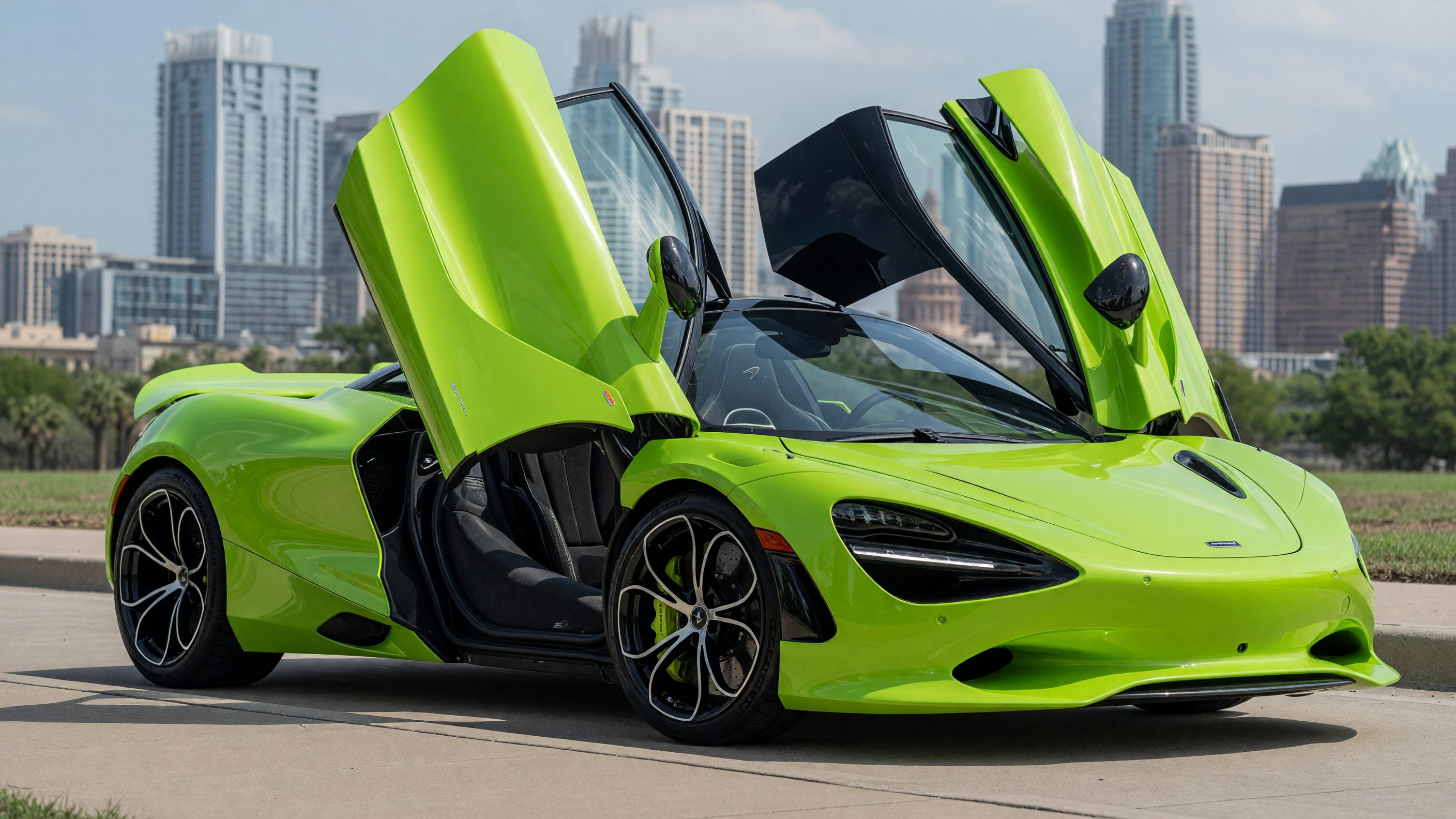
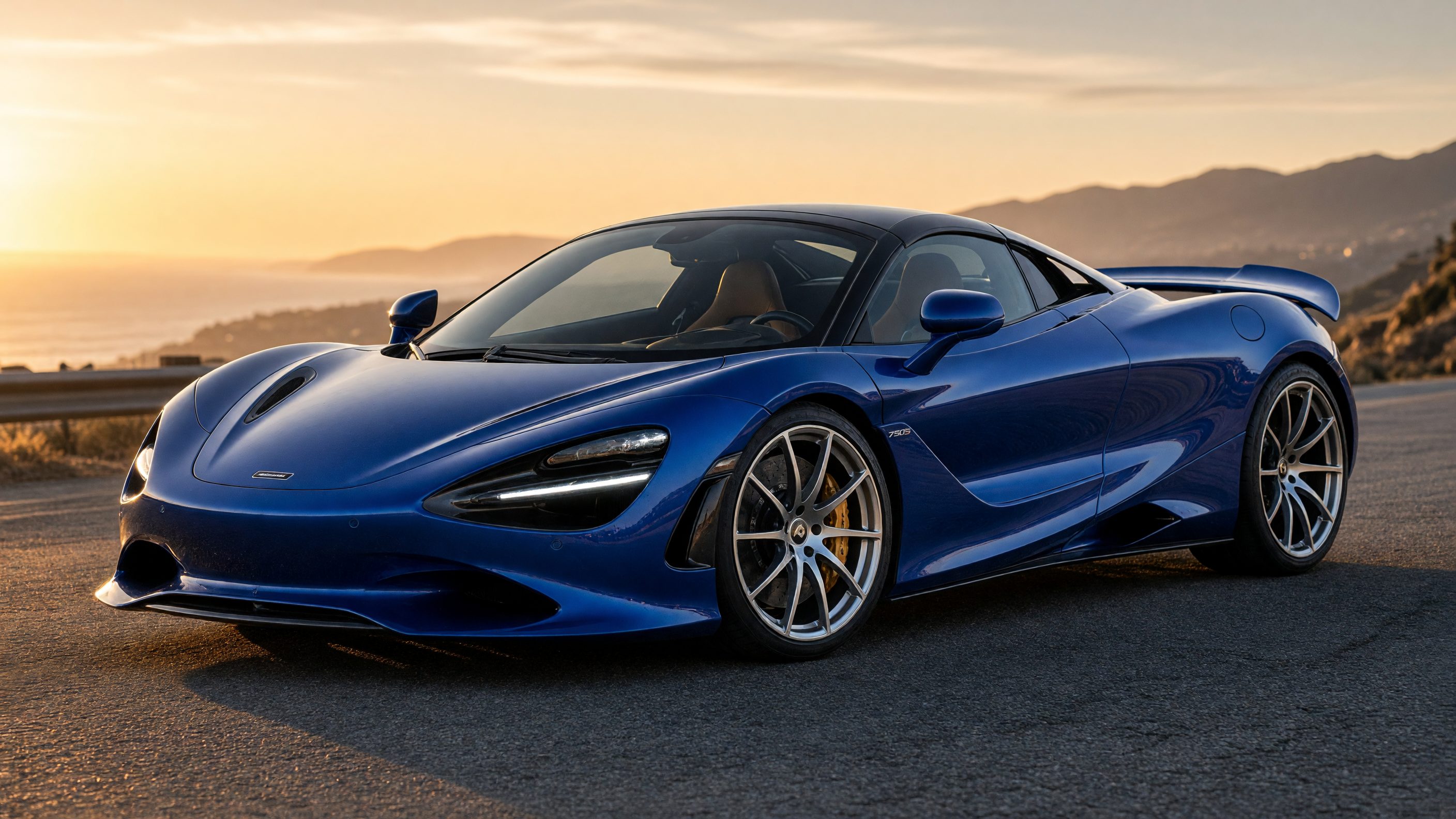
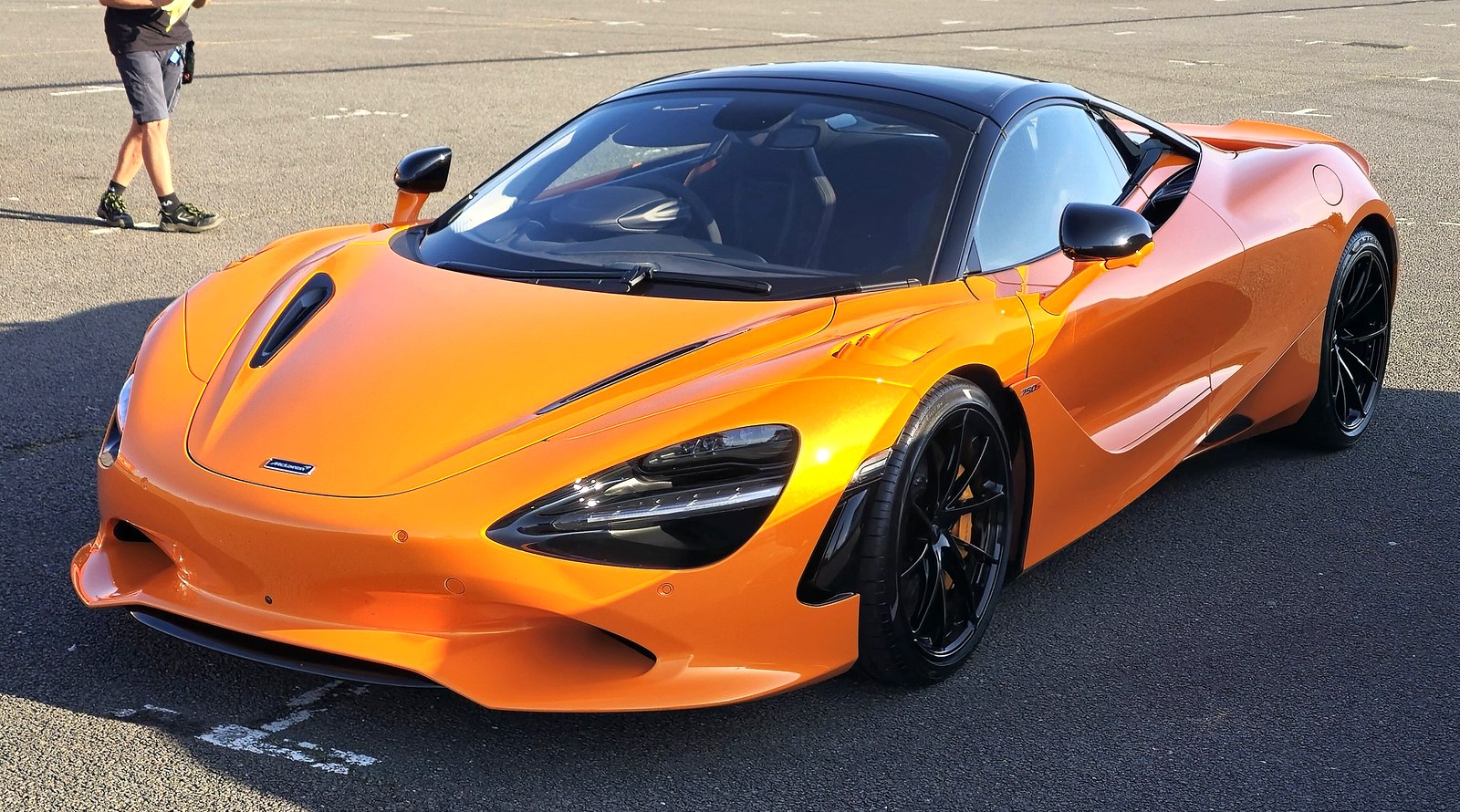
McLaren fits carbon-ceramic discs as standard on the 750S, 390 mm front and 380 mm rear. Its optional track brake upgrade uses 390 mm discs derived from the McLaren Senna system that McLaren says take seven months to make, seven times longer than a conventional carbon-ceramic disc, but are 60% stronger with four times the thermal conductivity. If you want to see McLaren's standard carbon-ceramic setup on a real car for sale, this Mantis Green 2025 McLaren 750S on Exotics Group is a good example; carbon-ceramic discs are standard on every 750S.
Two names keep turning up behind the badges: Ferrari's CCM discs come from Brembo, and Porsche's original PCCB material came from SGL Carbon. Their joint venture, BSCCB, says its plants in Italy and Germany reached a capacity of 200,000 discs a year in 2020.
Why track days cook them
Here is the plot twist. Carbon-ceramic discs barely wear in the way iron discs do. On the road, Brembo puts their lifespan at around 150,000 km (about 93,000 miles), and Porsche's original 2000 announcement claimed 300,000 km or more. Porsche's own wording today is more careful: if PCCB discs are used primarily on the road, "rather [than] on track," and maintained correctly, "they can last for long periods."
The reason is oxidation: at high temperature, the carbon in the disc reacts with oxygen in the air and literally leaves as gas. Race Technologies, writing about Brembo's OEM discs, says "oxidation increases rapidly with temperature," and that "extended high temperature use such as experienced on the race track dramatically reduces the discs life." As the carbon burns away inside the matrix, the disc loses mass and strength. ForzaCCB, a carbon-ceramic specialist, sums it up: oxidation "leads to a loss of mass and structural density rather than a simple reduction in rotor thickness." Race Technologies is also blunt that OEM CCM discs "have limitations for serious performance driving and dedicated track use."
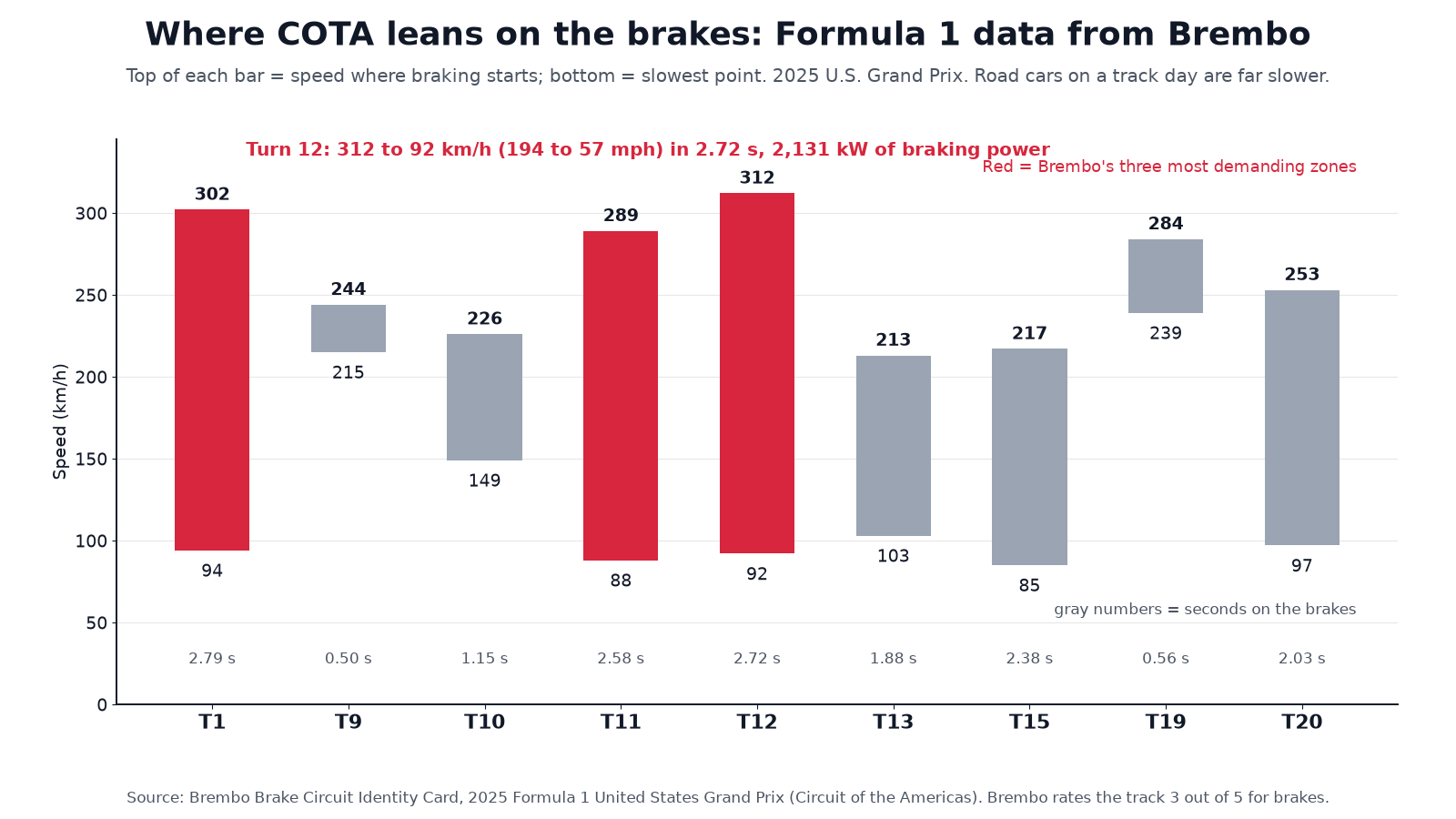
That is exactly what a track like Circuit of the Americas does to brakes. Brembo rates COTA a medium 3 out of 5 for Formula 1 brakes, but its three hard stops are brutal. Turn 1 sits at the top of the steep climb from the start-finish straight, the track's signature feature, and Turn 12 comes at the end of the long back straight. In F1 trim, cars go from 312 to 92 km/h into Turn 12 in 2.72 seconds, with 2,131 kW of braking power, and from 302 to 94 km/h into Turn 1. Your street car will be nowhere near those speeds, but the pattern is the same: long straight, huge stop, repeat every lap for a whole session. The disc gets hot, stays hot, and slowly gives up carbon.

If you are heading to COTA for Austin Schnell Fest on November 21-22, this is your weekend. The Hill Country, Lone Star and Maverick Regions of the Porsche Club of America are billing it as "The Last Rodeo at COTA," with a solo-only HPDE (no novice or intermediate groups) alongside a PCA Club Race. Lone Star Region PCA says it is open to all makes, and PCA membership is not required, so expect plenty of yellow calipers, and plenty of hot discs in the paddock.
Why you weigh them instead of measuring them
With iron discs, a mechanic grabs a micrometer, measures thickness and compares it with the minimum stamped on the disc. On carbon-ceramics, that is not enough. They carry a minimum thickness too, but Race Technologies explains that the life of an OEM CCM disc is "determined by the loss of disc mass as the material oxidizes," which "cannot be verified by simply measuring the overall disc thickness." Instead, each disc assembly is weighed at the factory, the minimum allowable weight is permanently etched into the bell, and a used disc has to be cleaned before it is weighed against that number.
Ferrari and Maserati specialist Aldous Voice shows why. A Ferrari California came in with discs that measured 34 mm against a 33.5 mm minimum thickness, so on a micrometer they passed. On the scale, all four were below their minimum weight, the rears by much more. The car's dash estimate of disc wear showed just 12% front and 10% rear, which the shop suspected had been reset at some point.
Taking discs off to weigh them is a chore, so there is now a gadget. Carboteq, made by Proceq (now Screening Eagle) in collaboration with BSCCB, is a handheld tester that uses pulse induction to measure the interlacing of the carbon fibers and the effects of heat and oxidation; Screening Eagle says no dismantling is needed. Owners on the UK 911 forum report that Porsche Centres use it, under the workshop name VAS 6813, with laser-etched reference values on newer PCCB discs instead of weighing, and that readings are most reliable with the discs off the car.
Living with them: cold bite, squeal and pads
Carbon-ceramics have a few quirks on the street. When Edmunds asked dealership service managers about them, the only problems reported were at low speed and low temperature, like pulling out of your driveway in the morning: a slightly "grabby" feel and some squeal. The cure, in Edmunds' words: "Warm 'em up."
Pads matter more than with iron. Race Technologies says OEM CCM discs are designed to work with very specific pad materials, and that while some aftermarket pads claim to be "CCM friendly," there is no established validation process for them. Edmunds adds the general warning that pads that outperform the factory originals on track are often hard on discs. If you track a ceramic-braked car, the safest default is the pad the car maker specifies for that disc.
Also, mind the edges. ForzaCCB warns that carbon-ceramic discs can chip at the edges during wheel changes, and chips can turn into structural problems. A wheel hanger pin (a guide bolt that holds the wheel in line while you start the lug bolts) is cheap insurance.
What they cost, and the steel escape hatch
Now the bad news. As of November 10, 2026, Suncoast Porsche Parts listed a set of Genuine Porsche PCCB front discs for the 991-generation 911 GT3, GT3 RS, GT2 RS, 911 R and Speedster at $24,900, and the rear pair at $27,900. That is $52,800 for four discs before pads or labor.
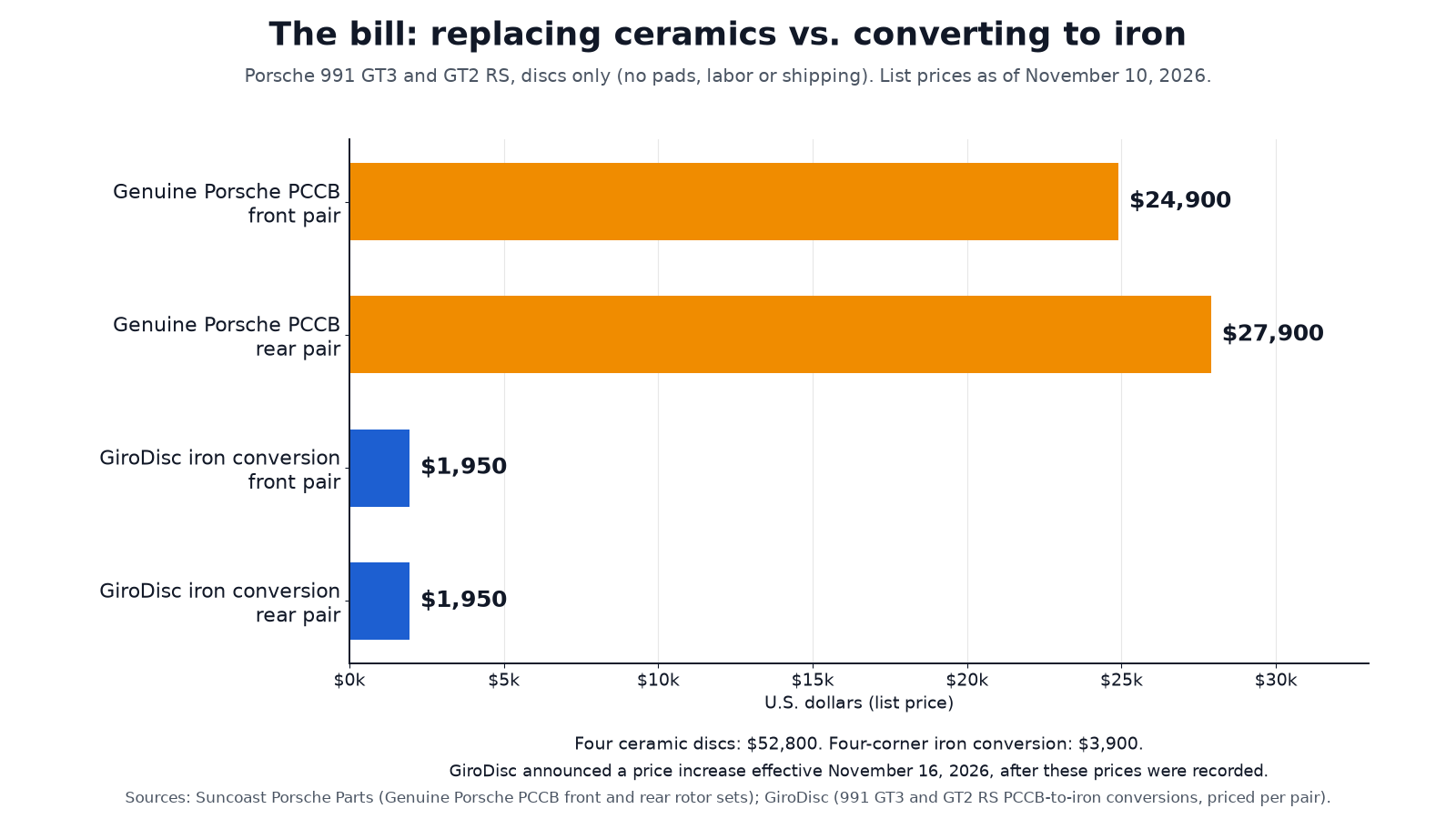
That is why some track regulars keep two sets: one GT4 owner on Rennlist described having his factory PCCBs plus a set of GiroDisc iron rotors that he uses. GiroDisc, for example, sells two-piece iron conversions for PCCB-equipped Porsche GT cars, including the 991 GT3, 991 GT2 RS and 718 GT4 RS, at $1,950 per pair, front or rear (GiroDisc's list price on November 10, 2026; it announced a price increase effective November 16, so check current pricing), with an aluminum hat and a floating mount. The catch is pads, at least up front: for the front conversion, GiroDisc says you must use the smaller pad shape from the iron-braked 991 GT3, because a rotor with the full PCCB pad sweep would be unnecessarily heavy. The rear conversion works with the factory PCCB pads. In the same Rennlist thread, Essex Parts Services pitched AP Racing Radi-CAL kits that replace both the calipers and the discs. Iron discs wear out and get replaced like any track consumable, but each one costs a fraction of a ceramic disc.
There is a middle road too. Aftermarket carbon-ceramic makers like Surface Transforms sell replacement discs. In that same Rennlist thread, back in December 2021, a Surface Transforms dealer quoted $6,325 per axle and said the discs could be refurbished up to three times. Prices have certainly moved since then, so treat that as history, not a quote.
The owner's cheat sheet
- Buying a car with ceramics? Ask for the disc weights or a Carboteq-type reading in the pre-purchase inspection, not just a thickness measurement. A worn set can wipe out any deal.
- Street-only car? Enjoy them. Clean wheels, no rust and long life are the payoff.
- Track regularly? Budget for disc life or consider an iron conversion, and store the ceramics carefully if you want to put them back on for resale.
- Stick to the right pads. Use the pad specified for your disc, especially on track.
- Expect some cold squeal. A bit of noise and grab when cold is a known trait, not a fault.
- Be gentle at wheel changes. Use a hanger pin and avoid knocking the disc edges.
- Keep the fluid fresh. Porsche Fairfield says brake fluid should normally be replaced every two years or 20,000 miles; check your car's schedule.
Related reading
If COTA's heavy stops made you curious about what F1 cars do with all that braking energy, read Wide Open and Fully Charged: How F1 Learned to Pass Without DRS. Shopping for your first exotic? First-Time Supercar Buyer, Part 2: Technical Realities and Reliability covers the wear items to check before you buy, and Getting a Grip: Hot Rubber, Slip Angles and the Magic Formula Behind Supercar Tires covers the other half of every stop.
Run a brake, track-prep or performance shop? Owners of ceramic-braked cars are looking for people who know how to weigh a disc and fit an iron conversion properly. Add your business to Exotics Group so they can find you.
#Austin
Sources
- Brembo, Carbon ceramic disc
- Brembo, The Innovation of Carbon-Ceramic Discs
- Brembo SGL Carbon Ceramic Brakes, How it's made
- Brembo SGL Carbon Ceramic Brakes, Who we are
- Race Technologies (Brembo Performance and Brembo Racing), Brembo Carbon Materials (CCM, CCM-R, and Racing Carbon)
- Porsche, Porsche Ceramic Composite Brakes (PCCB) explained
- Porsche 2000 PCCB announcement (SIGRASIC by SGL Carbon), via AutoIntell
- Ferrari, All Ferraris to have carbon brakes (December 2007 press release), via Racecar
- McLaren Automotive, The new McLaren 750S media release (April 2023), via MotorShow.me
- Lamborghini Revuelto press information, via Ryland Lamborghini
- Edmunds, Ceramic Composite Brakes
- Aldous Voice, Ferrari and Maserati CCM Brake Wear
- Screening Eagle (Proceq), Carboteq
- 911uk forum, PCCB wear question
- ForzaCCB, How to measure carbon ceramic brake disc wear and condition
- Suncoast Porsche Parts, PCCB Front Rotor Set (991 GT models)
- Suncoast Porsche Parts, PCCB Rear Rotor Set (991 GT models)
- GiroDisc, Porsche 991 GT3, GT2RS, GT4RS PCCB Front Iron Rotor Conversion
- GiroDisc, Porsche 991, 992 GT3, GT2RS, GT4RS PCCB Rear Iron Rotor Conversion
- Rennlist, Cost of PCCB replacement (page 2)
- Porsche Fairfield, Porsche Ceramic Composite Brakes: Benefits and Maintenance
- Brembo, Brake Circuit Identity Card, 2025 Formula 1 United States Grand Prix
- Brembo, 5 facts about the USA Formula 1 GP
- ScuderiaFans, COTA F1 weekend technical insights
- Formula1.it, GP Stati Uniti, Anteprima Brembo
- Hill Country Region PCA, Fall Schnell Fest (HPDE), November 21/22, 2026
- Lone Star Region PCA, Austin Schnell Fest, Autumn
- Wikimedia Commons, Carbon ceramic brake surface detail (Julian Herzog, CC BY 4.0)
- Wikimedia Commons, Ferrari Enzo (Axion23, CC BY 2.0)
- Wikimedia Commons, McLaren 750S (MrWalkr, CC BY-SA 4.0)
- Wikimedia Commons, Main straight and Turn 1 hill, Circuit of the Americas (Lars Plougmann, CC BY-SA 2.0)
- Wikimedia Commons, AMG carbon ceramic brake, Geneva 2011 (Cheeni, CC BY-SA 3.0)
- Wikimedia Commons, Porsche 911 Turbo S (992), Greater Toronto Area (OWS Photography, CC BY 4.0)