exoticsgroup.com
Getting a Grip: Hot Rubber, Slip Angles and the Magic Formula Behind Supercar Tires

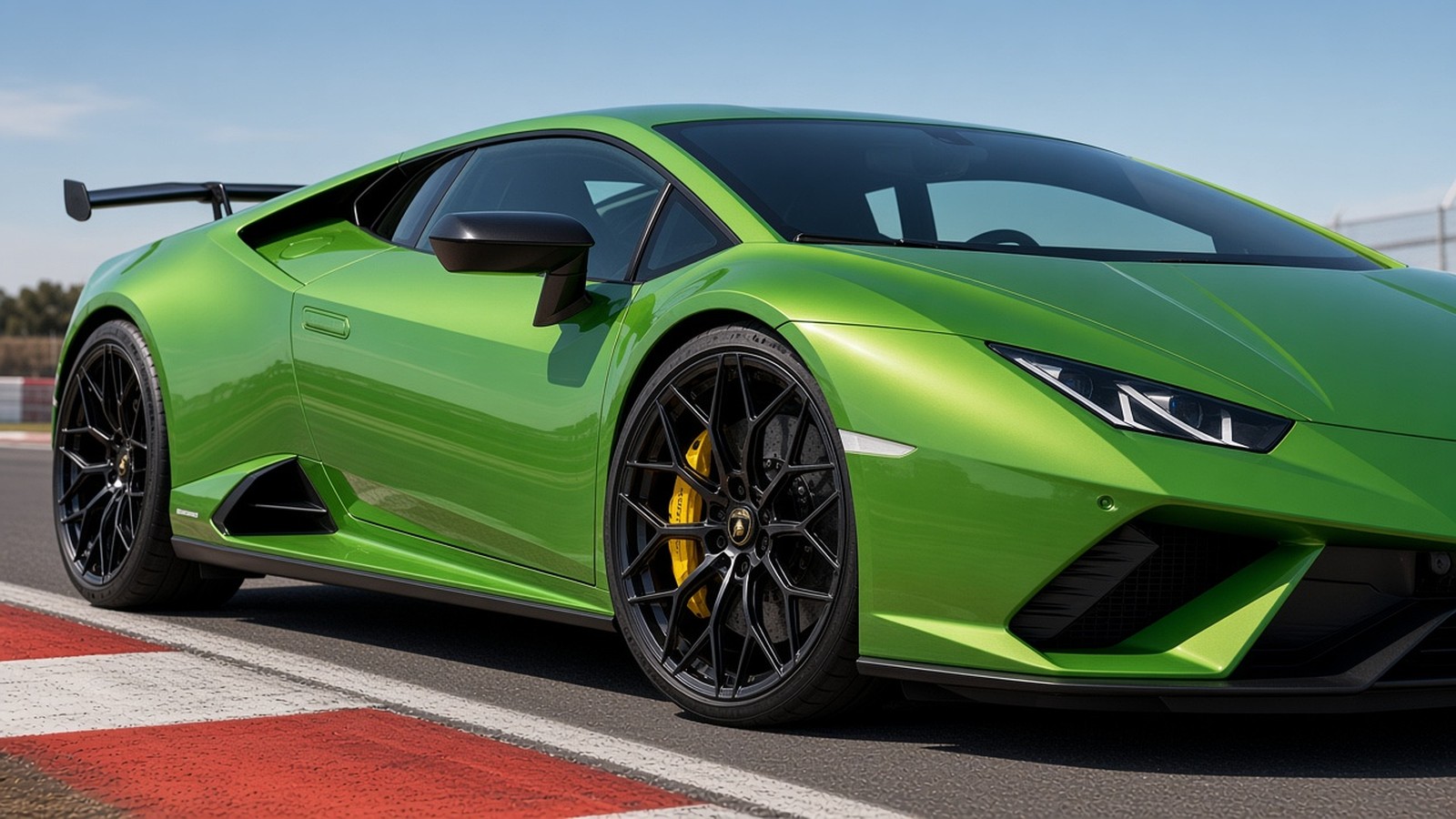
Here is a slightly uncomfortable truth for anyone who has ever spent a weekend obsessing over horsepower figures: your supercar does not touch the road. Not the carbon tub, not the active aero, not the twin-turbo V8 or the hybrid V12. The only parts of the car that are actually in contact with planet Earth are four patches of rubber, each roughly the size of your hand. Every bit of acceleration, every heroic late-braking move, every corner you take with a grin on your face has to squeeze through those four little rectangles.
So today we are going to talk about tires. We will start with the simple stuff - the kind of thing you could explain to a friend at a cars-and-coffee - and then we are going to keep pulling on the thread until we end up somewhere genuinely nerdy: slip angles, friction circles, load sensitivity, a formula so empirical that its own author called it "magic," and the strange fact that a tire needs to roll a little distance before it even starts to turn the car. Grab a coffee. It is a deep rabbit hole, and the rubber gets hot down there.
Level 1: What a tire actually does
At its simplest, a tire has three jobs. It holds the car up, it cushions the ride, and it transmits forces between the car and the road: forward for acceleration, backward for braking, and sideways for cornering. That last job is the one that separates a supercar tire from a commuter tire, and it is where all the interesting physics lives.
Think of a shoe. A running shoe, a hiking boot and a sprinter's spike all hold you up, but they grip in very different ways, on different surfaces, for different lengths of time. A performance tire is the sprinter's spike of the car world: phenomenal grip in the right conditions, a narrower comfort zone, and a shorter life.
Level 2: The contact patch
The contact patch is the flattened area where the tire meets the road. Press a balloon against a table and you get a feel for it: the harder you push, or the softer the balloon, the bigger the flat spot. A tire works much the same way. As a rough first approximation, the patch grows until the air pressure inside, acting over that area, can hold up the load on the wheel. Real tires are more complicated than that, because the carcass and sidewalls carry some of the load too, but the balloon picture gets the direction right: more load or less pressure means a bigger, longer patch.
Two things about the contact patch surprise most people. First, it is not one uniform blob of grip. The pressure across it varies, and different parts of the patch are doing different things at the same moment - some rubber is gripping the road firmly while other bits are sliding. Second, the patch is not stationary rubber. On a rolling tire, fresh rubber is constantly entering the front of the patch and leaving the back. That conveyor-belt effect is the key to almost everything that follows.
Level 3: What the tire is made of
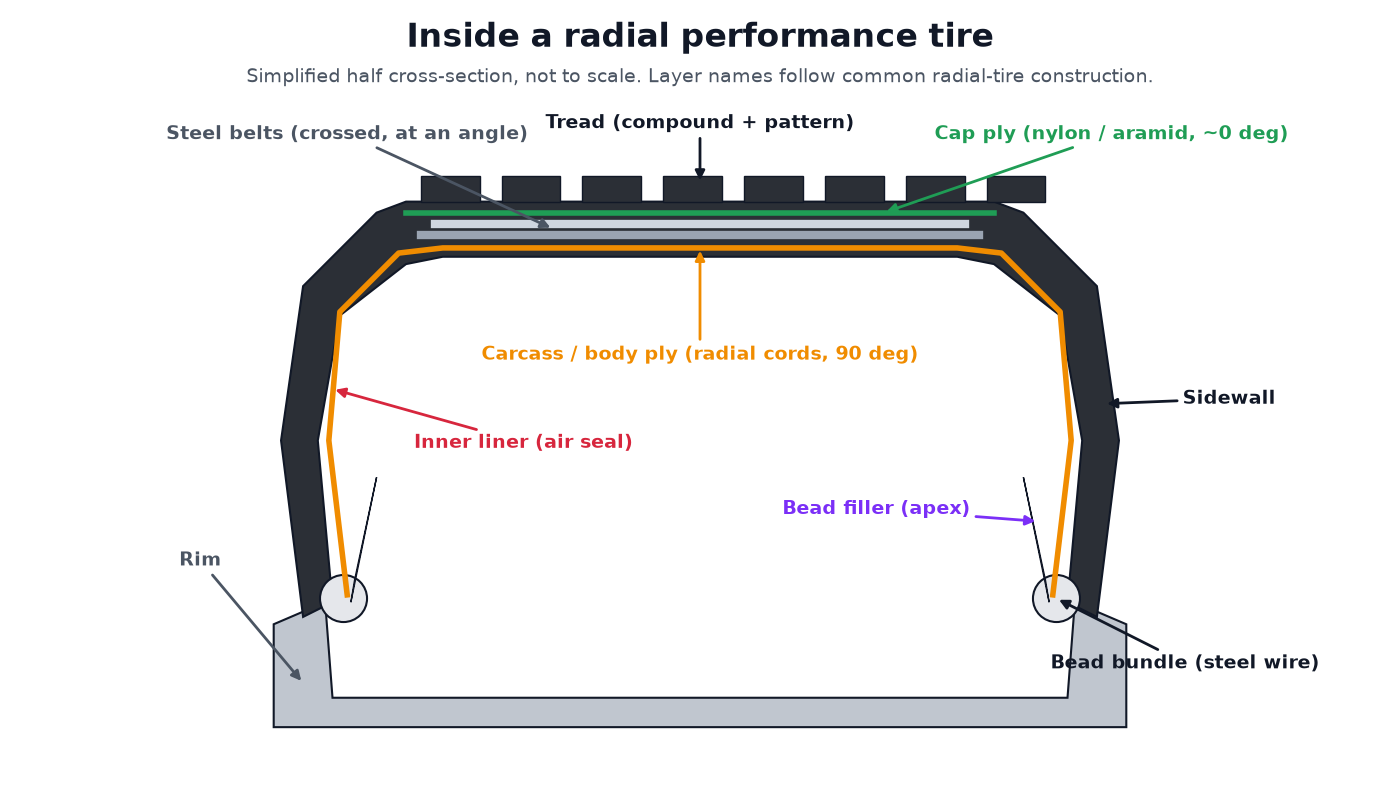
A modern performance tire is not a lump of rubber. It is a layered composite, closer to a carbon-fiber part than to a rubber band. The pieces, from the inside out:
- Inner liner. A thin layer of air-tight rubber that replaces the inner tube of old.
- Carcass (body plies). Layers of cord - textile such as polyester, sometimes steel - embedded in rubber. This is the skeleton that gives the tire its shape and strength. In a radial tire, these cords run straight across the tire from bead to bead, at 90 degrees to the direction of travel.
- Belts. Steel belts laid under the tread at an angle, crossing each other. They stiffen the tread area so it stays flat on the road instead of squirming.
- Cap ply. On high-speed tires, a layer of nylon or aramid wound around the circumference over the belts, helping hold everything together against centrifugal growth at speed.
- Bead. A bundle of steel wire that anchors the tire to the wheel rim, usually with a stiff rubber filler (the apex) above it.
- Sidewall. The flexible wall between bead and tread. On a supercar it is usually very short, which is one reason those tires feel so sharp.
- Tread. The compound and pattern that actually touch the road.
The big idea behind the radial tire, which Michelin commercialized with its X tire developed in 1946, is that it splits the tire into two systems that can be tuned separately. The radial cords let the sidewall act like a spring, while the belts keep the tread stiff and flat. The older cross-ply (bias) design laid cords at criss-crossing angles from bead to bead, so the plies rubbed against each other as the tire flexed, making heat and rolling resistance. Radials are now standard on essentially all car tires.
For a supercar, the construction is a balancing act. A stiffer carcass and shorter sidewall give a quicker, more precise response, but make the ride harsher and the tire less forgiving at the limit. A more compliant build is friendlier and more progressive. This is why two tires of the same size can feel completely different on the same car.
Level 4: Compounds, and why grip has a temperature
Tire rubber is a viscoelastic material: part spring, part honey. That dual nature is where grip comes from. Engineers usually describe two mechanisms:
- Adhesion. At a molecular level, rubber sticks to the road surface, a bit like how a clean glass sticks to a wet countertop.
- Hysteresis (deformation). The road is not smooth. It is covered in tiny peaks and valleys. As rubber drapes over those bumps, it deforms, and because it is viscoelastic it does not spring back perfectly. Energy is lost, and that loss shows up as friction.
Both of these depend heavily on temperature. Cold rubber is stiff and glassy: it cannot drape over the road texture properly, and it grips poorly. Warm rubber becomes more pliable and grips much better. Overheat it and it gets greasy, starts to degrade, and can blister. The result is a grip-versus-temperature curve with a hill in the middle: the famous "operating window."
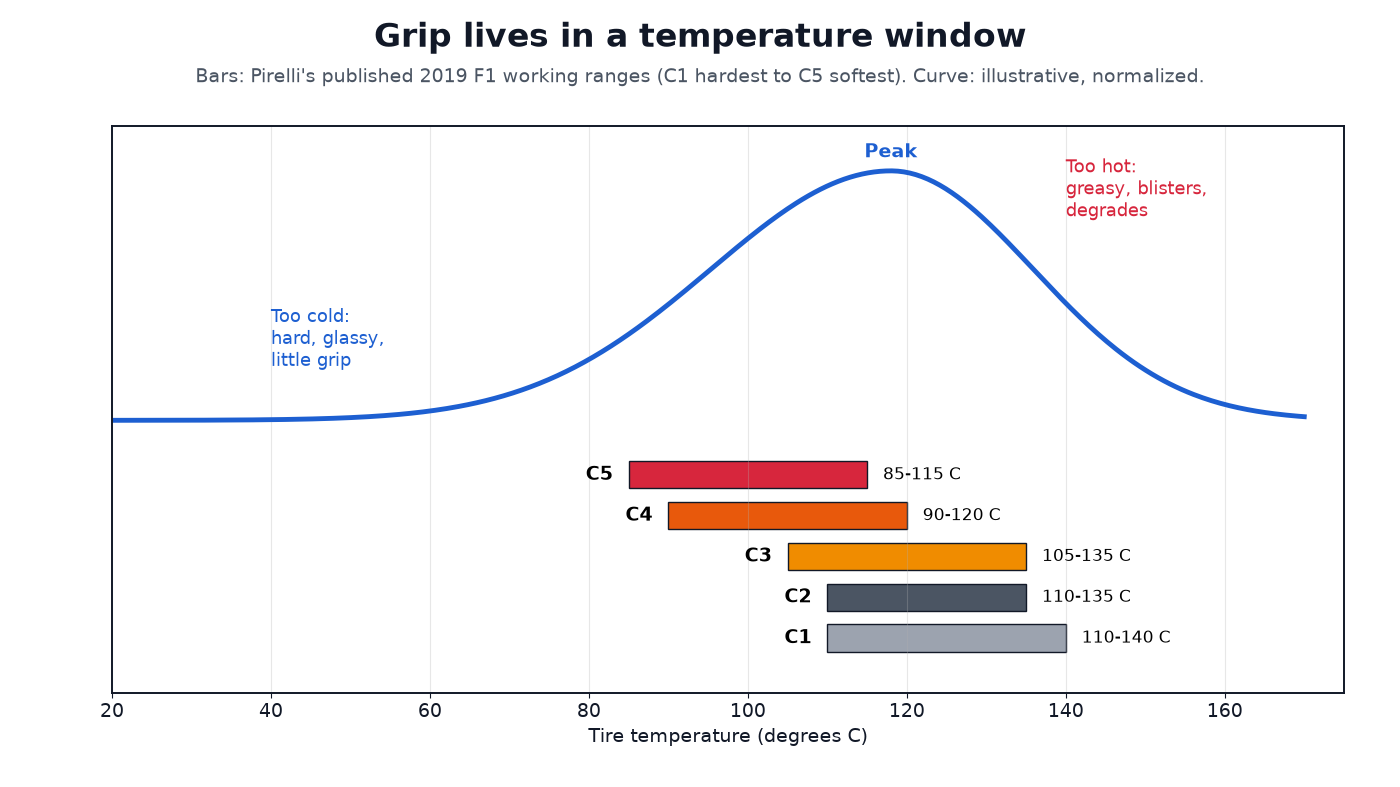
Formula 1 is the best public example, because Pirelli used to publish its windows. For 2019, Pirelli listed working ranges of 110-140 C for the hardest C1 compound, 110-135 C for C2, 105-135 C for C3, 90-120 C for C4 and 85-115 C for the softest C5. Notice the pattern: softer compounds are designed to switch on at lower temperatures. Pirelli has since stopped publishing compound-specific windows, and its head of motorsport Mario Isola explained to Motorsport.com that the usable window depends heavily on things like the asphalt and the suspension setup. He described the working range as the area around the peak of the grip curve, saying the graph "normally shows us a 3% area that we define as the 'working range'," and that Pirelli's goal is a tire "with a wide plateau."
Your road-legal performance tire obviously is not built to run at F1 temperatures, but the principle is identical. That is why the first few corners on a cold morning feel vague, why an extreme semi-slick can be genuinely sketchy on a chilly road, and why track-day regulars talk about "getting heat in" before pushing.
Level 5: Pressure - the cheapest tuning tool you own
Inflation pressure changes almost everything: the size and shape of the contact patch, how stiff the tire is laterally, how quickly it heats up, and how it wears. Too low, and the sidewall flexes excessively, the tire runs hot and the steering goes mushy. Too high, and the patch shrinks and crowns, so grip and feel suffer.
There is also a subtle point that catches people out: pressure rises as the tire heats up. That is why track drivers talk about "hot" pressures and set "cold" pressures lower to land in the right place once the tire is up to temperature. We are deliberately not giving you numbers here, because the right ones depend on your specific car, tire and use. For the road, the pressures on your car's placard or in the owner's manual are the starting point; for track use, follow the tire manufacturer's or your car maker's track guidance.
Level 6: Slip angle - tires turn by sliding (a little)
Here is the first genuinely counterintuitive bit. When you turn the steering wheel, the front tires do not simply roll in the direction they are pointing. To generate a sideways force, a tire has to travel at a slight angle to the way it is pointing. That angle is the slip angle.
Back to the conveyor belt. As the tire rolls at a slip angle, rubber enters the front of the contact patch lined up with the wheel, but the road beneath it is moving in a slightly different direction. So the tread elements get dragged sideways as they travel through the patch, bending like the bristles of a brush. That bent rubber is what pushes the car around the corner. Near the front of the patch, the rubber grips; toward the back, where it has been stretched farthest, it starts to slide.
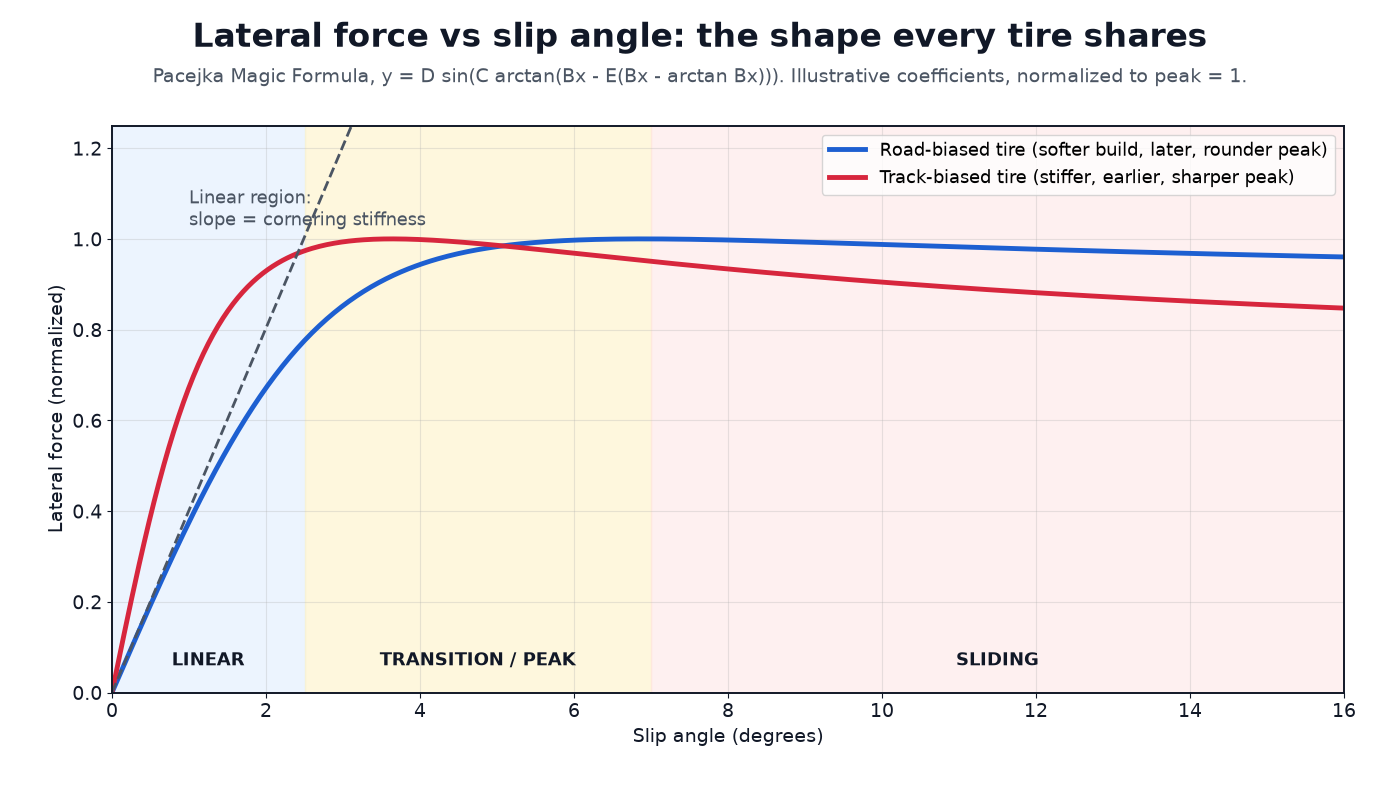
Plot lateral force against slip angle and every tire gives you the same basic shape:
- Linear region. At small slip angles, force rises almost in a straight line. The slope is the tire's cornering stiffness, and it is a big part of what makes a car feel "sharp."
- Transition and peak. As more of the patch begins to slide, the curve bends over and reaches a maximum.
- Sliding. Past the peak, force levels off or falls. This is where the car is "over the limit."
How many degrees are we talking? Milliken and Milliken's Race Car Vehicle Dynamics notes production car tires typically peak at around 6-10 degrees of slip, and that the angle grows with load; Peter Wright's Formula 1 Technology puts F1 tires as low as about 3 degrees. That difference matters. A tire with a sharp, early peak rewards precision but bites back when you overstep it. A tire with a broad, rounded peak gives you more warning and is easier to drive near the edge. That is the shape the two curves in the chart above are meant to illustrate.
Level 7: The friction circle - grip is a budget
So far we have talked about cornering on its own. But tires also brake and accelerate, and the grip has to be shared. The classic way to picture this is the friction circle, also called the traction circle or friction ellipse.
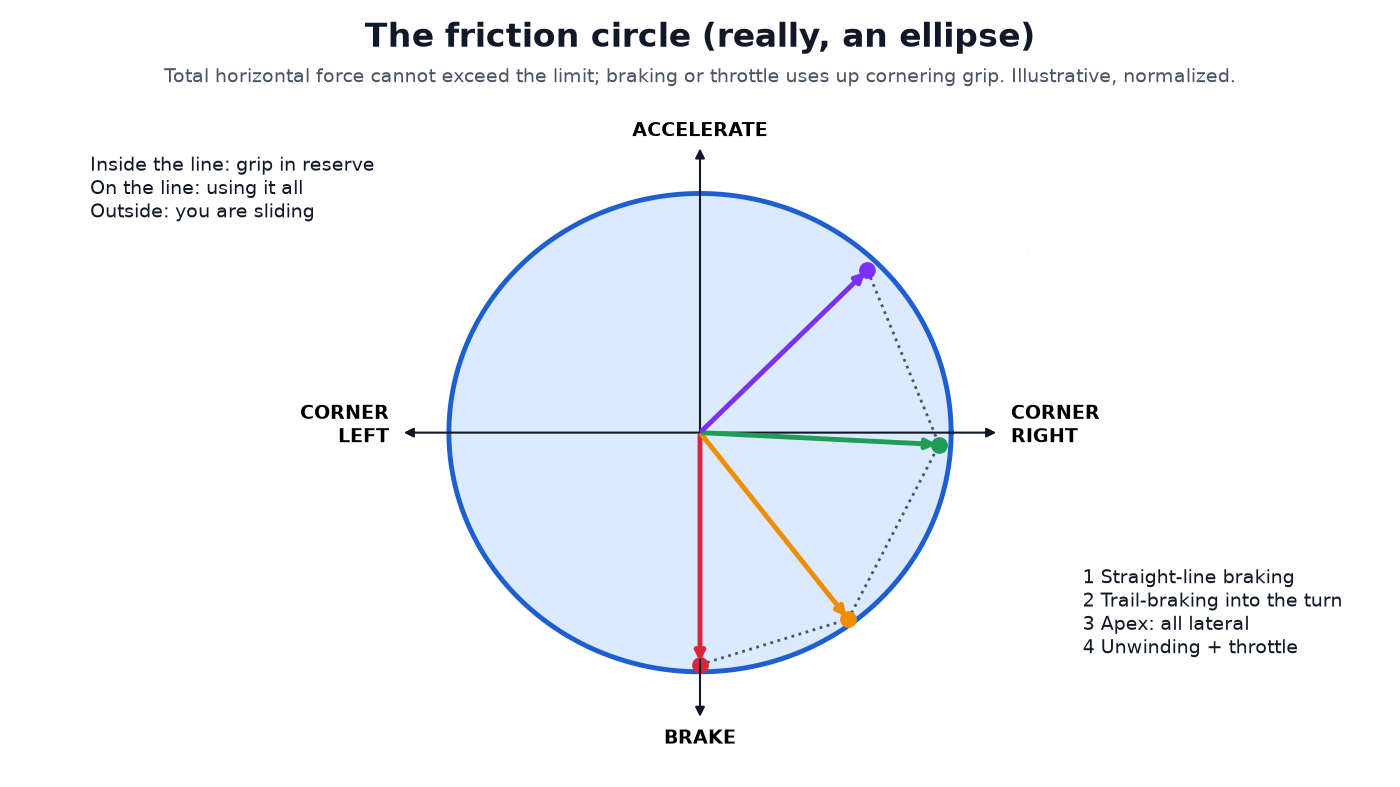
Picture the tire's total grip as a circle. Braking force goes down, acceleration goes up, cornering goes left and right. The tire can deliver any combination of these, as long as the arrow stays inside the circle. Brake as hard as possible in a straight line and you are using the whole budget longitudinally - there is nothing left for steering. Turn as hard as possible at the apex and there is nothing left for throttle.
This is the physics behind good driving technique. A smooth driver traces the outside of the circle: heavy braking in a straight line, then gradually trading brake pressure for steering as they turn in (trail-braking), maximum cornering at the apex, then trading steering for throttle on the way out. An unsmooth driver jumps from one axis to the other, or overshoots the edge and slides.
Two refinements for the pedants. First, real tires usually produce a slightly different maximum in the longitudinal and lateral directions, so the "circle" is really an ellipse. Second, its size is not fixed: it depends on the tire design, its temperature and age, the road surface, and - crucially - the load on the tire. Which brings us to the next level down.
Level 8: Load sensitivity - why more weight is not more grip
In school physics, friction is simple: friction force equals the coefficient of friction times the normal load. Double the load, double the grip. Tires do not obey this. As the vertical load on a tire increases, the maximum force it can produce goes up, but the coefficient of friction - the force per unit of load - goes down. This is called load sensitivity.
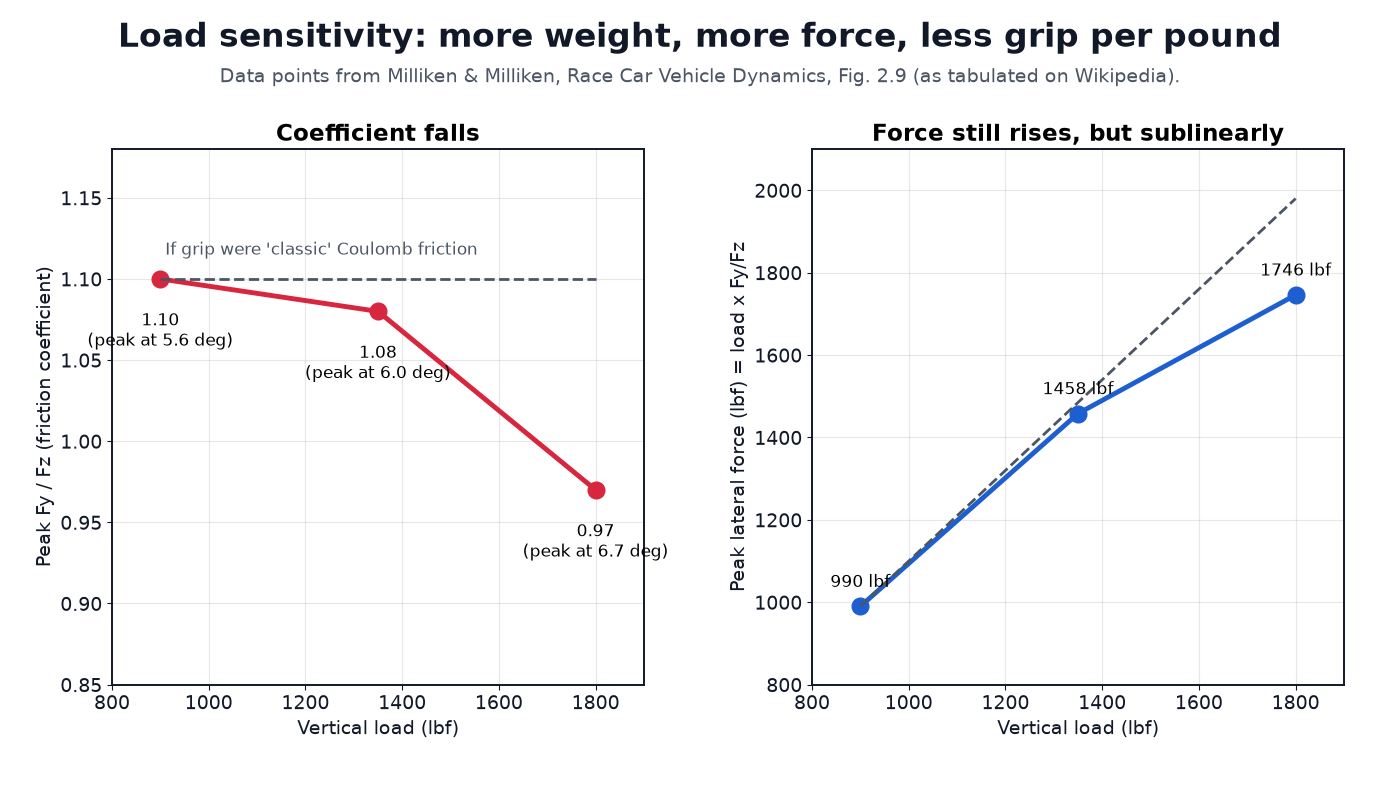
The chart above uses data from Figure 2.9 of Race Car Vehicle Dynamics, as tabulated on Wikipedia. At 900 lbf of vertical load, the tire produced a peak lateral force of 1.10 times the load. At 1,350 lbf it was 1.08. At 1,800 lbf it dropped to 0.97. The force still climbs (from roughly 990 lbf to about 1,746 lbf), but nowhere near proportionally. Notice also that the slip angle at peak creeps up with load, from 5.6 to 6.7 degrees.
Load sensitivity has huge consequences for how a car handles:
- Weight transfer costs grip. In a corner, load shifts to the outside tires. The outside tire gains less grip than the inside tire loses, so the axle as a whole ends up with less total grip than if the load had stayed evenly shared. That is why a low center of gravity and a wide track are so valuable.
- Anti-roll bars tune balance. Stiffen one end of the car and you push more of the load transfer onto that axle, which reduces its total grip. That is a key way to dial understeer or oversteer.
- Weight is doubly bad. Adding mass adds load, but grip does not rise in proportion. The car has to work its tires harder for every extra pound.
- Downforce is still worth it. Aerodynamic downforce adds load without adding mass, so even though the coefficient drops, the tire is producing more force per unit of mass it has to accelerate - which is why aero is such a big deal on fast cars.
Level 9: The Magic Formula
By now you might be wondering how engineers actually describe all of this in a simulator. The most famous answer comes from Hans B. Pacejka, a professor at Delft University of Technology whose work is a standard reference in tire dynamics. His "Magic Formula" family of models fits measured tire data with a deceptively compact expression:
y = D sin{ C arctan[ Bx - E (Bx - arctan(Bx)) ] }
Here x is a slip quantity (slip angle for lateral force, or slip ratio for longitudinal force), and y is the force or moment that results. The four letters each shape the curve:
- D is the peak value - the top of the hill.
- C is the shape factor; it controls how the curve looks after the peak.
- B is the stiffness factor; together with C and D it sets the initial slope (the product BCD is the cornering stiffness).
- E is the curvature factor; it adjusts how the curve bends around the peak.
Why "magic"? Because, as Wikipedia summarizes it, there is no particular physical basis for the structure of the equations - it just happens to fit a wide variety of tires and conditions remarkably well. In practice it is not four numbers but many: each tire is typically characterized by 10-20 coefficients for each important force it produces at the contact patch, fitted to test-rig data, so that B, C, D and E themselves change with vertical load, camber and other conditions. That is how load sensitivity gets built into the model. The Magic Formula is widely used in professional vehicle dynamics simulation and in racing games because it is accurate, easy to program and fast to solve.
It is not perfect. Implemented naively, it misbehaves at very low speed - around pit-entry speed or slower - because a velocity term in the slip calculation sits in a denominator and blows up as speed approaches zero. Physical alternatives such as brush models, which treat the tread as rows of tiny bristles exactly like our conveyor-belt picture, can be derived analytically, but still need empirical fitting and tend to be less accurate than Magic Formula fits.
Level 10: Combined slip - when the circle meets the curve
The friction circle is a lovely mental model, but real tires do not trade forces in a perfect circle. When a tire is braking and cornering at the same time, it has both a slip angle and a slip ratio, and the two interact. Brake while cornering and the lateral force at a given slip angle drops; corner while braking and the braking force at a given slip ratio drops. The shape of that trade-off depends on the tire.
Pacejka's models handle this with "combined slip" formulations, in which the pure-slip curves are scaled by weighting functions that depend on the other slip. That is why a tire model that looks great in a straight line or a steady corner can still get the transition wrong - trail-braking into a corner, or feeding in throttle at the exit - which is precisely where drivers feel a car's character most.
Level 11: Relaxation length - the tire's reaction time
And now for the bottom of the rabbit hole. Everything above assumes the tire responds instantly: give it a slip angle, get a force. It does not. When you suddenly introduce a slip angle, the side force builds up over a distance as the tire rolls, because the carcass and tread have to deform into their new shape. The characteristic distance for that build-up is called the relaxation length.
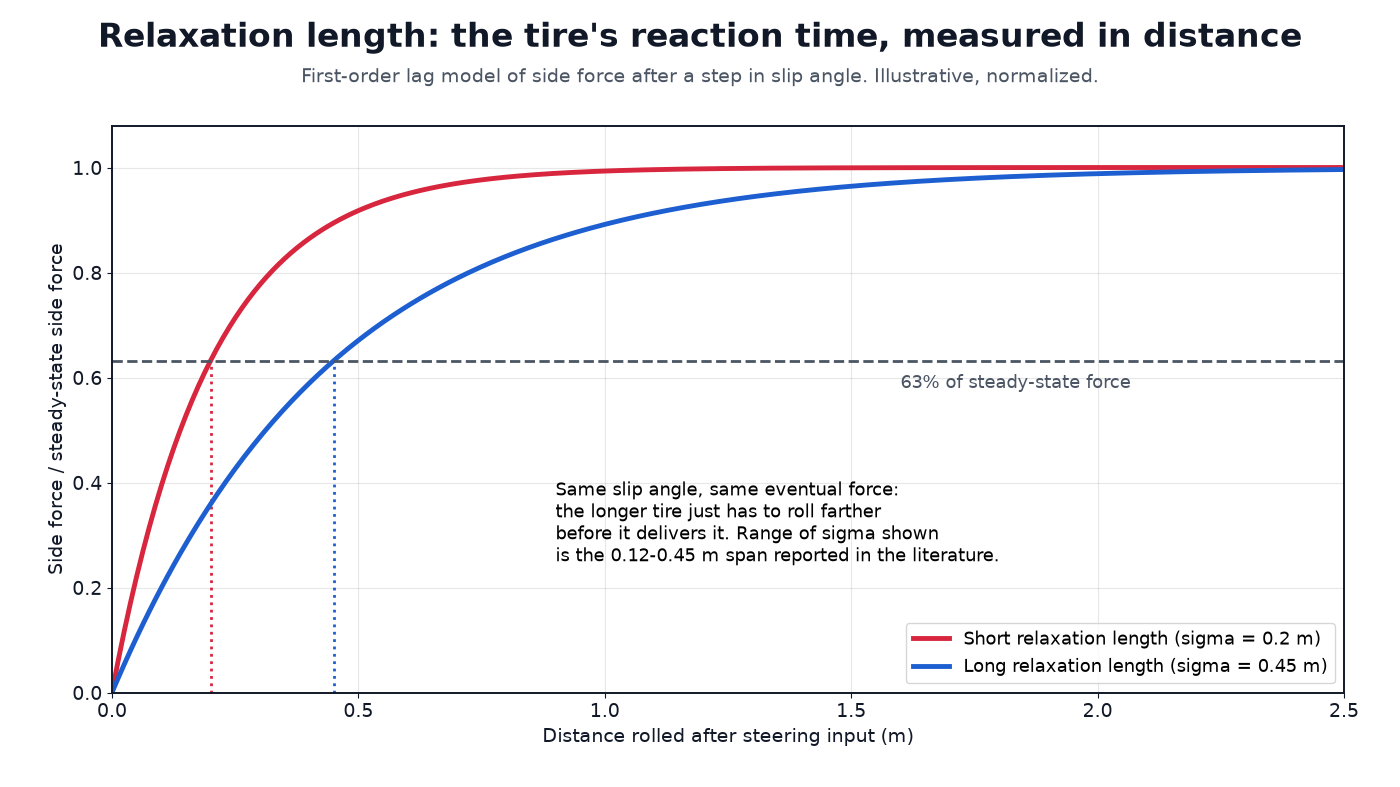
One common definition is the distance the tire must roll for the lateral force to reach 63% of its steady-state value - the classic signature of a first-order lag. It can also be calculated as the ratio of the tire's cornering stiffness to its lateral stiffness. Pacejka's rule of thumb is that at nominal vertical load, the relaxation length is of the order of magnitude of the wheel radius. Measured values cited on Wikipedia, drawn from motorcycle dynamics literature, run from about 0.12 to 0.45 meters, with higher values at higher speeds and heavier loads.
Why should a supercar driver care? Because the lag is a distance, not a time. At low speed, a tire that needs to roll a fraction of a meter responds in a noticeable fraction of a second. At high speed the same distance is covered much faster, so the delay in time shrinks. But during quick transients - a fast direction change, a snap of opposite lock, a mid-corner correction - the tire is always a little behind your hands. Stiffer constructions, lower-profile sidewalls and careful pressure choices all shorten that lag, which is a big part of why a well-sorted performance tire feels so immediate. Relaxation length is also a key parameter in "shimmy," the self-excited wobble of a wheel that was the subject of Pacejka's own 1966 doctoral thesis.
Put all eleven levels together and you get a startling picture of what is happening at every corner: a viscoelastic composite, operating in a narrow temperature window, distorting into a contact patch the size of your hand, sliding at the back of that patch while it grips at the front, sharing a finite budget of grip between braking and cornering, losing efficiency as load piles on, and lagging behind your steering inputs by a fraction of a meter. All while turning several hundred horsepower into forward motion. Treat your tires accordingly.
Find your people
If this kind of deep dive is your idea of a good Sunday, you will fit right in. You can create a free account on Exotics Group to follow the cars, events and specialists in the exotic car world - and if you run a tire, wheel or performance shop, it is the place to add your business so enthusiasts can find you.
Sources
- Pacejka, H. B. and Besselink, I., Tire and Vehicle Dynamics, 3rd ed. (Butterworth-Heinemann, 2012), via Wikipedia summary of Hans B. Pacejka
- Wikipedia, Tire load sensitivity (data from Milliken and Milliken, Race Car Vehicle Dynamics, SAE, 1995, Fig. 2.9; Wright, Formula 1 Technology, SAE, 2001)
- Wikipedia, Relaxation length (citing Pacejka, Tyre and Vehicle Dynamics; Cossalter, Motorcycle Dynamics)
- Wikipedia, Circle of forces
- Wikipedia, Radial tire
- Pirelli, What's new with Pirelli's 2019 Formula 1 tyres?
- Pirelli, Seeing through the window
- Motorsport.com, The "peak grip" tyre secrets that are key to F1's qualifying battle
- Formula1.com, The beginner's guide to F1 tyres