exoticsgroup.com
Wide Open and Fully Charged: How F1 Learned to Pass Without DRS (Austin Edition)

Picture rush hour on the freeway. You're stuck behind a slow truck, you finally get a gap, and you floor it - only to discover the truck driver has the same idea, and now you're both doing 80 side by side, staring at each other like it's awkward. Now give every car on that freeway a spoiler that folds flat on command and a battery that can add hundreds of horsepower for a few seconds at a time, and make the battery bigger if you happen to be stuck right behind someone. Congratulations: you now understand roughly half of Formula 1 in 2026.
This weekend, Formula 1 rolls into Circuit of the Americas for the United States Grand Prix (Friday, October 23 through Sunday, October 25, 2026, with lights out at 3:00 PM local time on Sunday). It's the first time COTA hosts the new-generation cars, and the track's long back straight is about to become the best classroom in America for the sport's brand-new overtaking toolkit. So let's do the homework together: what DRS was, why it's gone, what "Straight Mode", "Corner Mode", "Boost" and "Overtake Mode" actually do, and what you should look for when the cars come screaming out of the Turn 11 hairpin.
The short version (for the people already in the car to Austin)
- DRS is dead. The Drag Reduction System, which let a chasing car open a flap in its rear wing on certain straights, ran from 2011 through 2025. It's been replaced by two separate things.
- Active aero is for everyone. Every car now has moving front and rear wing flaps. In designated zones, all cars switch to a low-drag Straight Mode; everywhere else they run a high-downforce Corner Mode. You don't have to be chasing anyone to use it.
- Overtaking help now comes from electricity. If you're within one second of the car ahead at the detection point, you get Overtake Mode on the next lap: an extra 0.5 MJ of energy to harvest and a power profile that keeps the electric motor pushing to a higher speed.
- Boost is the driver's "push to pass" button for spending stored energy wherever they like, attack or defense.
- At COTA, the FIA has marked two Straight Mode zones: the back straight from Turn 11 to Turn 12, and the main straight from Turn 20 up the hill to Turn 1.
Now the fun part: why it all works this way.
Why passing an F1 car is so hard in the first place
An F1 car is basically an upside-down airplane. Its wings and floor push it into the track (that push is called downforce), which lets it corner at speeds that would send a road car into the scenery. The catch is that all that aerodynamic cleverness leaves a big, messy wake behind the car - think of the choppy water behind a speedboat. A chasing car driving into that "dirty air" loses downforce, slides around more, cooks its tires, and can't stay close through the corners. If you can't stay close through the corners, you never get close enough on the straight to attack.
The front wheels are the worst offenders. As formula1.com's technical explainer puts it, they "punch a big hole in the air". For years designers have shoved that turbulent air outward around the car ("outwash"), which helps their own car but leaves a wider mess for the one behind. The FIA's single-seater director Nikolas Tombazis has put numbers on it: on the pre-2022 cars, a follower about 20 meters back kept roughly 50 percent of its downforce; the 2022 ground-effect cars started at around 80 to 85 percent, then slowly decayed to something like 70 percent as teams clawed back outwash. For 2026, with simpler front wings and "in-washing" bargeboards behind the front wheels, the FIA expected the new cycle to start at around 90 percent.
That's the long-term fix: make the wake less nasty. DRS was the short-term bandage.
DRS: the overtaking bandage that lasted 15 seasons
DRS arrived in 2011, at the end of the V8 era, when races had developed a reputation for being processional. The idea was brutally simple: give the chasing car less drag so it goes faster on the straight.
Here's how it worked, according to Raceteq's detailed DRS explainer:
- The rear wing had a main plane and an upper flap. Pressing a steering-wheel button told the FIA standard ECU to fire an actuator in the middle of the rear wing, which swung the flap to a pre-set "open" position. It was strictly on or off, with no in-between.
- The flap pivoted at its rear edge, so if the actuator failed, the airflow would tend to push it back closed (the safe, high-downforce position).
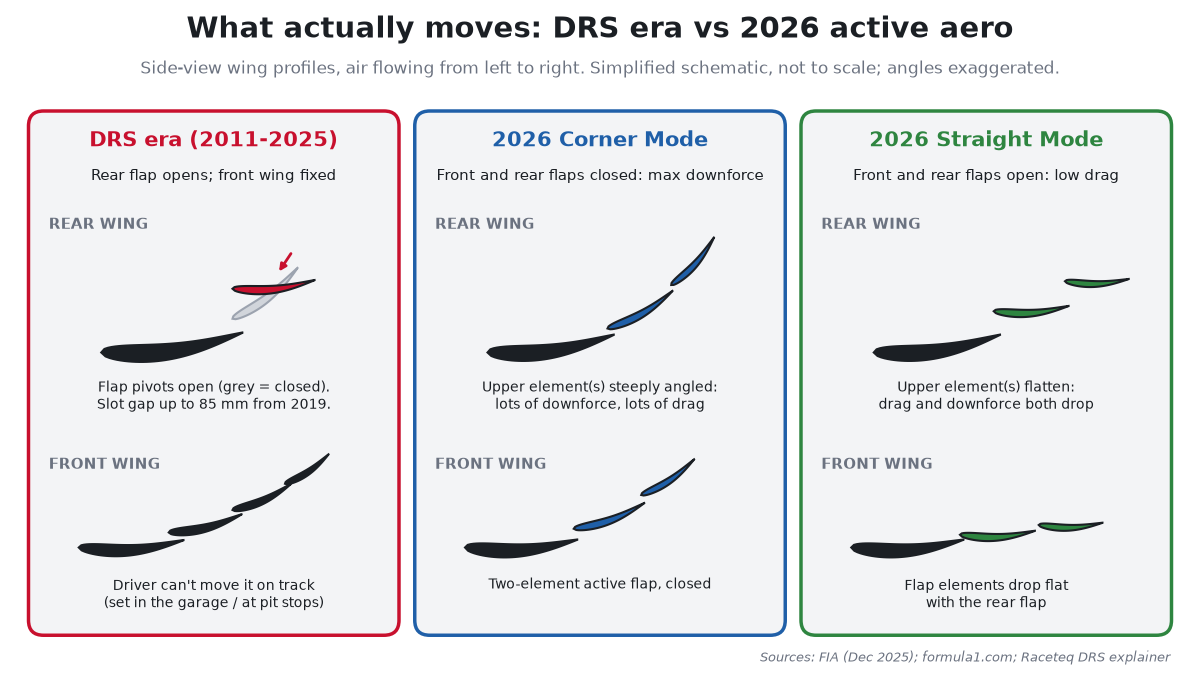
- The slot that opened between the elements grew over the years: 50 mm originally, 65 mm from 2014, and 85 mm from 2019.
- Lifting off the throttle or touching the brake slammed it shut, so a driver wasn't arriving at a corner with no rear downforce.
- In the race, DRS only worked in designated activation zones, and only if you crossed the detection point less than a second behind the car ahead (even a backmarker).
At COTA in recent years, the two DRS zones were the long back straight and the main straight up to Turn 1.
DRS worked, in the sense that it produced passes. It was also endlessly criticized as artificial. Some passes were "drive-bys" that took no skill at all, and when several cars ran within a second of each other, everybody had DRS and nobody gained anything - the dreaded DRS train.
Why 2026 needed something completely different
The 2026 rules rebuilt both the chassis and the power unit at the same time, which the sport almost never does. The power unit is still a 1.6-liter turbo V6 hybrid, but the balance has flipped dramatically toward electricity:
- The combustion engine's output drops from roughly 550-560 kW to about 400 kW.
- The MGU-K (the electric motor-generator on the crankshaft) jumps from 120 kW to 350 kW - about 470 hp on its own.
- The MGU-H (the complex turbo-mounted generator) is gone entirely.
- The battery can be recharged with more than double the previous 4 MJ per lap.
- Everything runs on advanced sustainable fuel.
That roughly 50-50 split is the root of everything else in this article. A battery runs out. BBC Sport reported that at full throttle, the 350 kW motor can drain it in about 11 seconds. If a 2026 car punched a hole in the air as hard as a 2025 car did, it would run out of electric shove halfway down every long straight. The cars therefore needed to slip through the air far more cleanly on the straights, without losing their grip in the corners.
The FIA's headline targets for the new cars: around 30 percent less downforce and somewhere in the region of 55 percent less drag. The cars also got smaller (wheelbase down 200 mm to 3,400 mm, floor 100 mm narrower, slimmer tires) and lighter, with the minimum weight dropping from 800 kg to 768 kg. The venturi tunnels of the 2022 ground-effect floors are gone, replaced by a flatter floor and a much larger diffuser.
Here's the key insight that most "DRS replacement" headlines miss: according to the FIA, active aero is primarily an energy-efficiency device, not an overtaking aid. Cutting drag on the straights is what makes the electric-heavy power unit workable. Overtaking help has moved somewhere else entirely - into the battery.
Active aero, explained: Corner Mode vs Straight Mode
The 2026 cars have a front wing with a two-element active flap and a three-element active rear wing. Formula1.com compares them to a Venetian blind: with the blades "closed" (steeply angled into the airflow), the wings make lots of downforce and lots of drag. With them "open" (flattened), both drag and downforce fall.
- Corner Mode is the default: flaps closed, maximum downforce, maximum grip for corners and braking.
- Straight Mode opens them: the uppermost front wing elements drop at the same time as the rear wing's top element opens up a DRS-style gap. Less drag means more top speed for the same power, or the same speed for less energy.
What's different from DRS
| DRS (2011-2025) | Straight Mode (2026) | |
|---|---|---|
| What moves | Rear wing flap only | Front and rear wing flaps together |
| Who can use it in a race | Only a car within 1 s of the car ahead at detection | Every car, whether chasing or not |
| Where | Designated DRS zones | Designated Straight Mode (SM) zones, straights of a minimum length |
| Main purpose | Overtaking aid | Energy efficiency and top speed |
| Wet or low grip | Could be suspended by race officials | Shorter zones, front wing only |
Because everyone gets Straight Mode, it no longer creates a speed difference between the attacker and the defender by itself. On a straight where both cars are open, the playing field is level - and that's exactly why a separate overtaking tool was needed.
Why the front wing moves too
DRS only touched the rear wing, which shifted the car's aerodynamic balance forward when it opened. That was tolerable when only the rear flap moved on a few straights. In 2026, the cars spend a lot more of the lap with reduced drag, so the front flaps move in harmony with the rear to keep the car trimmed and stable. It's a bit like lowering both ends of a seesaw at once instead of just one. Formula1.com notes that F1 actually tried a driver-adjustable front wing back in 2009 "without much success" - this time it's coordinated with the rear and built in from the start.
The fine print you can actually see on TV
- New trackside boards. Where you used to see a "DRS" board, you'll now see boards marked SM marking the start of a Straight Mode zone. Four were used in Bahrain pre-season testing.
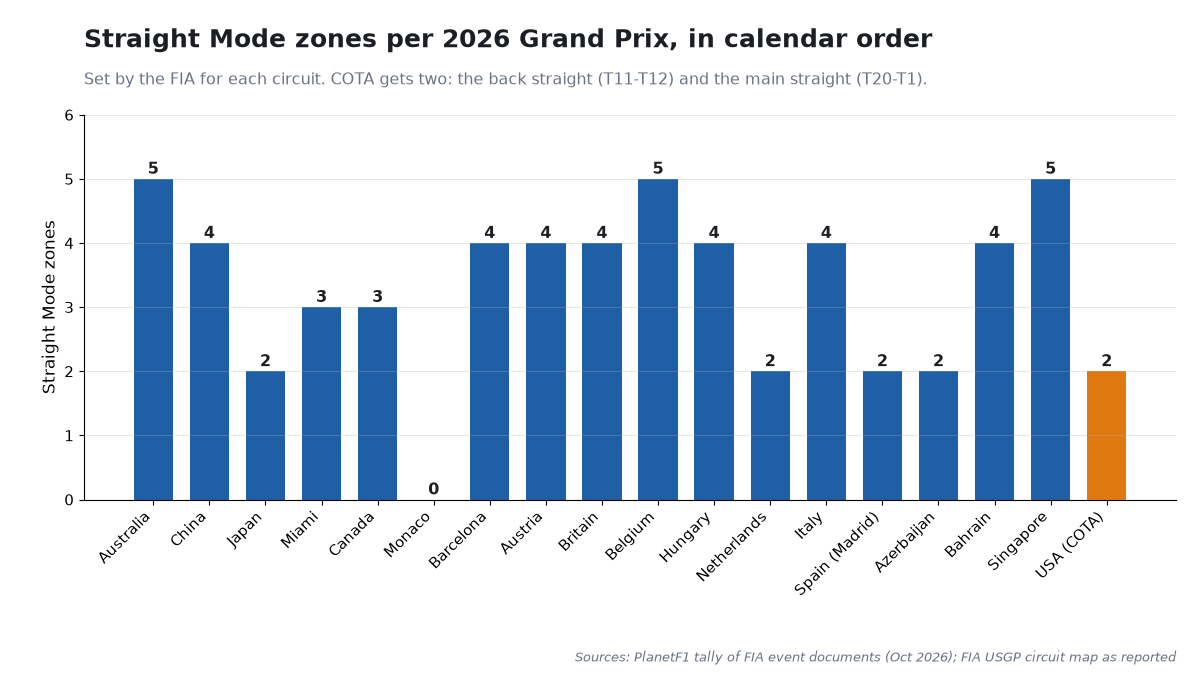
- Zones vary a lot. Melbourne, Belgium and Singapore have had five; Monaco had none. COTA gets two.
- Low grip, half measures. When race control declares low-grip conditions, shorter zones apply, starting further from the previous corner, and only the front wing drops into its low-drag setting.
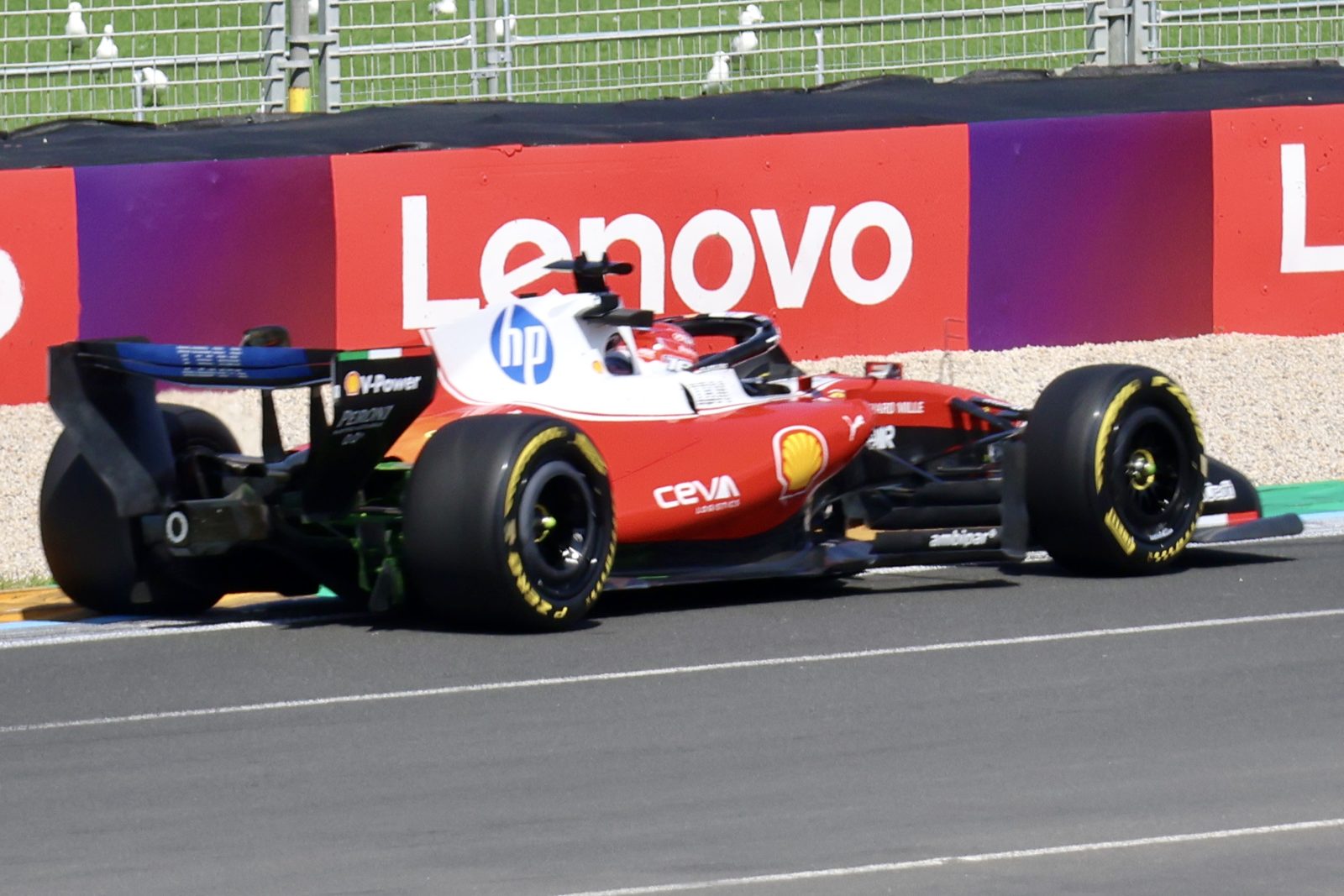
- Lift and you lose it. Lift-off regeneration (the driver lifting off the throttle to recharge) also disables the active aero, so the wings close. "Super clipping" - harvesting energy while still at full throttle near the end of a straight - keeps the wings open.
The engineering trade-off: why not just let drivers open the wings anywhere?
You might reasonably ask: if open wings save energy, why restrict them to zones? BBC Sport reported that this exact idea was discussed in the spring as a way to ease the energy crunch, but there's a safety catch. A driver hunting for lap time in qualifying might try to take a fast corner with the wings open, discover mid-corner that the car doesn't have the downforce to do it, and have a very large accident. Zones are the FIA's way of keeping that temptation in check.
The battery is the new slipstream: Recharge, Boost and Overtake Mode
If active aero is how the 2026 car saves energy, the battery is where the real racing happens. Think of it like a phone battery on a long day: what you do with your charge matters as much as how big it is.
Recharge
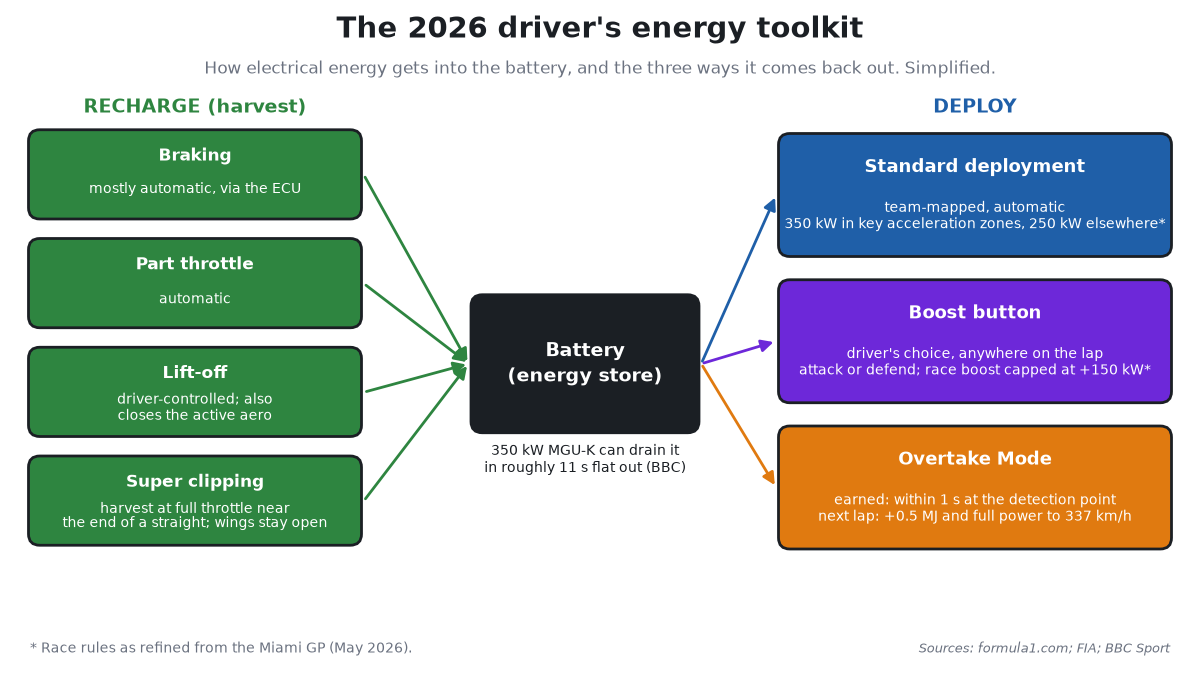
Energy goes back into the battery under braking, on part throttle, when the driver lifts off early, or via super clipping (the MGU-K working as a generator against the engine while the driver is still flat out). Most of this is automatic, managed by the car's ECU. The one recharge mode drivers control directly is lift-off regeneration - with the side effect that it closes the wings.
Boost
The Boost Button lets a driver take manual control of deployment, either returning the power unit to maximum or calling up a profile the team has pre-configured. It works anywhere on the lap, for attack or defense, and it can be spent in one big burst or sprinkled across the lap. Drivers have had a form of this for years; what's new is that the electric share is now big enough for it to create real speed differences.
Overtake Mode: the actual DRS replacement
This is the bit that does what DRS used to do, using electrons instead of wing flaps.
- Detection. There's one detection point per lap, typically at or just after the final corner. Cross it within one second of the car ahead and you've qualified.
- Reward, next lap. For the whole of the following lap, you can recharge an extra 0.5 MJ and use an additional electrical power profile that sustains a higher speed for longer.
- The speed trick. Normally, MGU-K power starts tapering off above 290 km/h (about 180 mph) and reaches zero at 355 km/h (about 221 mph). That rampdown exists so cars don't suddenly fall off a power cliff halfway down a straight. With Overtake Mode, the chasing car can keep the full 350 kW all the way to 337 km/h (about 209 mph). So right where the leader's electric push is fading, the attacker is still getting the full shove.
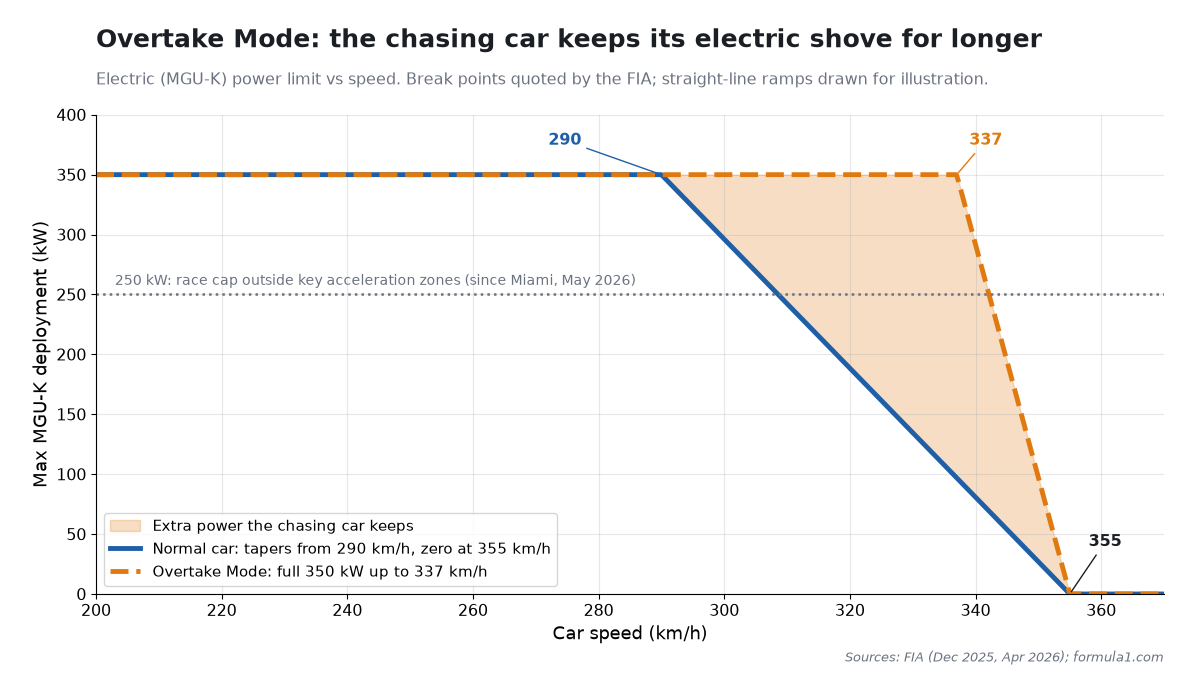
That last point is why Overtake Mode, like DRS before it, is most effective on long straights: the longer the run, the more of it happens in that high-speed window where the two cars have different power limits.
How strong is it? Mercedes' head of trackside operations Andrew Shovlin was candid after the Canadian Grand Prix: "It's not particularly powerful in terms of lap time. You're only getting a tenth, tenth and a half." What it does, he explained, is let the chasing car harvest more and therefore deploy more, plus reach a higher top speed thanks to that higher power threshold. The result in Montreal was that cars got "a little bit locked together in a battle". At Monza in September - where the FIA had set the lowest energy harvest limits of the year - Max Verstappen described how hard it was to defend against cars in Overtake Mode: "not a lot when people just drive by you like you're a turtle."
The plot twist: the rules changed mid-season
No honest 2026 explainer can skip this part. The first three races produced plenty of passing, but also a lot of complaints. Drivers were lifting and coasting on qualifying laps to recharge, and big speed differences opened up between a car that was deploying and one that was harvesting. At Suzuka, Oliver Bearman crashed heavily (BBC Sport reported a 191 mph impact measured at 50G) after coming up on Franco Colapinto's Alpine, which was traveling more than 30 mph slower on the approach to Spoon Curve.
On April 20, the FIA, teams, power unit manufacturers and Formula 1 agreed a package of refinements that took effect from the Miami Grand Prix:
| What changed | Before | From Miami (May 2026) |
|---|---|---|
| Max recharge per lap (qualifying) | 8 MJ | 7 MJ |
| Peak super-clip power | 250 kW | 350 kW (qualifying and races) |
| Boost power in races | Up to full deployment | Capped at +150 kW (or the car's current power if higher) |
| MGU-K deployment in races | 350 kW | 350 kW in key acceleration zones (corner exit to braking point, including overtaking zones); 250 kW elsewhere |
| Events allowed lower energy limits | 8 | 12 |
The FIA's stated goal: "These measures are designed to reduce excessive closing speeds while maintaining overtaking opportunities and overall performance characteristics." Translated: keep the big electrical shove where passing is supposed to happen - like a long straight into a heavy braking zone - and calm it down in places where a sudden power difference just makes someone a passenger in a very fast accident. The package also lined up, after testing at Miami, a low-power start detection system with flashing rear and side warning lights for cars that accelerate abnormally slowly at the start.
"Yo-yo racing": thrilling or artificial?
The new rules have produced a style of racing in which cars pass, re-pass and pass again as the energy advantage swings back and forth. Opinions are, let's say, spicy. Verstappen called it "anti-driving" and likened it to Mario Kart. Lewis Hamilton loved it: "If you go back to karting, it's the same thing. People going back and forth, back and forth - you can never break away." Reigning world champion Lando Norris landed in the middle, noting that some passes happen because the attacking car spends its battery and then "has absolutely zero battery and you're just a complete passenger." Veteran engineer and pundit Gary Anderson has argued that passing which comes from one team's harvesting strategy outwitting another's isn't "competitive overtaking" at all.
Whatever your take, it's a genuinely different sport from the DRS era, and you'll see why the moment you watch a full stint.
Taking it to Austin: how a pass at COTA works in 2026
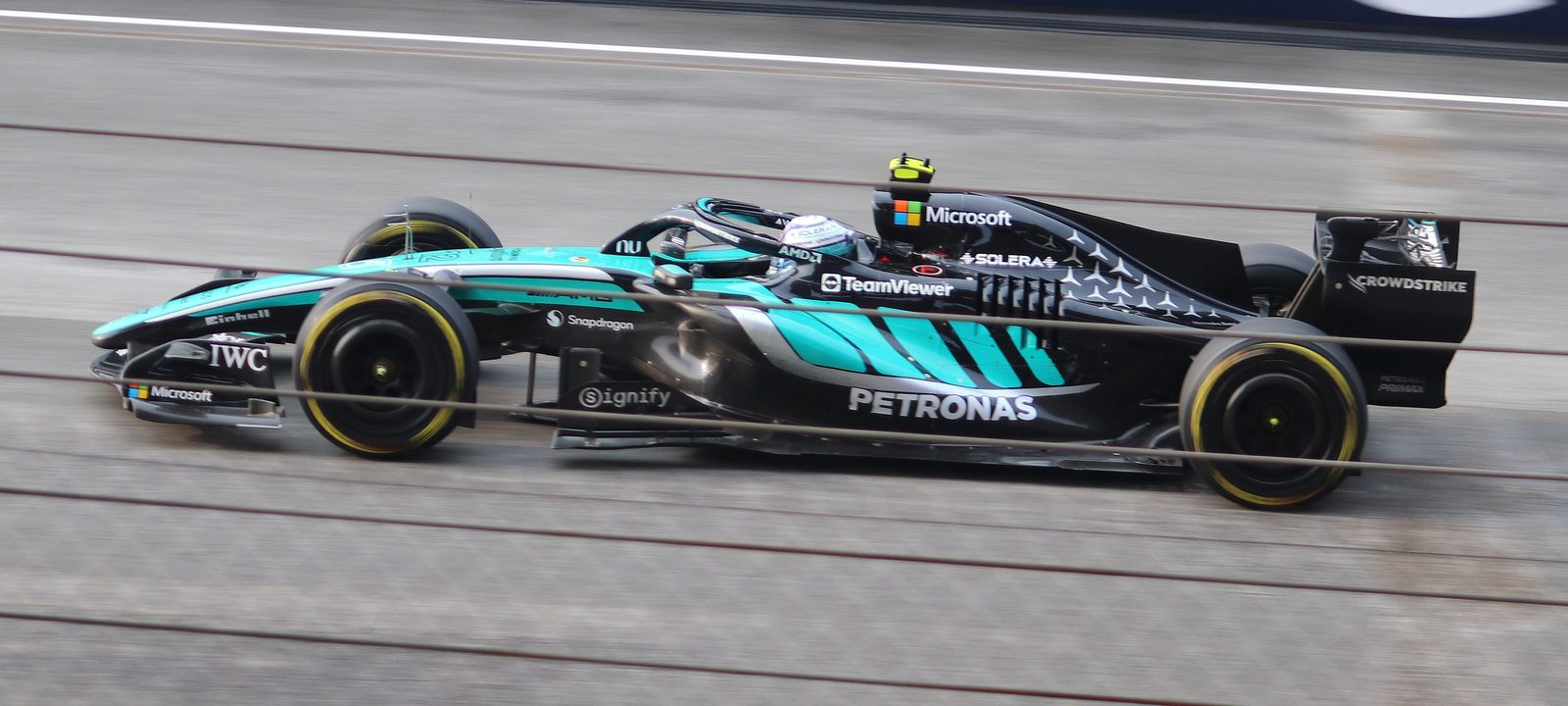
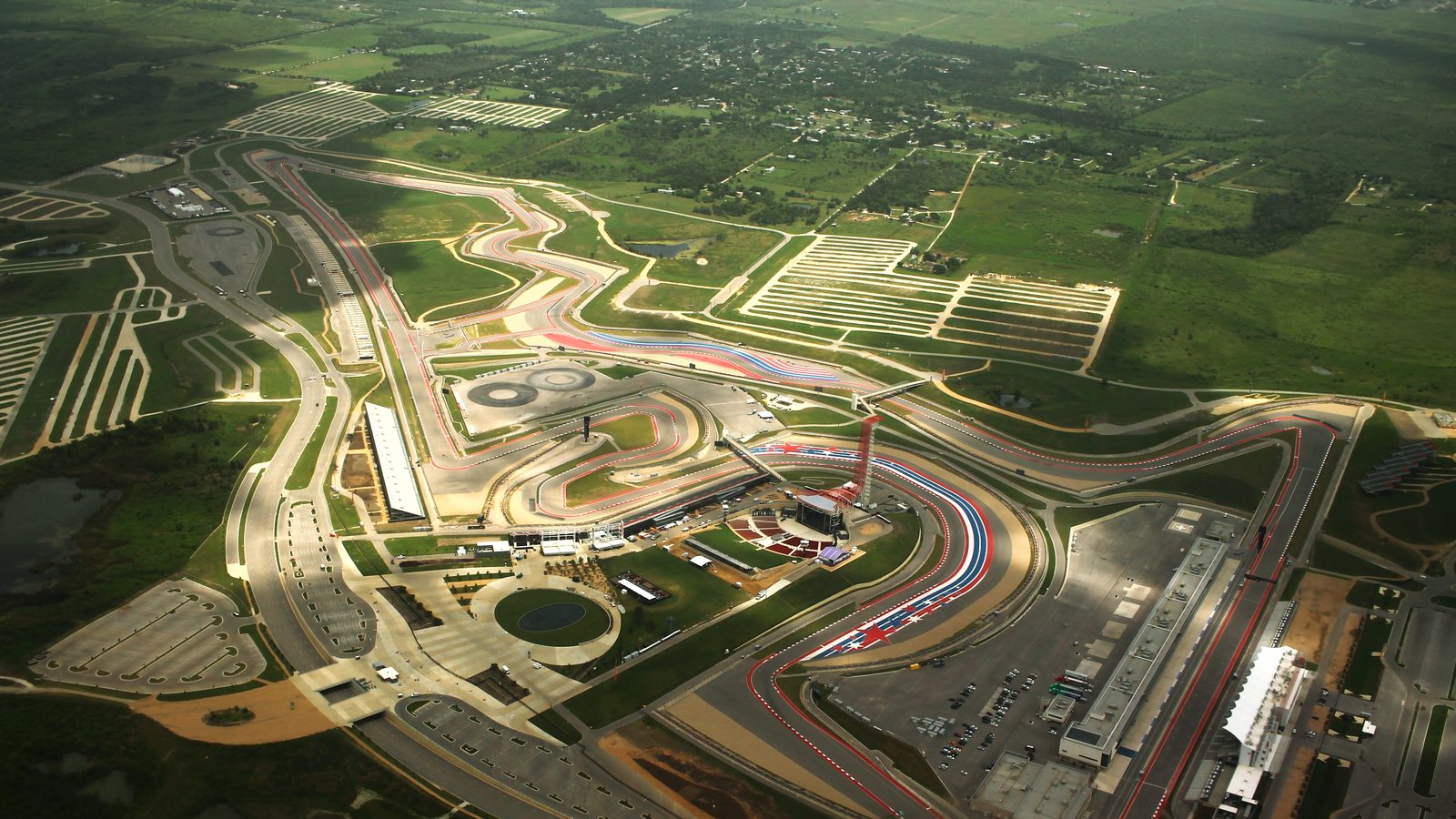
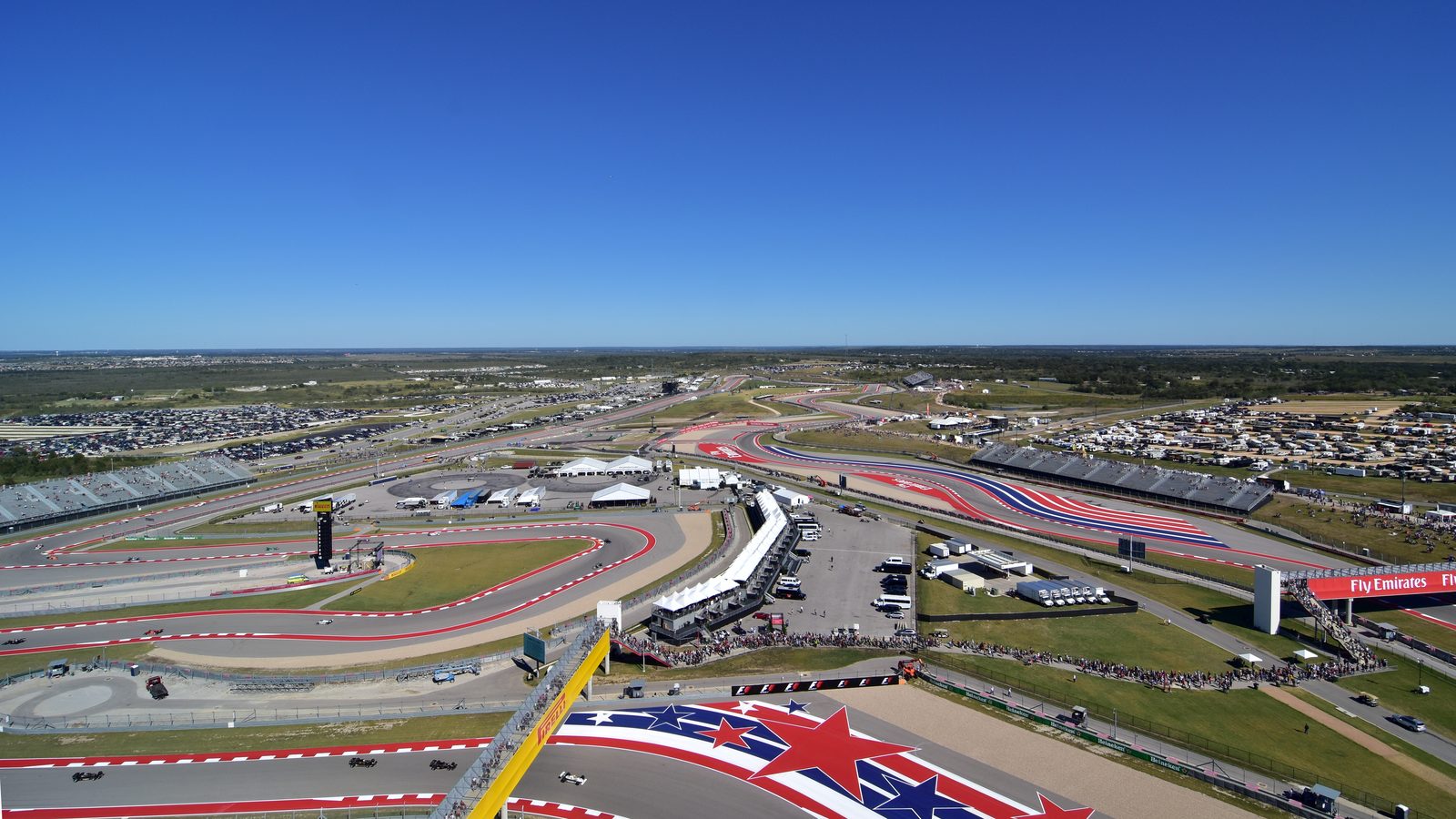
Circuit of the Americas is 5.513 km (3.426 miles) with 20 corners, and the race runs 56 laps. Its signature features are the steep uphill climb to Turn 1, the fast esses through Turns 3 to 6, and the Turn 11 hairpin that flings cars onto the longest straight on the track. COTA says that back straight is 0.63 mile long and that, under the previous rules, F1 cars reached up to 214 mph (about 344 km/h) on it before braking for Turn 12.
For 2026, the FIA's circuit map marks two Straight Mode zones: the back straight from Turn 11 to Turn 12 and the main straight from Turn 20 to Turn 1. The F1 track map, as reported ahead of the weekend, puts the Overtake Mode detection point just after Turn 20, with activation further along the main straight.
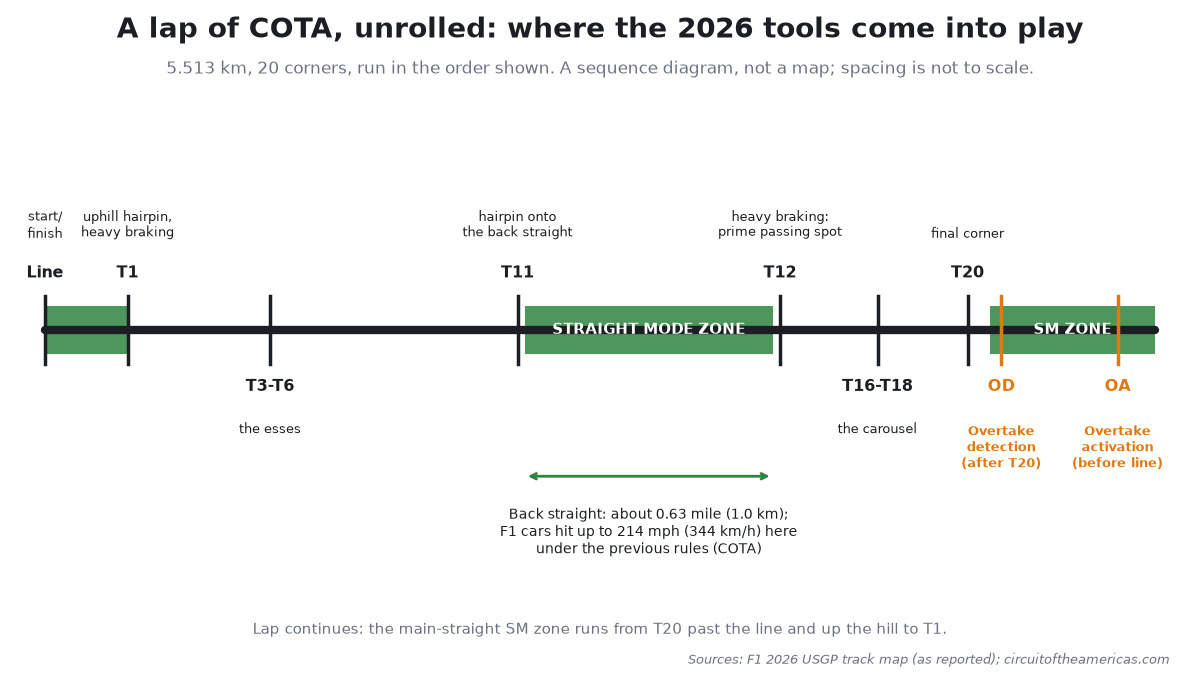
Here's how a classic COTA move could play out under the new rules. Treat this as an illustration of how the tools fit together, not a prediction:
- Lap N, Turn 20. Our attacker exits the final corner 0.8 seconds behind. Detection: qualified. Overtake Mode is unlocked for the next lap.
- Main straight, lap N+1. Both cars open into Straight Mode, as everyone does. The attacker has extra energy to harvest and a longer full-power window, and the uphill run to Turn 1 is the first chance to use it.
- The esses and Turn 11. The 2026 cars are designed to follow more closely through corners, so with luck the gap holds through the fast stuff. Through the hairpin, the attacker wants a clean, early exit; the defender may be tempted to burn Boost here to break the tow.
- Back straight. Both cars flick into Straight Mode. If the run gets into the range where the leader's normal electric power is tapering off, the attacker with Overtake Mode is still at full 350 kW until 337 km/h. That's where the closing speed comes from. It's also, by the FIA's Miami definition, exactly the kind of corner-exit-to-braking-point acceleration zone where full deployment is preserved.
- Turn 12. Wings snap back to Corner Mode for the braking zone, the attacker dives down the inside, and the defender is left deciding whether to spend what's left in the battery to fight back on the next straight. Hello, yo-yo.
Whether 2026 cars will actually reach previous-era speeds on that straight is something nobody will know until Friday practice, which is exactly why it's worth watching.
Your COTA viewing cheat sheet
Session times from the official timetable (Austin is on Central time; Pacific times in brackets):
- Friday, October 23: Practice 1 at 12:30 PM (10:30 AM Pacific), Practice 2 at 4:00 PM (2:00 PM Pacific).
- Saturday, October 24: Practice 3 at 12:30 PM (10:30 AM Pacific), Qualifying at 4:00 PM (2:00 PM Pacific).
- Sunday, October 25: The 56-lap Grand Prix at 3:00 PM (1:00 PM Pacific).
What to watch:
- The SM boards after Turn 11 and Turn 20. Watch onboard shots for the wing elements flattening and snapping back.
- Speed-trap numbers on the back straight. Compare a car with Overtake Mode against the car it's chasing.
- Qualifying laps that look "lazy." Lifting before a corner isn't always a mistake in 2026; sometimes it's harvesting.
- Re-passes into Turn 1 after a move into Turn 12. If the defender kept some energy, the main straight is the counterpunch.
- Rain. If Austin gets wet, expect the shorter, front-wing-only Straight Mode zones and reduced electrical deployment.
In town early? The Road to the Race supercar gathering at The Long Center on Wednesday, October 21 bills itself as the prelude to the Grand Prix, with more than 100 hypercars and supercars plus Formula 1 cars on display. Details are on our events page. It's a great chance to get a close look at real F1 wings before watching them flap at 200 mph.
The bottom line
DRS was a single trick: open the flap, pass the car. The 2026 formula splits that trick in two. Active aero gives every car the same low-drag wings on the straights, mainly so the electric-heavy power units can make it to the end of the straight with something left. Overtaking now lives in the battery, through Overtake Mode's extra energy and longer power window, with the Boost button as the wild card. It's more complex, it's more strategic, and when it works - as it should on COTA's long back straight - it means a pass is earned over a whole lap of energy management, not just pushed through with one button.
See you at Turn 12. Bring earplugs and a fully charged phone - the cars certainly will.
Race week tags, for the group chat: #Austin #USGP #F1
Sources
- FIA: F1's New Era - everything you need to know about the 2026 regulations
- FIA: Refinements to the 2026 FIA Formula 1 regulations agreed by all stakeholders
- Formula 1: The beginner's guide to the 2026 regulations
- Formula 1: 2026 regulations explained - F1's new aerodynamics
- Formula 1: 12 rule changes you need to know in 2026
- Formula 1: The inside scoop on the 2026 power unit regulations
- Formula 1: 2026 United States Grand Prix timetable
- BBC Sport: The thorny issues facing F1 over racing, qualifying and safety
- BBC Sport: Formula 1 makes series of rule changes to address new engine regulation concerns
- RaceFans: Overtake Mode helped lock cars together in battle at Canadian GP
- RaceFans: Overtake Mode meant others passed me like I was a turtle, says Verstappen
- The Race (Gary Anderson): F1's overtaking problem is bigger than one circuit
- Raceteq: What is the Drag Reduction System and how does DRS work?
- Motorsport.com: What F1 2026's new terminology and technology all means
- PlanetF1: FIA confirms five Straight Mode zones for Singapore (with 2026 tally by circuit)
- Scuderia Fans: FIA confirms two Straight Mode zones at COTA
- F1 Live Pulse: 2026 United States Grand Prix track map with Straight Mode and Overtake Mode points
- Circuit of The Americas: Formula 1 United States Grand Prix 2026
- Circuit of The Americas: COTA Crash Course - History in 20 Turns
- Wikimedia Commons: Circuit of the Americas aerial, July 2015 (Formulanone, CC BY-SA 4.0)
- Wikimedia Commons: Circuit of the Americas, Austin, TX (pedrik, CC BY 2.0)
- Wikimedia Commons: 2026 Bahrain GP - Mercedes - Kimi Antonelli - Race (Liauzh, CC BY-SA 4.0)
- Wikimedia Commons: Ferrari SF-26 of Charles Leclerc (Yu Chu Chin, CC BY-SA 4.0)