 exoticsgroup.com
Sleeping Beauty Mode: How to Put a Supercar to Bed for Winter (and Wake It Up Without Drama)

Think about what happens to your phone when you leave it in a drawer for a month. Even switched "off," it slowly bleeds charge, and if you forget it long enough, it won't even turn on until it has sat on a charger for a while. Now imagine that phone has a dozen computers inside it, an alarm system, a keyless-entry receiver listening for your fob, and a battery that costs real money to replace. Congratulations: you own a modern supercar, and it is about to spend the winter in the garage.
Putting an exotic into hibernation isn't hard, but it is one of those jobs where five minutes of laziness in November turns into a tow truck, a new battery and a vibrating steering wheel in April. Most of the drama comes from the same handful of culprits: a battery that drains while the car "sleeps," fuel that goes stale, tires that take on the shape of the floor, mice looking for a warm apartment, and moisture that sneaks in under the cover. Let's take them one at a time, look at why each one happens, what the manufacturers actually say, and then walk through waking the car up without drama.
Why your parked supercar is quietly eating its battery
Here is the part that surprises new owners: a car that is switched off is not really off. Battery Tender, which has been making battery chargers for decades, explains that every modern vehicle keeps drawing some current with the ignition off. The engine computer holds its memory, the clock runs, the alarm watches the car and the key-fob receiver keeps listening. Engineers call this "parasitic draw," and on a healthy car Battery Tender puts it at about 20 to 50 milliamps (mA).
That sounds like nothing, and over a weekend it is. Over a winter, it adds up. Battery Tender's own math says a 60 amp-hour battery can, in theory, feed a 50 mA draw for about 50 days before it is completely flat. At 100 mA it lasts about 25 days, and at 250 mA (the kind of draw a misbehaving module or a short can cause) it is gone in under 10. Remember that "flat" is the end of the road. Your car will refuse to start well before that.
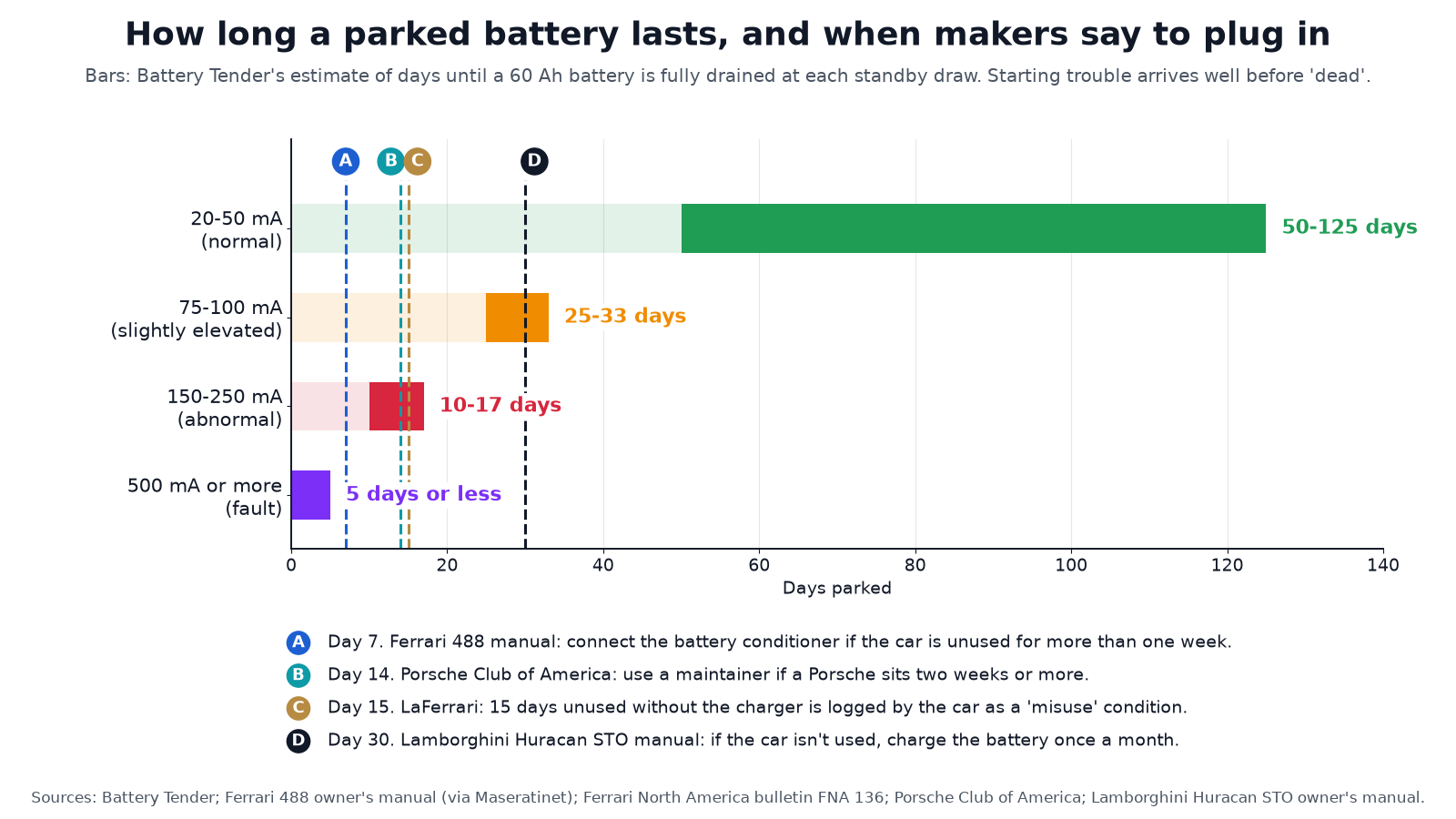
So is a supercar that drains its battery in a couple of weeks a design flaw? Mostly, no. Exotics pack in a lot of electronics, and their makers don't pretend otherwise: they plan for a maintainer and tell you so in the manual. The guidance is remarkably consistent:
- Ferrari's 488 owner's manual, as summarized by the Ferrari specialists at Maseratinet, recommends connecting the battery conditioner if the car will be unused for more than one week, and warns that a battery that isn't maintained periodically can suffer an irreversible loss of function.
- Lamborghini's Huracan STO manual says that if the car sits for several months, devices that draw power even when "shut off" can discharge the battery completely, which causes "irreparable internal damage." Its fix: charge the battery once a month, with a charger available from a Lamborghini dealer.
- McLaren's owner's handbook (we checked the Elva's) tells owners to leave a suitable lithium-ion charger connected and switched on whenever the car isn't in regular use. Parts specialists sell the McLaren-branded charger as a CTEK Lithium US unit built for lithium-iron (LiFePO4) batteries.
- Porsche owners get similar advice from the Porsche Club of America: modern Porsche electronics draw significant standby power, so if your car will sit for two weeks or more, use a maintainer such as a CTEK or Porsche's own Charge-o-Mat.
Where it does become a fault is when the draw is abnormal. Battery Tender calls anything above about 100 mA "definitively abnormal" and lists the usual suspects: an aftermarket dash cam, tracker or alarm wired to constant power, a factory module that never goes to sleep, or a light that never switches off. Maseratinet notes that Ferrari itself says a battery that tends to discharge quickly is a reason to have the electrical system inspected. A maintainer keeps a healthy battery healthy. It does not fix a car with a short.

What about simply disconnecting the battery? It works, and Hagerty lists it as an option (negative cable off first). But on a modern exotic it has costs. Battery Tender points out that disconnecting resets electronic systems and can trigger security lockouts, and Lamborghini's manual warns that disconnecting and reconnecting disables some features until they are reset. Ferrari's 458 and California manuals, per Maseratinet, say the battery master switch should only be used if the conditioner can't be connected. Translation: plug it in if you have an outlet.
Maintainers, tenders and trickle chargers: not the same thing
Old-school "trickle chargers" push a small, steady current into the battery whether it needs it or not. Prestige Imports, a Porsche dealer in Colorado, warns that many trickle chargers provide an unregulated charge and, if left unmonitored, can boil a battery's fluid dry. A maintainer (also sold as a "tender" or "conditioner") is smarter: it charges the battery, then backs off and only adds what the car's standby draw takes away.
CTEK's eight-step program for lead-acid batteries is a good example of what happens inside the box. It starts by pulsing to break down sulphate on the plates, checks that the battery can accept a charge, then charges at full current until the battery is around 80% full ("bulk"), tapers the current to reach 100% ("absorption"), and tests whether the battery can hold a charge. After an optional reconditioning step, it holds a constant voltage ("float") and finally switches to "pulse" mode, watching the voltage and topping up only when it drops, to keep the battery at 95 to 100%.
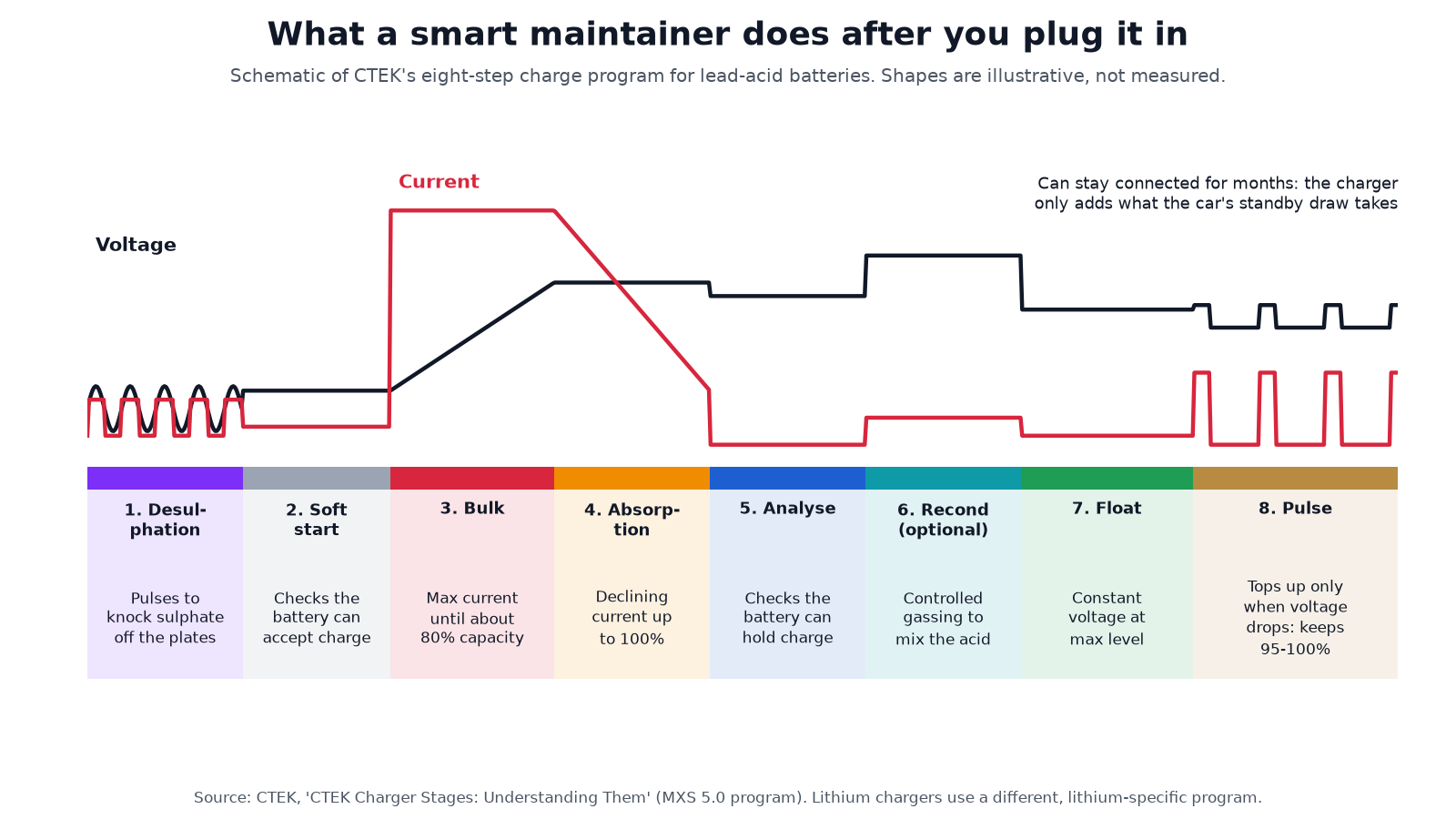
That last stage is why these things can stay connected all winter. It is also why a cheap charger that just sits at full output is not a substitute.
Lithium batteries and hybrids play by stricter rules
Many exotics now use lithium-iron-phosphate (LiFePO4) starter batteries because they are much lighter. McLaren's handbook is blunt about it: the car has a sealed lithium-ion battery, and only a lithium-ion charger can be used on it. Porsche's Charge-o-Mat Pro, according to Prestige Imports, has a dedicated lithium mode for Porsche's lightweight battery.
Lithium batteries have another quirk worth knowing. CTEK's manual for its LITHIUM US charger explains that some lithium batteries have built-in "under voltage protection" that disconnects the battery to keep it from being discharged too deeply. Once that trips, an ordinary charger can't even tell a battery is connected. CTEK's lithium charger can open the protection if you hold its reset button for 10 seconds. The same manual also warns against charging a battery below 32 degrees F unless the battery maker says it is OK, which matters if your garage is unheated.
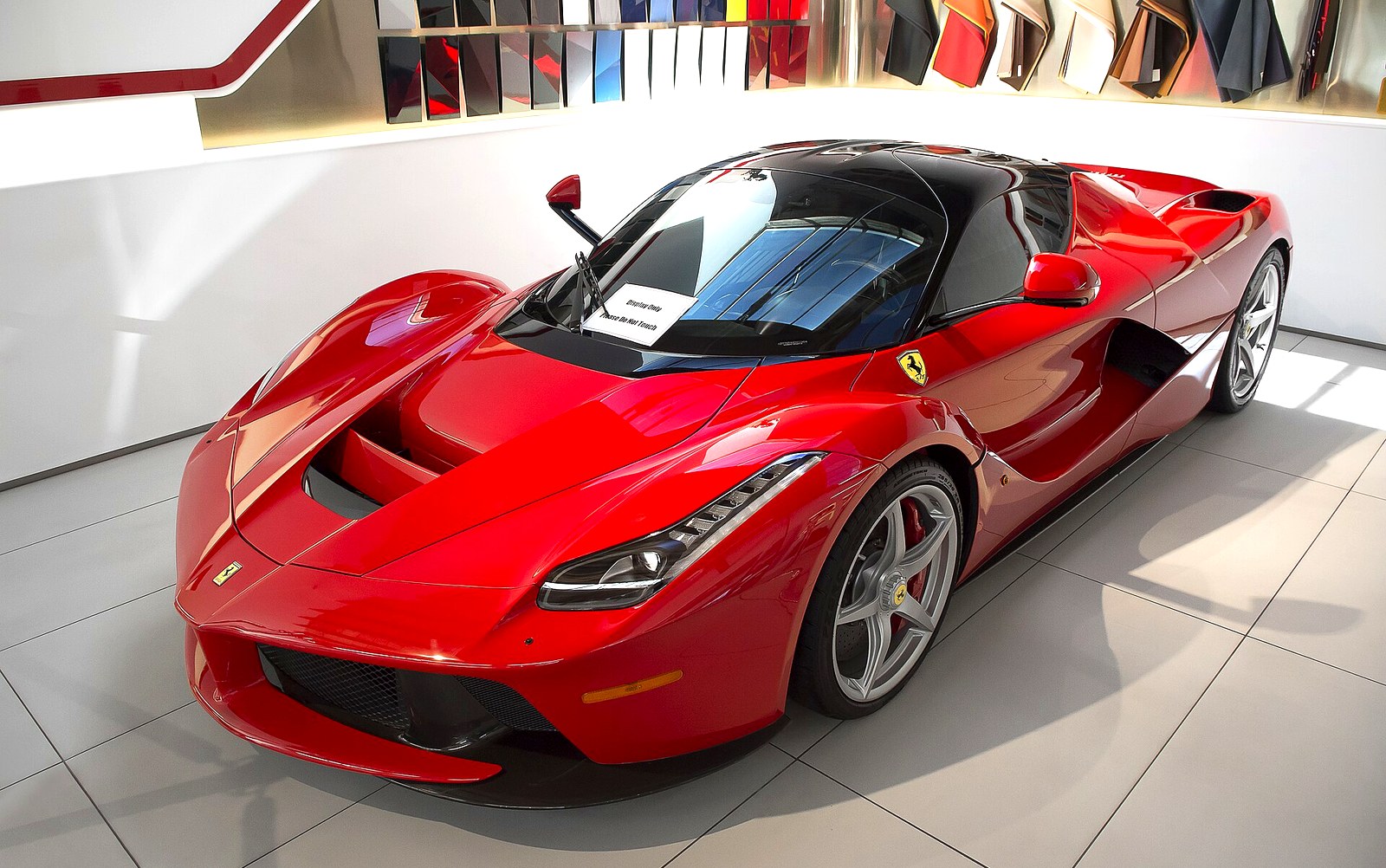
Hybrids raise the stakes further. In a 2016 bulletin to its dealers, Ferrari North America said the LaFerrari's charger "MUST be connected" any time the car is not in use, because both its high-voltage and 12-volt batteries are lithium-ion and need maintenance. The car keeps a log: if it sits unused without the charger for 15 days, it stores a "misuse" condition, and Ferrari warned that a battery failure with misuse logged would not be covered under warranty. An owner on FerrariChat quoting his SF90 manual describes the same idea: connect the car when it won't be used for more than a week. If you own a hybrid exotic, read the battery section of your manual twice.
Fuel and fluids: fill it, treat it, run it
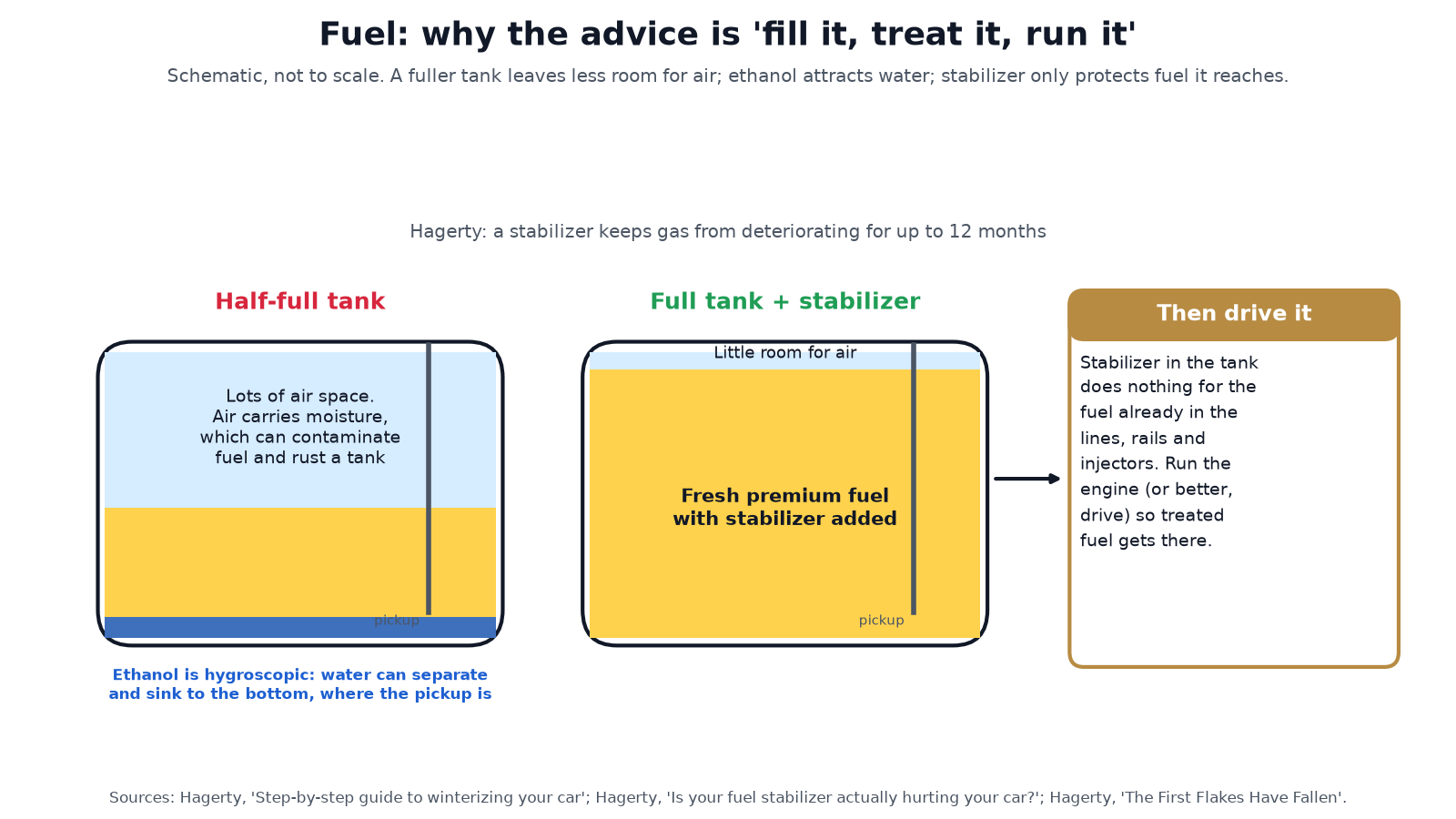
Fuel is the next thing to go off while the car sleeps. Hagerty's winterizing guide recommends filling the tank (preferably with premium), adding a fuel stabilizer and then running the engine so the treated fuel reaches the fuel rails and injectors. The reason for the full tank is simple: the fuller the tank, the less room for air, and that air carries moisture that can contaminate the fuel and possibly rust the inside of the tank. Hagerty also says a stabilizer will keep fuel from deteriorating for up to 12 months.
Ethanol is the troublemaker. As Hagerty's Kyle Smith explains, the ethanol in modern pump gas is hygroscopic, meaning it attracts water. In long-term storage that water can separate from the fuel and settle at the bottom of the tank, which is exactly where the fuel pickup is. In a FortNine test that Hagerty wrote up, STA-BIL and K100 did best at reducing moisture absorption and corrosion. For older engines in particular, Hagerty says the best solution is to start with ethanol-free fuel if you can find it.
Then there's the oil. Hagerty recommends changing the oil and filter right before the car goes into storage, because fresh oil reduces the risk of harmful contaminants working away at your engine during hibernation, and you'll be ready to drive in the spring. While you're under the hood, check the antifreeze.
Tires: how to avoid the dreaded flat spot
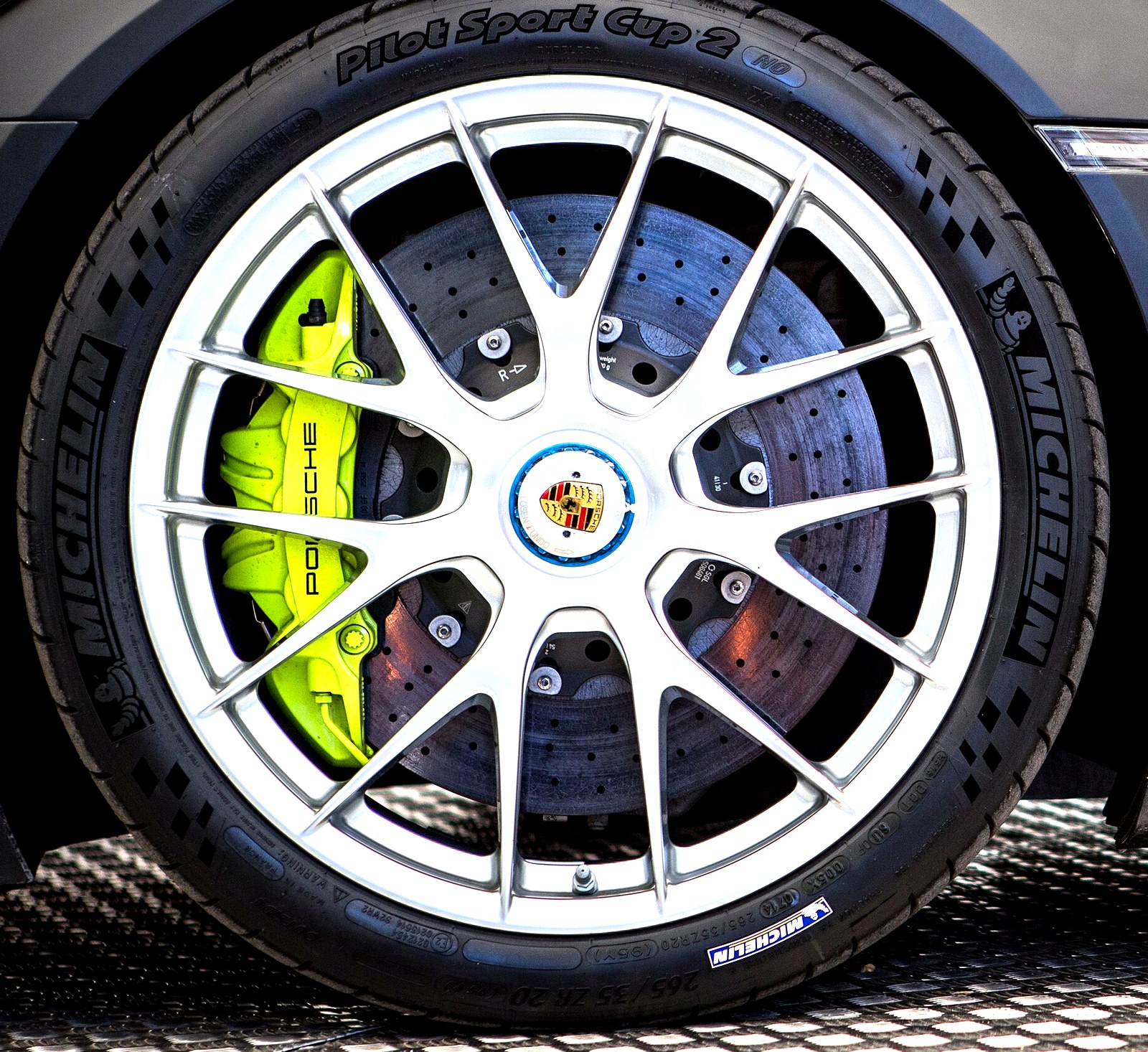
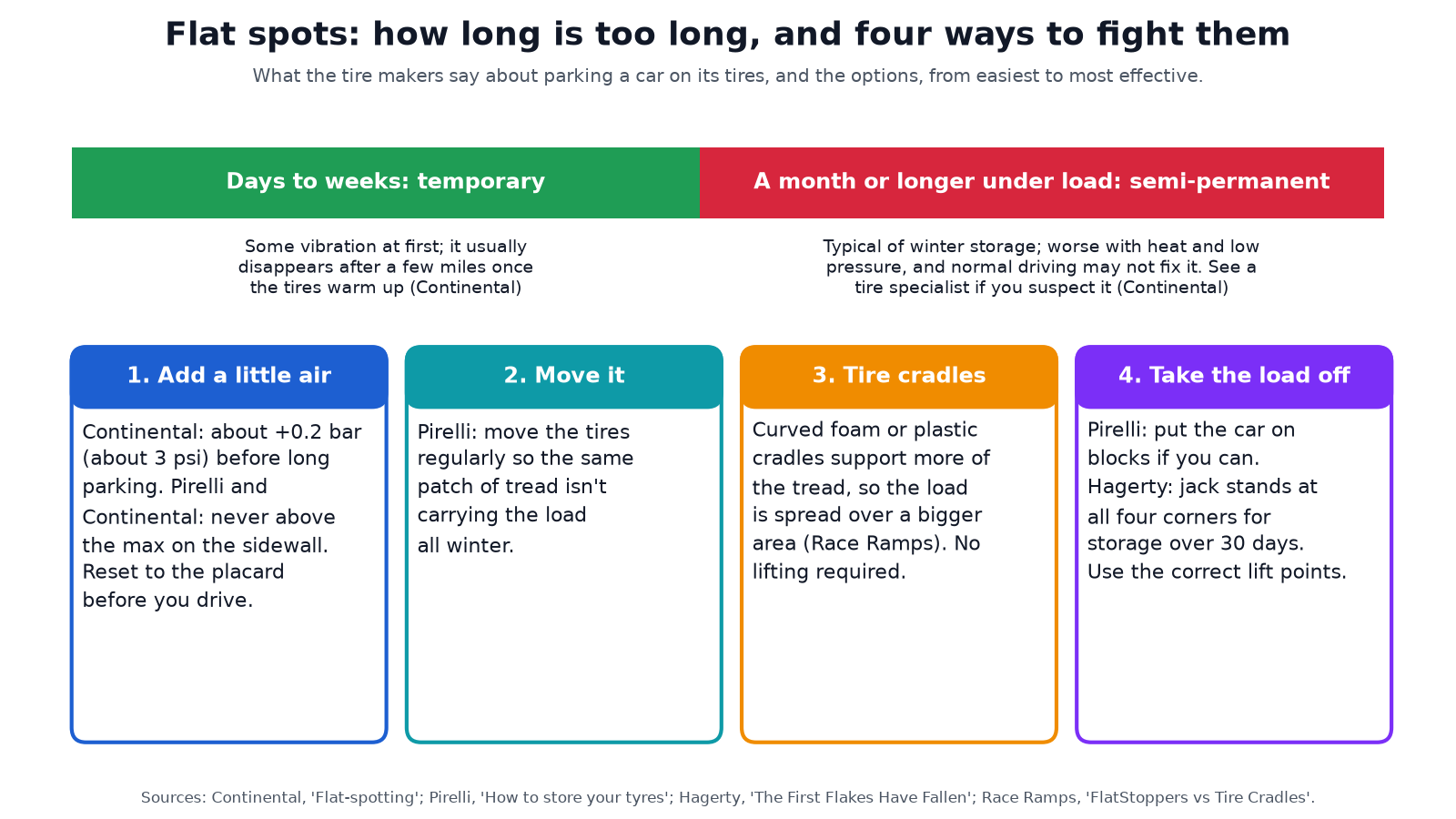
Tires are round only because they keep rolling. Park a car and the patch of tread touching the floor flattens slightly, especially as the tire cools. Continental, which explains this well, describes two kinds of flat spot. A car parked for a few days or weeks gets a temporary flat spot: some vibration for the first few miles that goes away once the tires warm up. A car left standing under load for a month or longer, which is exactly what winter storage is, can develop a semi-permanent flat spot that normal driving won't fix, especially if the tires were low on pressure or the car sat somewhere hot. Hagerty adds that flat-spotting happens faster in the cold and is worse with high-performance and low-profile tires, which describes basically every supercar.
You have four tools, from easiest to most effective:
- Add a little air. Continental suggests raising pressure by about 0.2 bar (roughly 3 psi) before long parking, and both Continental and Pirelli say never to exceed the maximum pressure on the sidewall. Pirelli adds the important part: let it back down to the recommended pressure before you drive.
- Move it. Pirelli recommends moving tires regularly so the same spot isn't loaded for months.
- Use tire cradles. Curved cradles like Race Ramps' FlatStoppers support more of the tread, which spreads the car's weight over a larger area. Race Ramps lists an 8.9-degree approach angle for FlatStoppers, so check that against your front splitter before you drive up.
- Take the weight off. Pirelli suggests putting the car on blocks if you can, and Hagerty recommends jack stands at all four corners for storage longer than 30 days. On a low exotic, use the manufacturer's lift points and be honest with yourself about your equipment.
One more cold-weather warning: ultra-high-performance summer tires don't like deep cold. Porsche's owner's manual for the 718 Cayman GT4 and 718 Spyder says its special sports tires harden at very low temperatures below about -7 degrees C (19 degrees F), which can lead to cracks, and tells owners not to drive the car below that. It also says summer tires can be permanently damaged in extreme cold (-15 degrees C, or 5 degrees F, and below). If your garage gets that cold, don't roll the car out on a frosty morning to "exercise" it.
Rodents, moisture and the great car-cover debate
A dry, quiet garage is a five-star hotel to a mouse. Hagerty's rodent-proofing guide notes that mice usually get in by climbing the tires, love the warmth of an engine bay or heater box, and will chew wiring, sometimes badly enough to start a fire. The defenses are boring but effective:
- Keep the building tight first: seal gaps at the bottom of walls and around pipes and wires.
- Clean out the cabin. No food, no crumbs, no forgotten fries in the seat rails.
- Plug the exhaust and air intake. Hagerty suggests steel wool, or a plastic bag or aluminum foil taped in place, and recommends checking every couple of weeks for droppings or a mousy smell.
- Put the sun visors down and keep the windows closed.
- Use traps around the car, and make sure someone checks them.
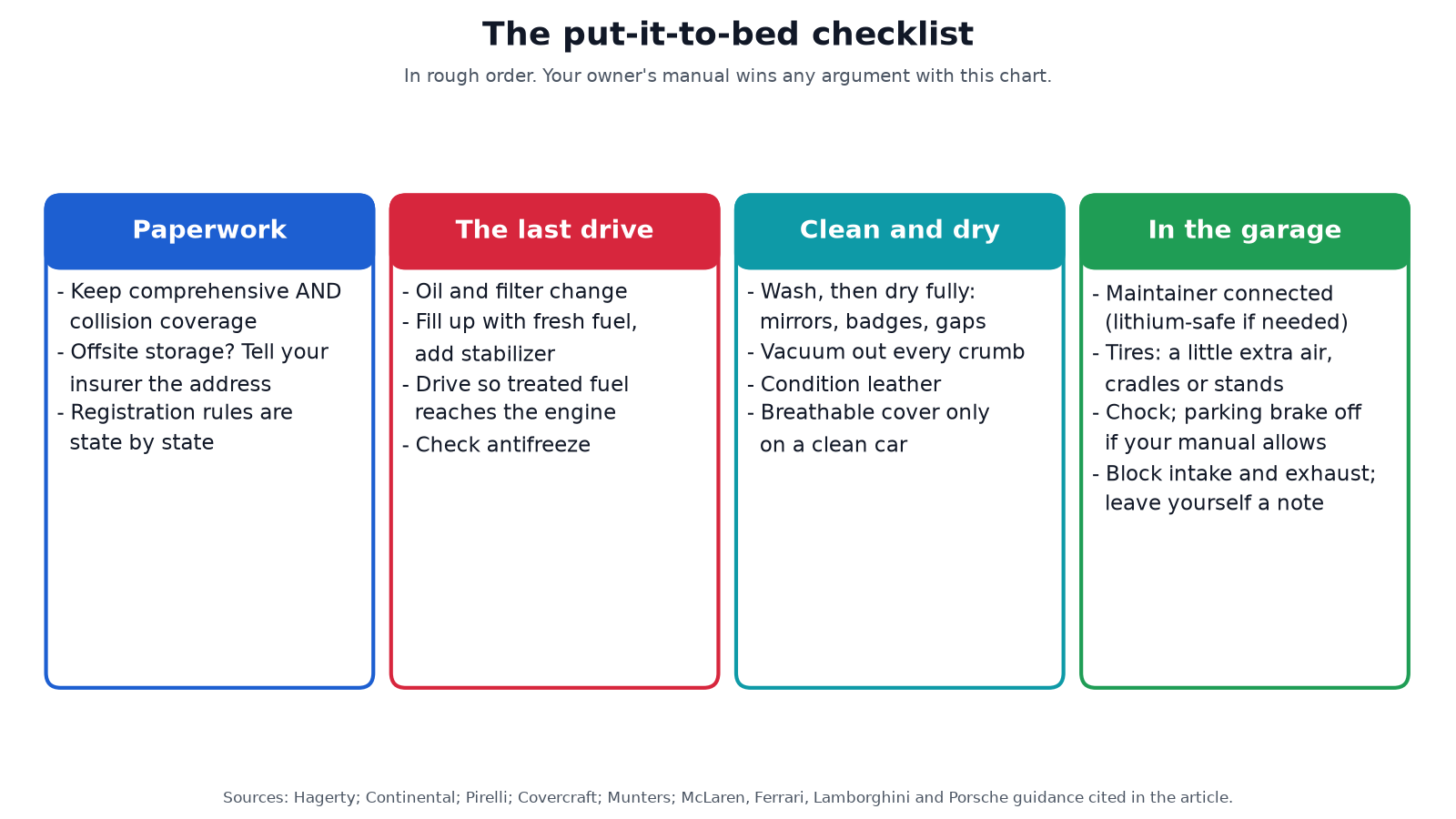
Most important of all: leave yourself a note on the steering wheel listing everything you stuffed into an opening. Hagerty's spring checklist starts with removing those plugs for a reason.
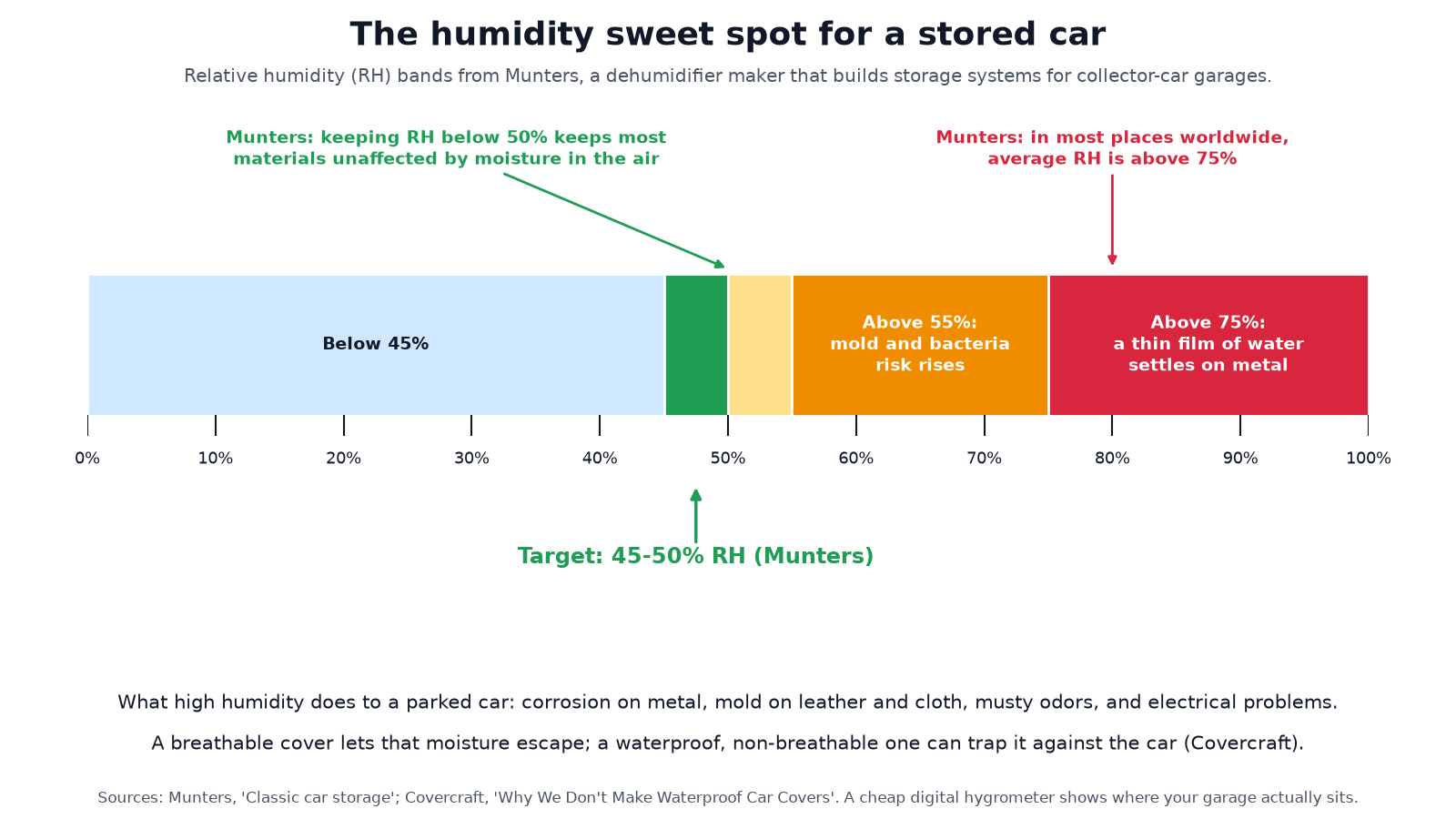
Moisture is the quieter enemy. Munters, which builds dehumidification systems for collector-car storage, says keeping relative humidity around 45 to 50% protects classic cars, and that once humidity rises above 55%, the risk of mold and bacteria rises, which can mean musty odors, corrosion and ruined leather and cloth. It also links damp air to electrical and electronic failures. An inexpensive hygrometer will tell you where your garage sits, and a dehumidifier is cheap insurance in a damp climate. Hagerty's guide also points out that a concrete floor is best at keeping moisture away, and recommends a plastic barrier under the car if you must store it on dirt.
Then there's the cover. A good fitted indoor cover keeps dust off the paint and protects it from a stray bike handlebar. But the material matters. Covercraft, which has been making car covers since 1965, explains why it won't make a truly waterproof cover: a waterproof fabric doesn't breathe, so moisture, humidity and gases trapped underneath have nowhere to go, which leads to rust, corrosion and mold. Choose a breathable cover. And put it on a clean car. Hagerty notes that pulling a cover on and off a dirty car scratches the paint, so wash it first and dry it completely, including the mirrors, badges and panel gaps that hold water long after you think you're done.
Paperwork: insurance, registration and the night-before checklist
It's tempting to cancel insurance on a car that isn't moving. Hagerty explains why that's a bad idea: drop coverage entirely and you're exposed to fire, theft or a garage roof collapsing under snow, and even dropping only collision coverage leaves you uncovered if something rolls into the car or it falls off its jack stands. Hagerty also says that if you store the car somewhere other than home, some insurers require you to report the storage address.
One more mechanical item belongs on the night-before list: Hagerty advises against leaving the parking brake on for long-term storage, because pads left clamped against rotors for months can stick, and suggests wheel chocks instead. Many exotics have electronic parking brakes, so check what your owner's manual says before you change anything.
Registration rules vary by state, so check yours. As one example, California's DMV offers "Planned Nonoperation" status, but only if the vehicle won't be driven, towed, stored or parked on public roads for the entire registration year. That makes it useful for a long project car, not for a winter nap.
Waking it up without drama
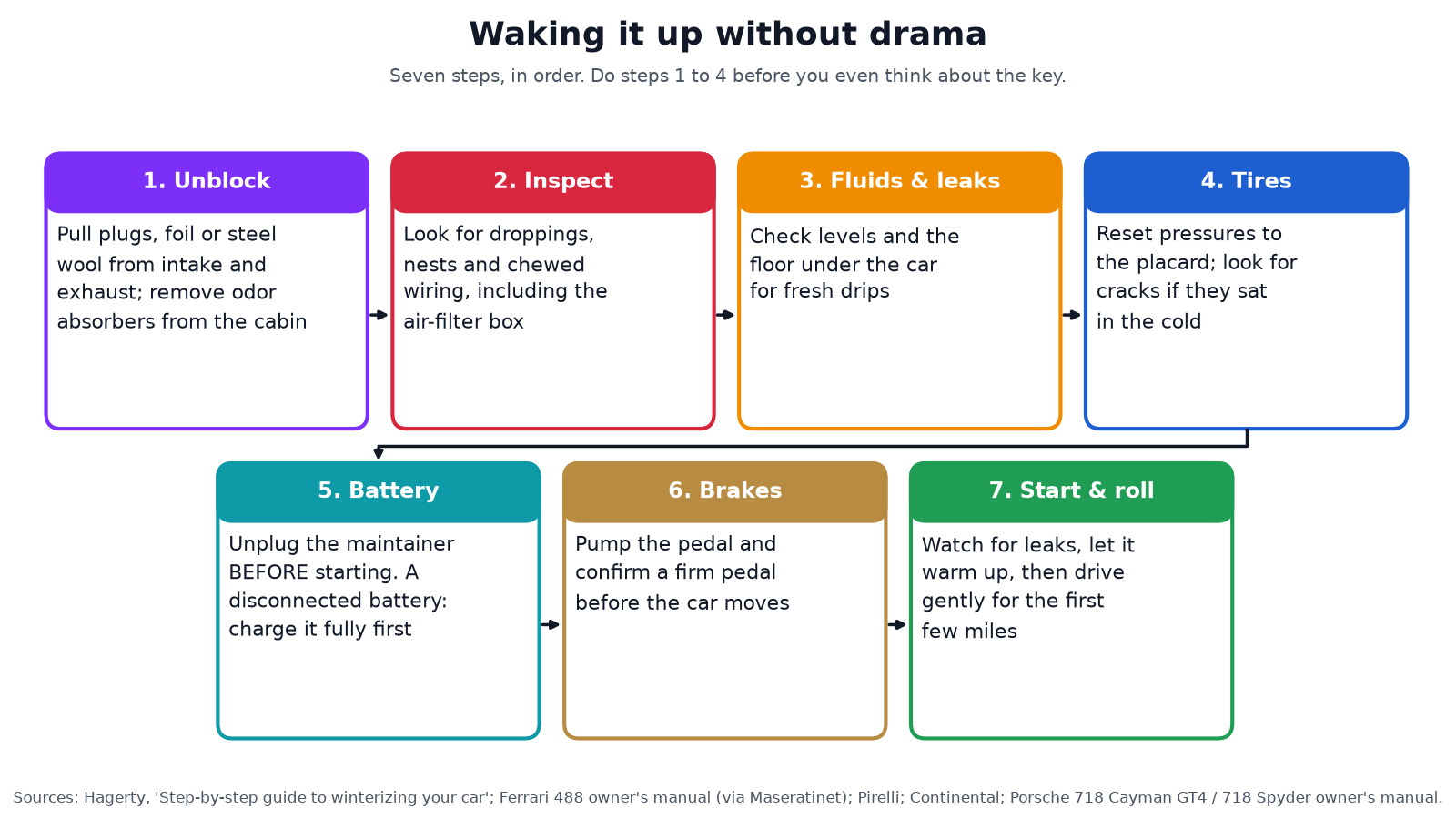
Spring arrives, the roads are dry, and you're itching to drive. Slow down for 15 minutes first. Hagerty's wake-up routine, plus a few exotic-specific details, looks like this:
- Unblock everything. Remove the steel wool, foil or plastic from the exhaust and intake, and pull any odor absorbers out of the cabin before they spill.
- Inspect. Look for droppings, nests and chewed wiring, including inside the air-filter housing.
- Check fluids and the floor. Check levels, and look under the car for fresh drips.
- Set the tires. Bring pressures back to the door placard, as Pirelli advises. If the car sat somewhere very cold on summer tires, look closely for cracks.
- Deal with the battery. If it was on a maintainer, unplug the maintainer before starting. Maseratinet notes Ferrari's 458 and 488 manuals say not to start the engine with the conditioner connected. If you disconnected the battery instead, Hagerty suggests a full 24-hour charge, and reconnecting the positive cable first.
- Check the brakes. Hagerty says to press the pedal and make sure you have a firm pedal before the car moves.
- Start, look, then roll. Start the car, check for leaks, let it warm up, and drive gently for the first few miles. Hagerty points out that some components, like transmissions, need movement for full lubrication, and Continental says temporary flat spots normally disappear once the tires warm up.
Should you start it during the winter?
This is the most argued-about question in car storage, and the experts genuinely disagree. Cauley Ferrari of Detroit tells customers to unplug the charger once a month, let the car idle for 20 minutes, take it around the block if the roads are dry, then plug it back in. Hagerty's writer takes the opposite view: unless you run the engine for a good 10-plus minutes at full operating temperature to burn off the water vapor that forms in a cold start, starting it is "not a good idea," because a short run leaves water in the combustion chambers and exhaust.
Notice what neither camp recommends: a 60-second start just to hear the engine. By Hagerty's logic, that makes condensation without getting anything hot enough to burn it off. Either commit to a proper warm-up drive or leave the car asleep on its maintainer.
The short version
Modern supercars drain their batteries while parked because they're full of electronics that never fully switch off, so plug in a maintainer that suits your battery chemistry, lithium included. Fill the tank, add stabilizer and drive the treated fuel through. Change the oil. Give the tires a little extra air, cradles or stands. Keep mice out and humidity down, and use a breathable cover on a clean, dry car. In spring, undo everything in order before you touch the starter. Your car will wake up like it only took a nap.
If you're shopping for something to put to bed next winter, this gray 2019 Ferrari 488 GTB with about 15,100 miles is currently listed on Exotics Group, and yes, it's one of the cars whose manual wants a conditioner on after a week.
Related reading
Worried about what cold storage does to rubber? Getting a Grip: Hot Rubber, Slip Angles and the Magic Formula Behind Supercar Tires explains why tire temperature matters so much. If your car wears film or a coating under that cover, Wrapped, Not Stirred: The Science of Vinyl Wraps, PPF and Ceramic Coatings on Supercars covers how to look after it. And for the wash-and-dry routine before the cover goes on, see Hot Air, Zero Swirls: Why MetroVac's All-Steel Dryers and Vacuums Belong in a Supercar Garage.
Getting the car ready for its long nap? The last wash matters more than any other, because whatever water you leave in the mirrors and panel gaps is going under the cover with it. The Exotics Group store carries MetroVac car dryers and vacuums for exactly that job: blowing out every hidden drip and vacuuming out every crumb a mouse might want.
Sources
- Battery Tender, Parasitic Battery Drain: How to Find and Fix It
- Maseratinet, How to Use a Ferrari Battery Conditioner (Ferrari 458, 488, California and F12 manual guidance)
- Maseratinet, Ferrari Battery Drain: Common Causes, First Checks, and the Right Way to Fix It
- Ferrari North America, Technical bulletin FNA 136, LaFerrari High Voltage and Low Voltage Batteries (June 2016, via NHTSA)
- FerrariChat, Bricked SF90 thread (owner quoting the SF90 manual)
- Lamborghini Huracan STO owner's manual, Battery section (via EasyManuals)
- McLaren Elva Owner's Handbook, Battery Care and Maintenance (via ManualsLib)
- Cannonball Garage, McLaren Charger: CTEK Lithium US
- Porsche Club of America, Porsche Maintenance Tasks You Can Handle at Home
- Prestige Imports, Winter Trickle Charging using the Porsche Battery Maintainer
- CTEK, CTEK Charger Stages: Understanding Them
- CTEK, LITHIUM US charger manual
- Hagerty, Step-by-step guide to winterizing your car
- Hagerty, The First Flakes Have Fallen: It's Time for Winter Storage Preparation
- Hagerty, Is your fuel stabilizer actually hurting your car?
- Hagerty, How to Rodent-Proof Your Car
- Continental, Flat-spotting
- Pirelli, How to store your tyres
- Race Ramps, FlatStoppers vs Tire Cradles: Keeping Flat Spots at Bay
- Porsche, 718 Cayman GT4 / 718 Spyder owner's manual (Japanese edition, Porsche Japan)
- Munters, Classic car storage
- Covercraft, Why We Don't Make "Waterproof" Car Covers
- Cauley Ferrari of Detroit, Common Q and A (winter storage)
- California DMV, Planned Nonoperation Filing
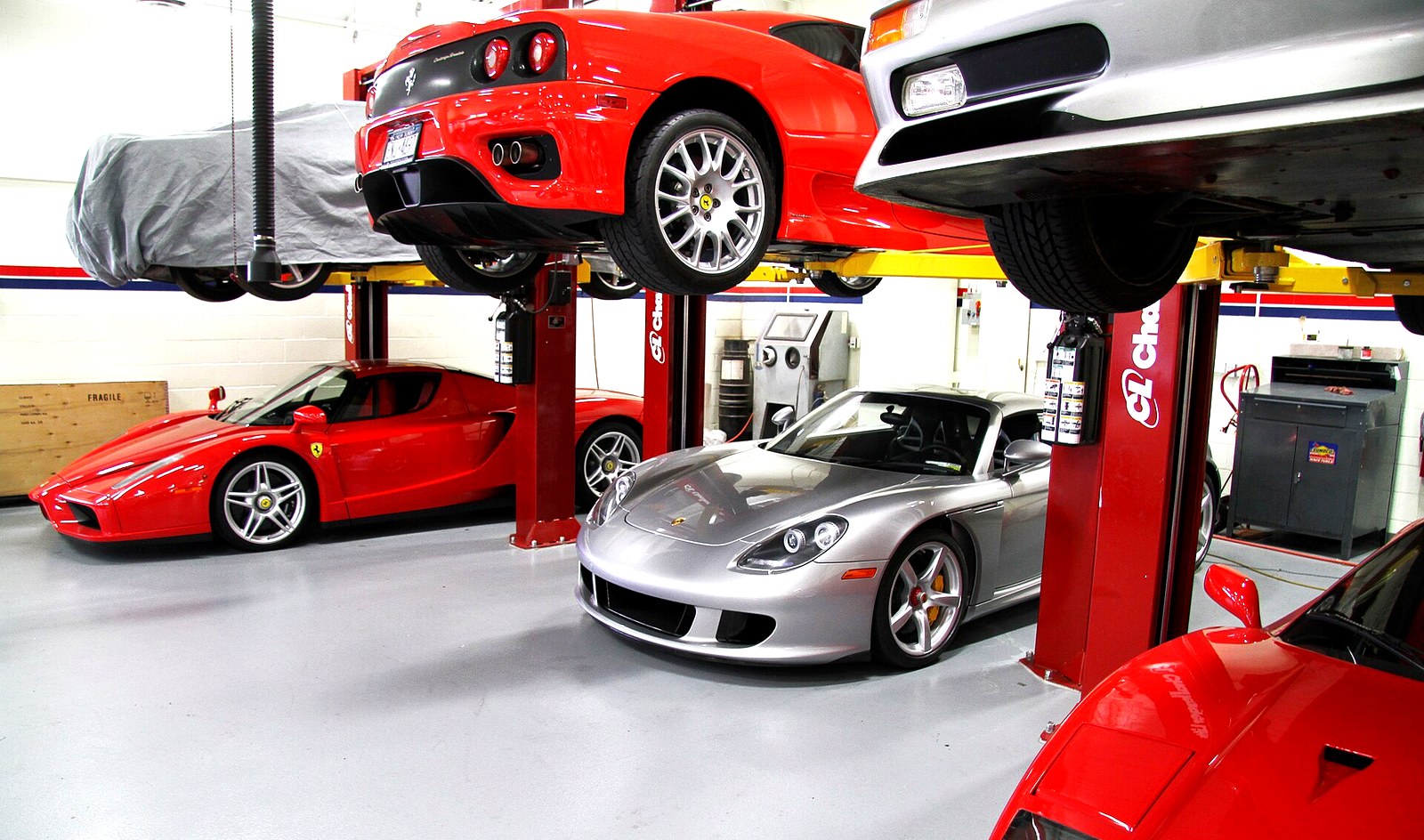
- Wikimedia Commons, Supercar Garage (Damian Morys, CC BY 2.0)
- Wikimedia Commons, McLaren 720S, Palm Beach (OWS Photography, CC BY 4.0)
- Wikimedia Commons, LaFerrari in Beverly Hills (Axion23, CC BY 2.0)
- Wikimedia Commons, Porsche 918 Wheel (Michelin LIVE UK, CC BY 2.0)
- Wikimedia Commons, Covered Ferrari 458 Italia, Paris (Mathious Ier, CC0)