 exoticsgroup.com
Read, Flagged, Stopped: What Flock Cameras and Signal-Tracing Tech Mean for Exotic-Car Owners

On June 28, 2026, auto journalist Joel Feder walked out of a Kohl's in Plymouth, Minnesota, got into the $155,000 Range Rover he was testing and found four police cars boxing him in. Officers told him the car's plate had been flagged as stolen and that Flock Safety cameras had tracked it for two days. The plate was not stolen. The Drive, where Feder works, has documented how a data-entry error, a partial-match alert and an unverified stop added up, and Plymouth has since voted to end its Flock contract.
Plate cameras are now a fixture of American roads, and a different vendor now pitches linking the phones and gadgets inside a car to its plate. For owners of cars that stand out, here is what these systems collect, how long they keep it, who can search it and where the law stands.
Key facts, as of November 19, 2026:
- Scale (Flock's figures): more than 120,000 cameras in 49 states and more than 20 billion plate scans a month, according to the company.
- Retention: Flock cut its default for new law enforcement customers from 30 days to 7 in August 2026. State limits range from 3 minutes in New Hampshire to 21 days in Virginia, Washington and Connecticut and 30 days in Missouri.
- Device tracing: SignalTrace, the system that correlates phone, Bluetooth and Wi-Fi signals with plate reads, is sold by Leonardo, an Italian defense group, not by Flock. We found no Flock product that detects personal devices. Leonardo has named no SignalTrace customers, but Prince George's County, Maryland, police say they are piloting it.
- Courts: a federal judge upheld Norfolk, Virginia's Flock network in January 2026. The appeal is pending at the U.S. Court of Appeals for the Fourth Circuit.
A Test Car, Four Squad Cars and a Plate That Wasn't Stolen
Feder's Range Rover wore a New Jersey manufacturer plate, 34 10 DTM, on which the middle two digits are printed smaller than the rest. According to The Drive's reporting, a similar plate, 34 03 DTM, had been lost by Land Rover during a photo shoot in California and reported stolen. It was entered into the FBI's National Crime Information Center (NCIC) database as just "34 DTM." The Drive reports the entry came from the Los Angeles County Sheriff's Department.
Flock's cameras pull wanted-plate lists from NCIC. Flock's chief communications officer, Joshua Thomas, told The Drive that, at law enforcement's request, the system alerts when the characters on a hot list appear on a plate, even if the plate carries additional characters, and that officers are trained to verify the full plate. These officers did not run it before the stop. Thomas said an alert "does not equal probable cause. It's like an alarm going off," and called the idea of distinguishing partial from exact matches "fair feedback."
Weeks later, Tim Esterdahl of Pickup Truck + SUV Talk was held for about an hour in Scotts Bluff, Nebraska, in a Range Rover Sport press car plated 34 08 DTM, The Drive reported.
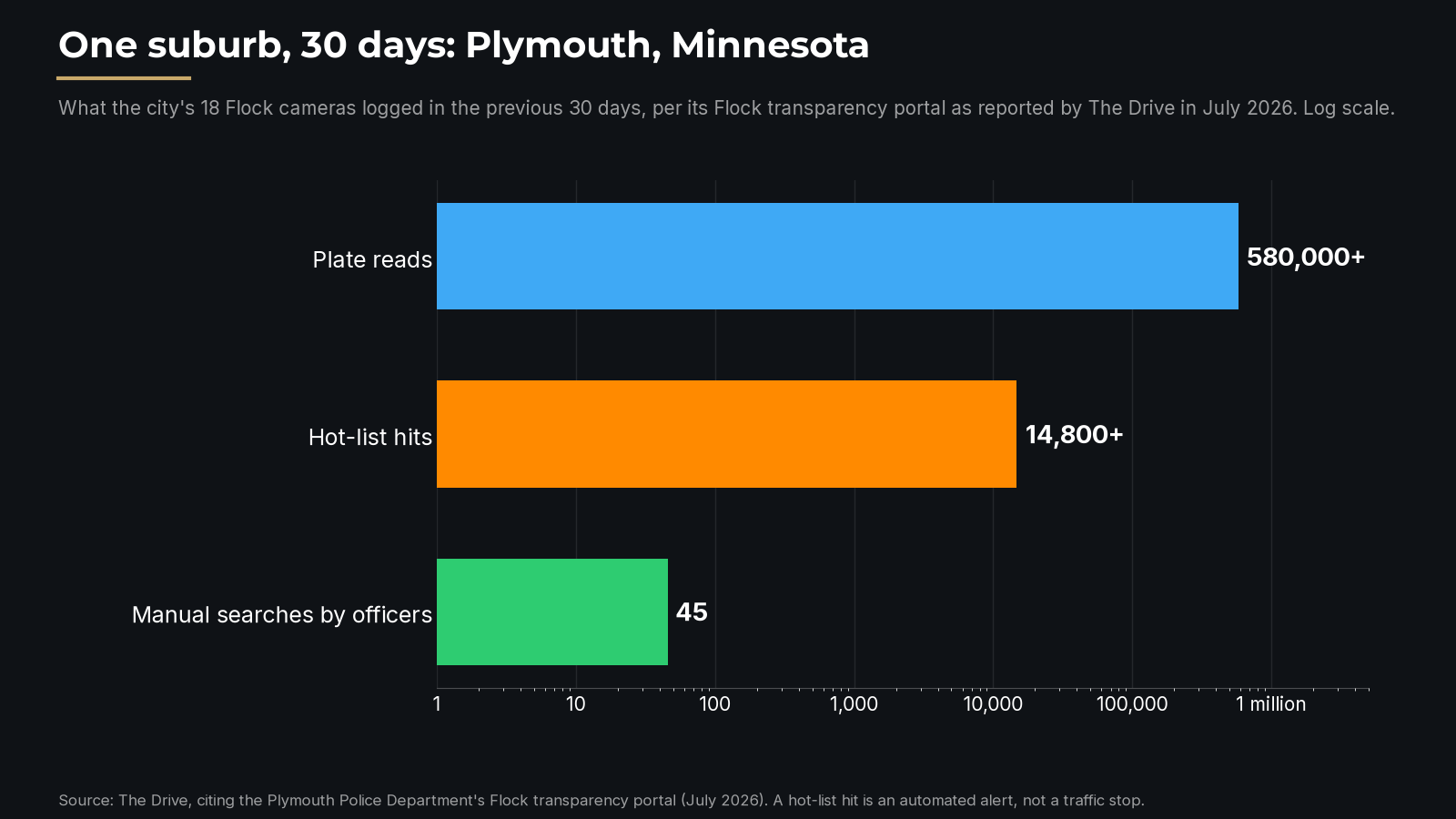
Plymouth Police Chief Erik Fadden told The Drive that "people sometimes make mistakes." Plymouth's Flock transparency portal, as reported by The Drive in July, showed that the city's 18 Flock cameras had logged more than 580,000 plate reads in the previous 30 days, along with more than 14,800 hot-list hits and 45 manual searches by officers.
In September 2026, the Plymouth City Council voted to cancel its Flock contract; Mayor Jeff Wosje cast the lone vote against canceling. Flock's position, in an August 13 statement from CEO Garrett Langley, is that "an alert is a lead, not a conclusion, which should be confirmed by an officer."
How Flock Cameras Work, and What They Can and Can't Collect
Plates and the "Vehicle Fingerprint"
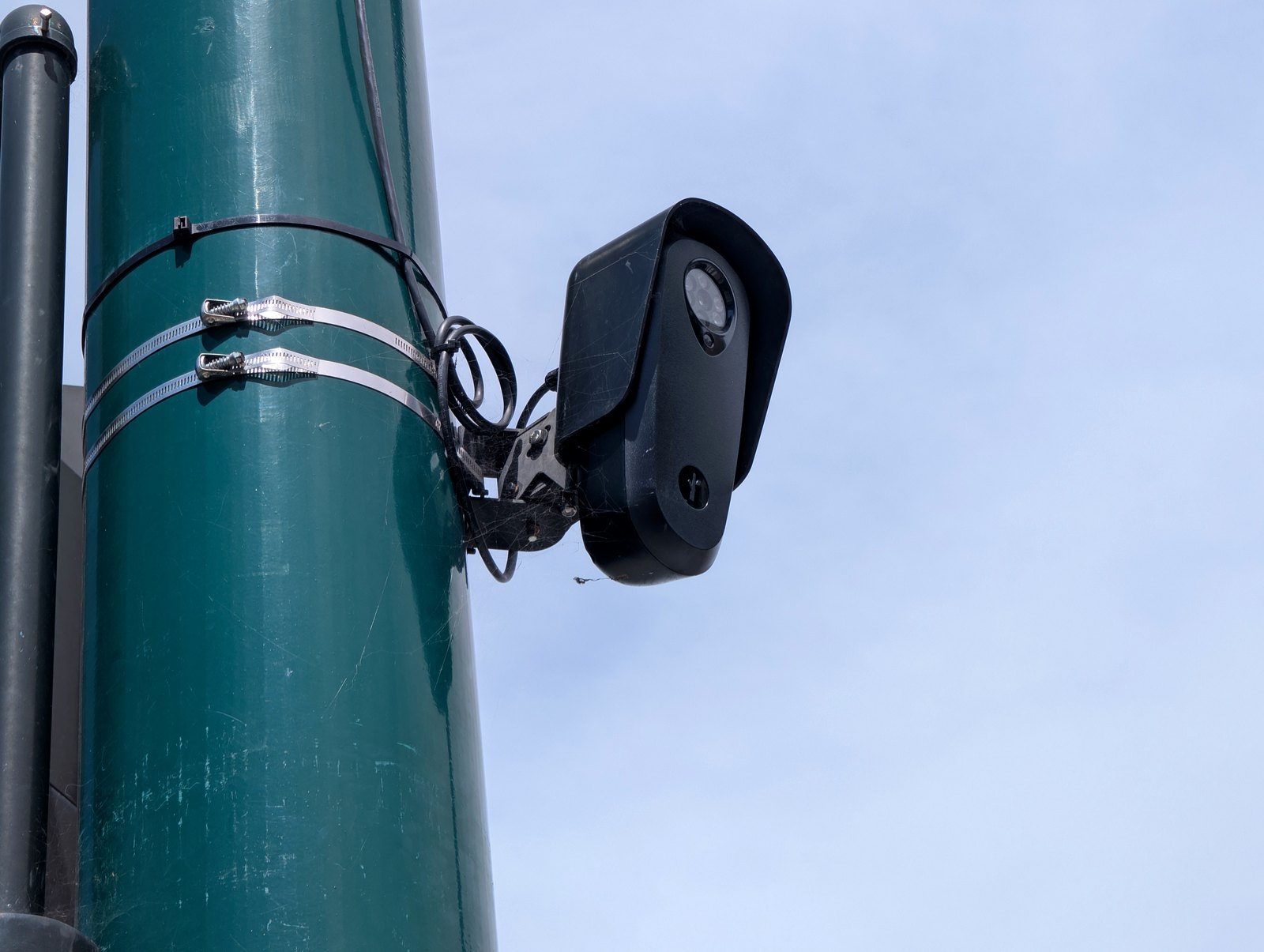
Flock's plate readers are compact, usually solar-powered pole cameras that photograph passing vehicles and read full, partial, temporary and missing plates along with the issuing state. Each image is also indexed by what Flock calls its Vehicle Fingerprint: make, body type, color, decals, bumper stickers, roof racks and toolboxes, according to Flock's product materials. Agencies can search by those attributes and receive alerts from NCIC, state lists and AMBER alerts. A Flock guide for security teams even advises recording "distinctive wraps" and finishes such as "matte, pearlescent, or metallic."
Flock says its plate cameras capture "visible vehicle characteristics, license plates, and related metadata such as location and timestamp information," that it does not use facial recognition and that it does not sell customer data.
How accurate are the reads?
Two figures circulate, and they measure different things:
- Alerts: Flock says its safeguards result in "fewer than 9 human-reported errors for every 1 million alerts." At a November 9 West Virginia legislative hearing, Flock's chief legal officer, Dan Haley, acknowledged that the figure is based on reports customers submit and that Flock has no other way to identify unreported false alerts, WV News reported.
- Reads: a Flock spokesperson told The Drive the system is "99% accurate." The Drive calculated that at 20 billion reads a month, a 1% error rate would mean 200 million misreads a month. That figure is The Drive's arithmetic, not a measured count.
Attribute matches can go wrong too. In San Diego, police looking for a red Alfa Romeo tied to an attempted carjacking arrested occupants of a different red Alfa Romeo after a Flock hit, though a Flock camera had photographed that car five miles away, 23 seconds after officers first tried to stop the suspect, the Times of San Diego and Ars Technica reported. One man, Hugo Parra, spent nearly a month in jail before the charges were dropped.
Beyond the plate: audio sensors
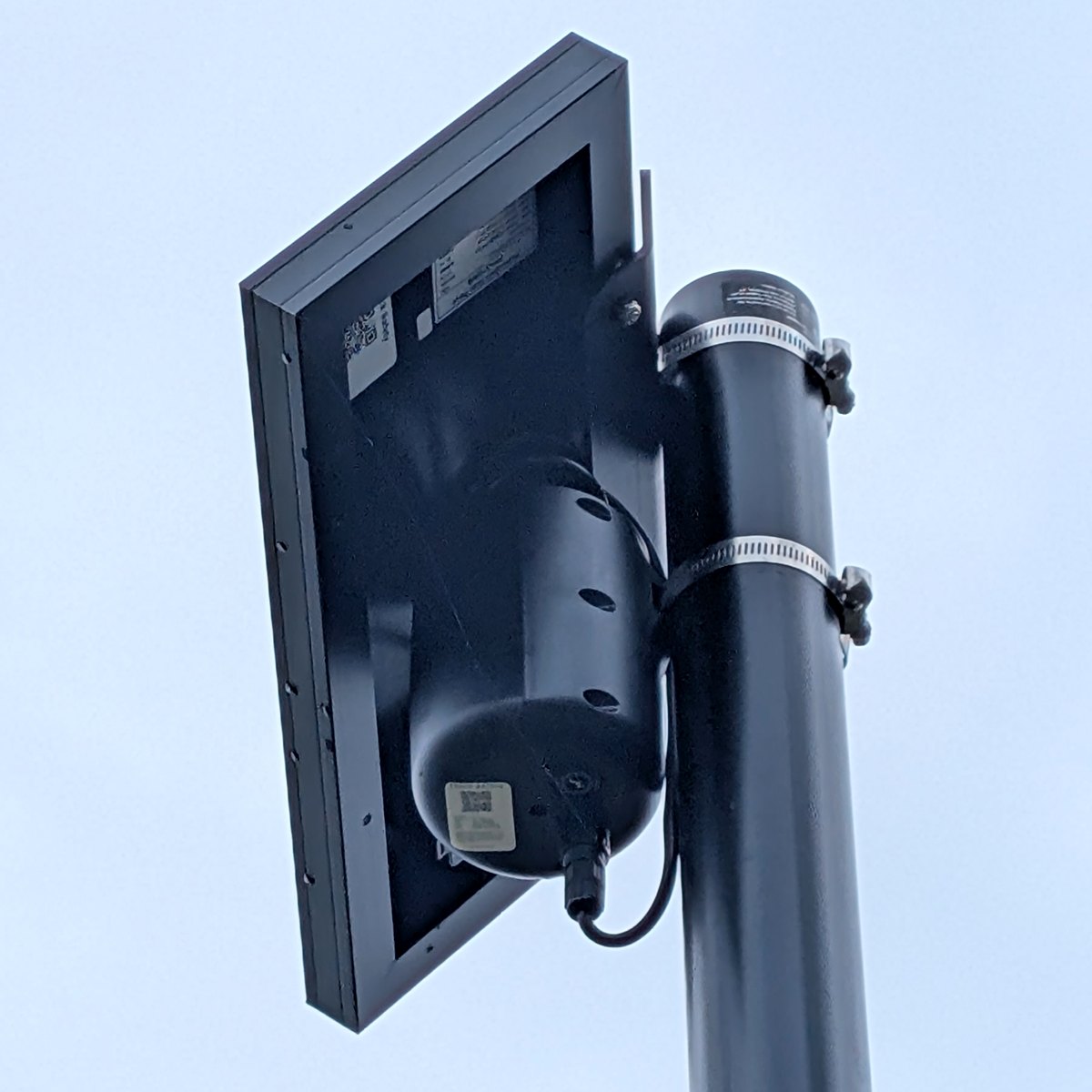
Flock also sells an acoustic sensor, formerly called Raven and now named Gunshot Detection. Flock says it keeps short clips only when it recognizes a qualifying event: gunshots, fireworks, vehicle crashes, screeching tires and sideshows. A confirmed event can surface vehicles nearby cameras saw. In July 2026, Flock dropped a pilot feature that listened for human distress such as screaming, which the Electronic Frontier Foundation, an advocacy group, had criticized.
Signal tracing: Leonardo's SignalTrace
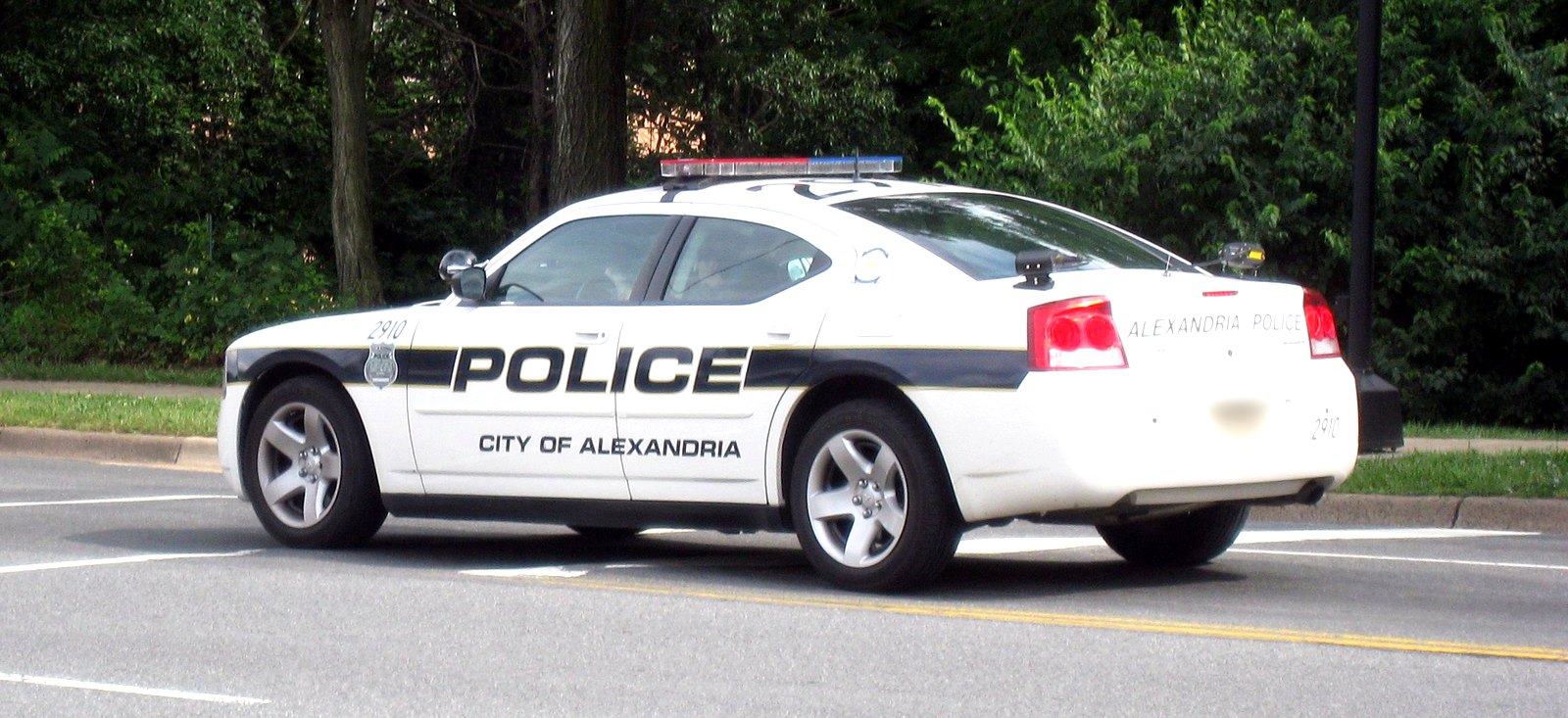
The "signal trace" idea in many recent headlines comes from a different company, Leonardo, not from Flock.
Who makes it. Leonardo S.p.A. is a Rome-based aerospace, defense and security group whose largest shareholder is Italy's Ministry of Economy and Finance, with a 30.2% stake, according to the company. Leonardo says it has more than 62,000 employees and 2025 revenue of €19.5 billion. Its U.S. plate reader business began in 2004 as a joint venture of Remington Arms and ELSAG Datamat, now part of Leonardo, which bought it out in 2008 and renamed it ELSAG North America. Its trunk-mounted Mobile Plate Hunter-900 was then used by more than 300 agencies in 28 states, Police Magazine reported. After a 2014 merger and a 2024 rename, the business is Leonardo U.S. Cyber & Security Solutions of Greensboro, North Carolina. It sells fixed, mobile and solar ELSAG readers and Enterprise Operations Center (EOC) software for searching their data, and it told Forbes in 2024 that it had more than 4,000 ELSAG customers in the U.S.
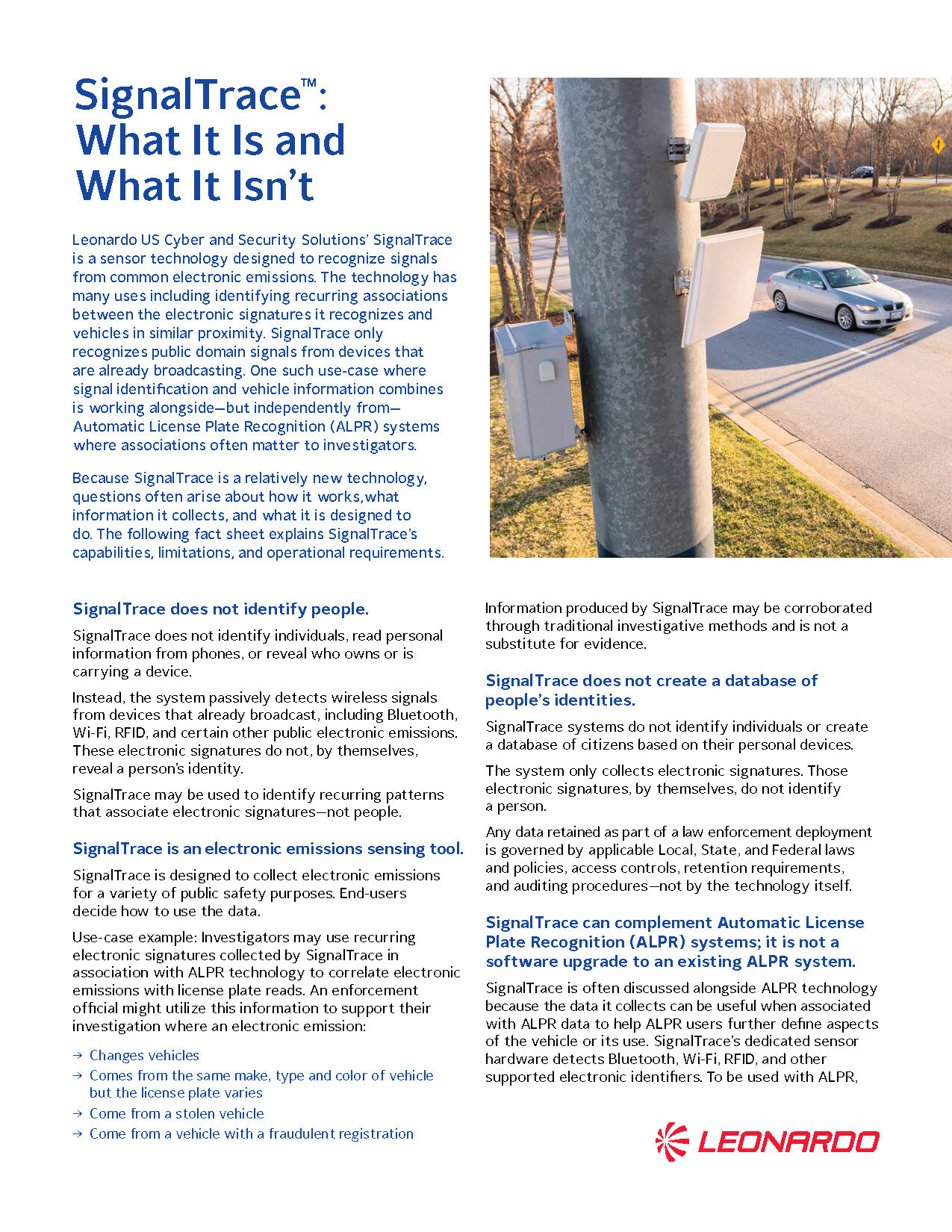
What Leonardo says SignalTrace does. The product began as EOC Plus, which Forbes described in 2024. 404 Media reported on its SignalTrace marketing in June 2026, and Leonardo announced the new name in a release posted in late July (its file is dated July 15) and sent on Business Wire on August 4. Leonardo's product page, spec sheet and fact sheet say:
- Signals: sensors passively detect publicly broadcast Bluetooth, Wi-Fi, RFID "and other supported wireless signals" from phones, wearables, headphones, laptops, vehicle hotspots, infotainment systems, "BT and RFID tire pressure sensors," key cards, asset tags and pet microchips.
- Signatures: software groups signals that "routinely travel together" into an "electronic signature" stamped with GPS location, date and time. Leonardo's example: "while 70 cars in 100 may contain iPhones, only one will have an iPhone 13rev2, an Audi radio, a pair of Bose headphones, a Garmin sports watch, and a key finder."
- Plates: with sensors beside plate readers, matching timestamps can show when a signature "changes vehicles" or turns up on a stolen car, a fraudulently registered car or a lookalike with a different plate. SignalTrace is separate hardware, "not a software upgrade to an existing ALPR system," and can also run alone in "rail stations, event venues, and shopping centers."
- Storage and privacy: data goes to the EOC server, which "simply stores data until a specific request is made." Leonardo says retention and access are set by law and agency policy, "not by the technology itself," and that SignalTrace "does not identify people" or "decrypt or read the contents of the devices." We found no published retention period or detection range.
- Hardware and price: the fact sheet shows two flat panel antennas and a control box on a roadside pole. A June 2025 Texas Department of Information Resources price list posted by Leonardo lists an "EOC Plus FCU" at $16,153.85 list ($10,500 contract price) plus an annual license at $2,769.23 list ($1,800).
Who uses it. In 2024, Leonardo told Forbes the product had no paying customers and at least one customer was testing it; it has named no SignalTrace customers. Ryan O'Horo, an independent security researcher who studies plate readers, has published photos of what he identifies as SignalTrace antennas operated by Prince George's County police in Oxon Hill, Maryland, and an invoice he says shows Calvert County, Maryland, buying two units in 2023. In October, the Prince George's County Police Department told the Baltimore Sun it is piloting SignalTrace, and the Harford County Sheriff's Office said it plans to use the system but is still researching it, with no deployment timeline. Leonardo told CyberGuy the product is in the early stages of adoption with a limited number of deployments, and did not say how many. We could not independently confirm the Calvert County purchase.
What critics and researchers say.
- Technical limits: O'Horo argues the marketing "oversells its capabilities." Apple and Android phones use private Wi-Fi addresses by default, Bluetooth LE Privacy lets manufacturers rotate broadcast addresses, devices transmit only intermittently and a car at 50 mph crosses a sensor's zone in under a second. He believes the hardware can likely read Wi-Fi, Bluetooth and some RFID tags, possibly many toll transponders, but not most tire pressure sensors, and works best on cars that pass the same sensors repeatedly.
- Identification by association: Nicole M. Bennett, an Indiana University researcher, wrote in The Conversation that a nameless signature can become identifying once police link it to a registered car or a home, and that the system "cannot know why people were close to each other." A borrowed phone or a regular passenger can draw someone into an investigation.
- Advocacy groups: the Electronic Frontier Foundation's Matthew Guariglia told Forbes in 2024 the technology is "ripe for abuse" and called such tools "Stingrays by another name," a reference to cell-site simulators. The ACLU of Northern California wrote in August that SignalTrace would let police track drivers, passengers and pedestrians "without a warrant."
- Leonardo's response: its spokesperson told Forbes that features can be switched off where an agency may not collect them without a warrant. "We're not going in and decrypting anything, these are just the signals in the air," he said.
The legal question. We found no court ruling on roadside device-signal sensors. In June 2026, the Supreme Court held 6-3 in Chatrie v. United States that police conducted a Fourth Amendment search when they obtained a suspect's Google location history, building on its 2018 Carpenter decision. Bennett notes the ruling does not decide whether collecting signals that devices broadcast into the open air is also a search. Techdirt, an opinion site, argues that the "anyone can see a plate" rationale does not extend to device identifiers.
How it compares with Flock. Flock's documentation describes cameras that photograph vehicles, not radios that log phones. We found no Flock product that detects phones, Wi-Fi or Bluetooth devices, and no public Flock statement about SignalTrace. The closest is Flock Nova, which searches agency records, public records and plate data by name, phone number, address or vehicle, a database search rather than radio detection.
For a closer look at the signals a car and its occupants give off, and what SignalTrace can and can't link, see Exotics Group contributor Alex Rivera's explainer, Radio Silence Not Included: How SignalTrace Listens to the Signals Your Car and Phone Give Off.
Who Runs the Cameras, and How Big the Network Is
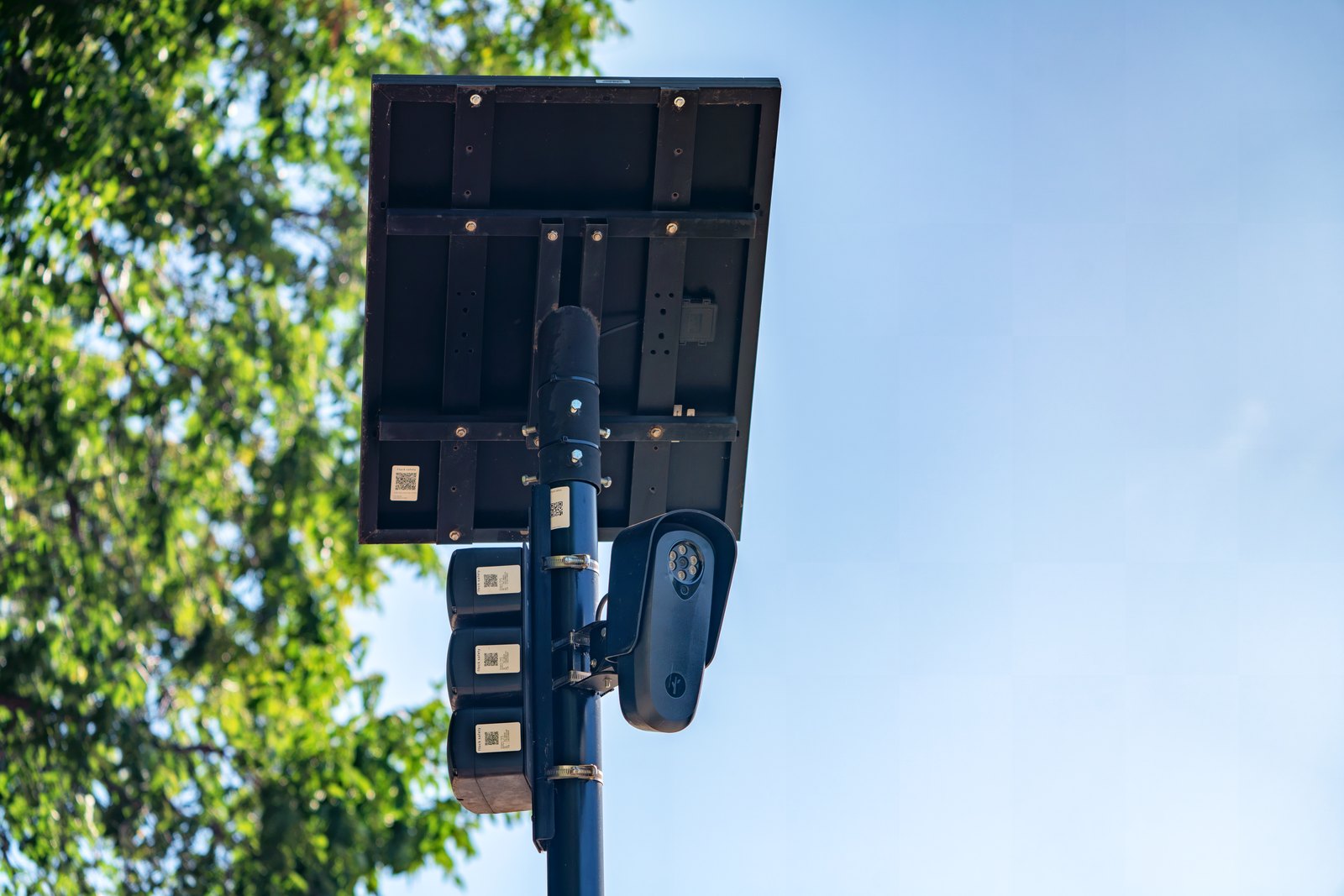
Flock, founded in 2017, says it has more than 120,000 cameras in 49 states performing more than 20 billion plate scans a month. At the West Virginia hearing, Haley estimated that Flock has about 6,000 law enforcement customers, about 3,000 of them in its voluntary nationwide sharing network. Businesses and homeowners associations also buy cameras and can share data with police. Flock raised $275 million at a $7.5 billion valuation in March 2025, TechCrunch reported.
Flock says its technology assists in "more than one million crimes solved annually," a company figure.
Flock offers one-to-one, statewide and national sharing, and says sharing is off by default and customers decide who sees their data. In August 2026 it added "offense filtering," which lets a city allow outside searches for, say, a stolen car while blocking searches related to immigration enforcement.
How Long Reads Are Kept and Who Can Search Them
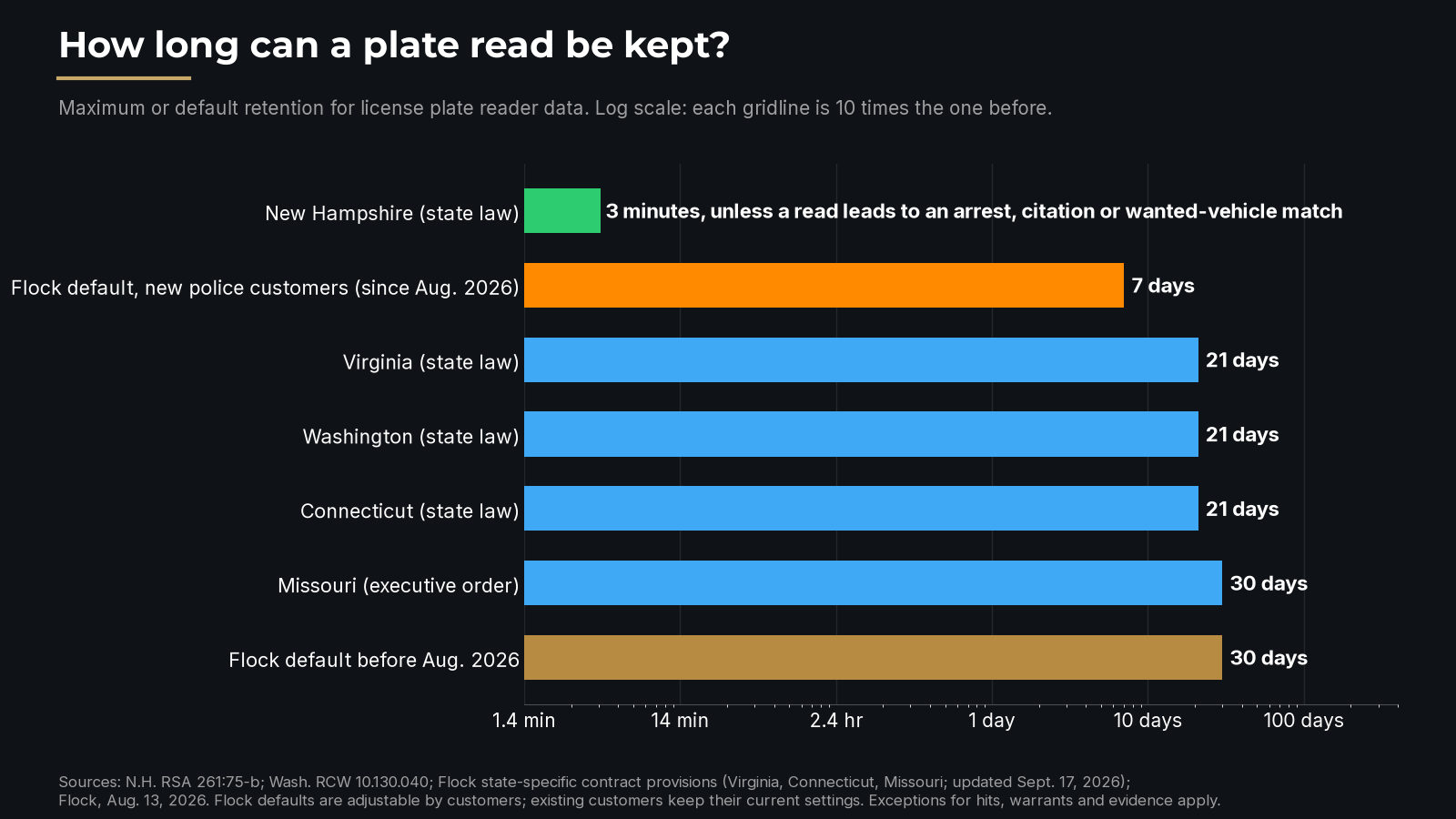
On August 13, 2026, Flock lowered its default retention for new law enforcement customers from 30 days to 7. Existing customers keep the periods they already set. Washington caps most plate reader data at 21 days. Virginia and Connecticut law set 21-day limits that Flock writes into its contracts there, and Flock's Missouri contracts carry a 30-day limit under a 2026 executive order. New Hampshire requires reads to be purged within three minutes unless a read leads to an arrest, a citation or protective custody, or identifies a vehicle tied to a missing-person or wanted broadcast.
Flock also said it would require case codes for every law enforcement search by the end of 2026; at the West Virginia hearing, Haley said the requirement takes effect beginning in January. Its "Audit Assistance" tool, which flags abnormal search activity, becomes mandatory, and Flock says multifactor authentication is now required for all users. The ACLU, an advocacy group, said the changes appear "more focused on addressing a perceived PR problem than the significant harms its products create," The Verge reported.
Reported misuse
- Personal searches: CNN reported that court documents show a former Milwaukee police officer searched the location of his romantic partner 124 times.
- Immigration and out-of-state lookups: in 2025, 404 Media reported that local police ran national lookups on behalf of immigration enforcement and that a Texas officer searched cameras nationwide for a woman who had self-administered an abortion.
- Illinois audit: in August 2025, Illinois Secretary of State Alexi Giannoulias said an audit found Flock broke state law by giving U.S. Customs and Border Protection access to Illinois data during a pilot, Capitol News Illinois and NBC Chicago reported. Flock disputed his legal conclusions but paused its federal pilots.
- Stale alerts: Milwaukee-area driver Amber Newell was stopped at gunpoint twice in 2026 over an alert police failed to clear, WTMJ reported.
The Institute for Justice, an advocacy law firm, counts at least 27 cases since 2018 in which plate reader errors led to wrongful stops or arrests, about one-third of them machine misreads and the rest human error.
The Legal and Political Debate
The leading federal case is Schmidt v. City of Norfolk. Two residents, represented by the Institute for Justice, argued that Norfolk's warrantless network of about 176 Flock cameras violates the Fourth Amendment; one plaintiff's car had been recorded 475 times in four months. On January 27, 2026, U.S. District Judge Mark S. Davis granted the city summary judgment, writing that "the limited number of photographs available on a 21-day rolling basis from 75 camera clusters in Norfolk does not 'track' the whole of a person's movements." A Flock spokesperson told NBC News that such counts are misleading because cameras can take several photos of one car in a second. The plaintiffs appealed to the Fourth Circuit (No. 26-1227). The case was tentatively calendared for the court's December 2026 session, but no argument date is final and the court has not ruled.
Local governments have gone both ways:
- Ending or curbing contracts: Denver declined to expand its Flock contract in May 2025, and Oak Park and Evanston, Illinois, ended their programs. TechCrunch counted at least 10 local governments that moved to curb or end Flock use between this summer and early November, and on November 10, Perris, California, voted to suspend its contract. On November 16, the San Diego City Council voted unanimously to end the city's use of license plate readers, KPBS reported, and on November 17, Santa Ana, California, voted to end its contracts with Flock and Motorola Solutions, the Los Angeles Times reported.
- Keeping or restoring them: on November 11, Lowell, Massachusetts, reinstated its program. In Perris, Mayor Michael Vargas voted against suspension, saying, "This is not an immigration tool."
The scrutiny crosses party lines: Sen. Josh Hawley (R-Mo.) opened an investigation in August, and Sen. Ron Wyden (D-Ore.) has also pressed the company. West Virginia legislators hope to have a bill ready when their session opens in January. Flock's CEO has called misuse "completely unacceptable" and backs state audit requirements, CNN reported.
This article is for general information and is not legal advice.
Why It Matters If You Drive Something Distinctive
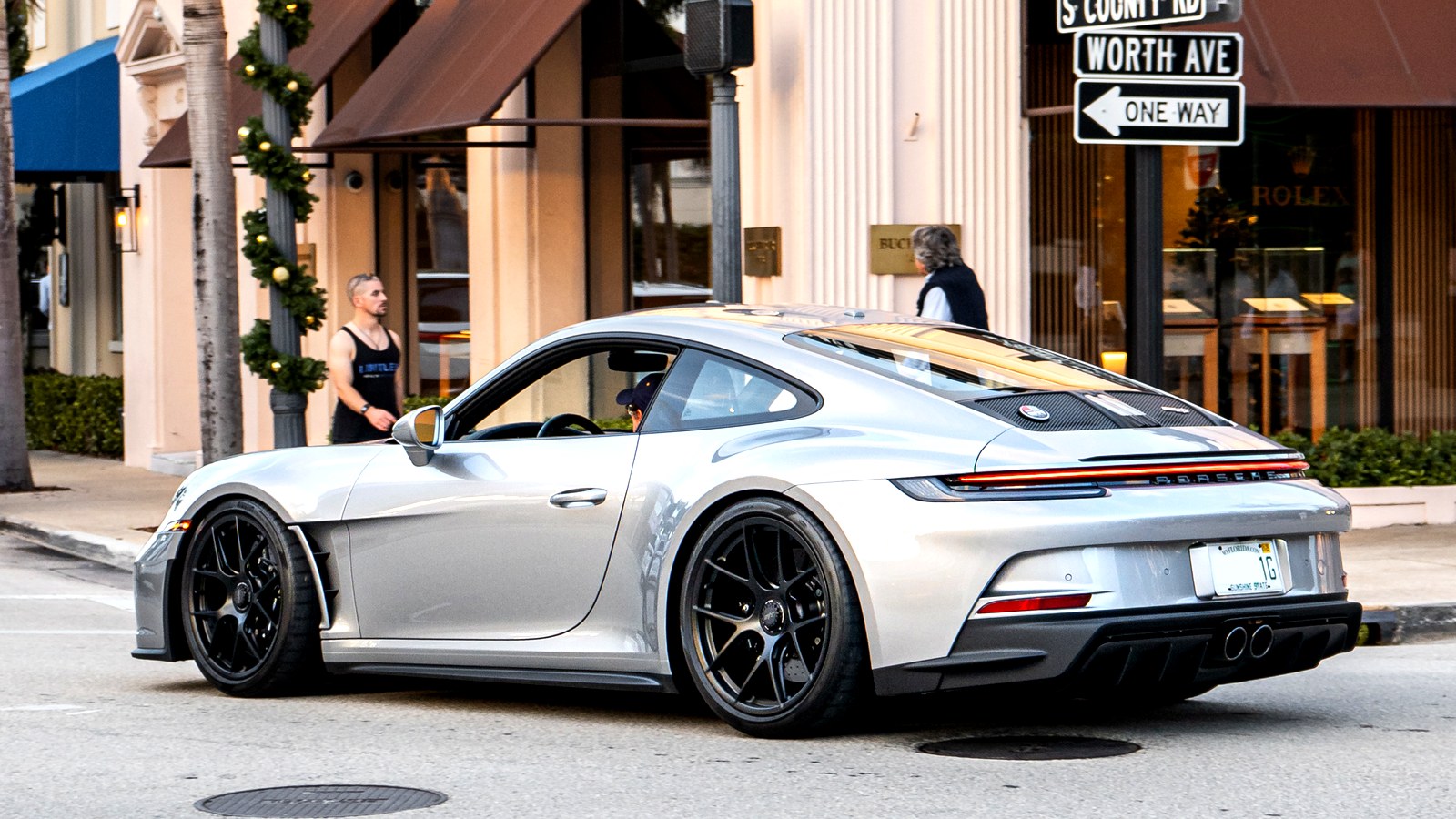
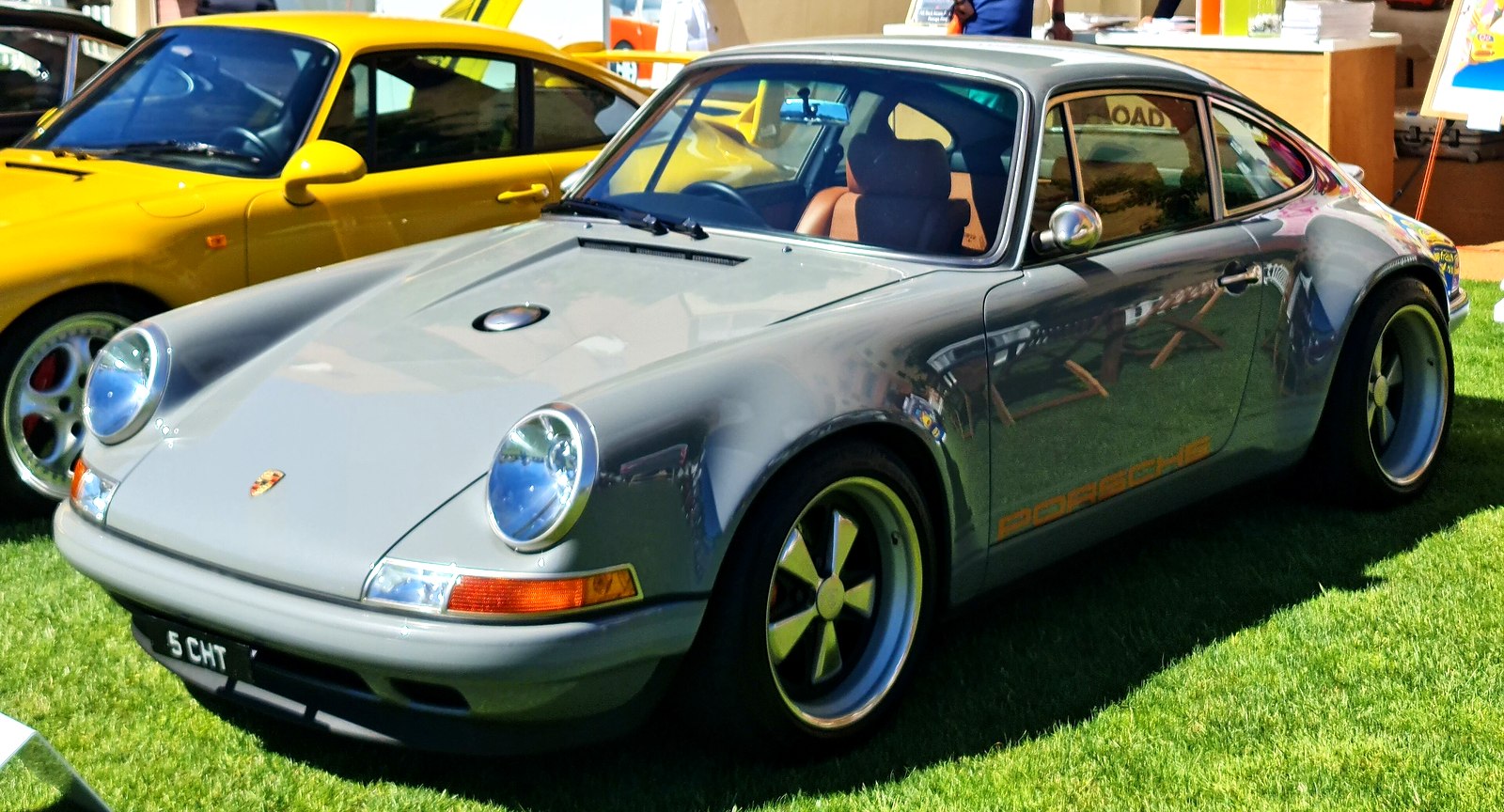
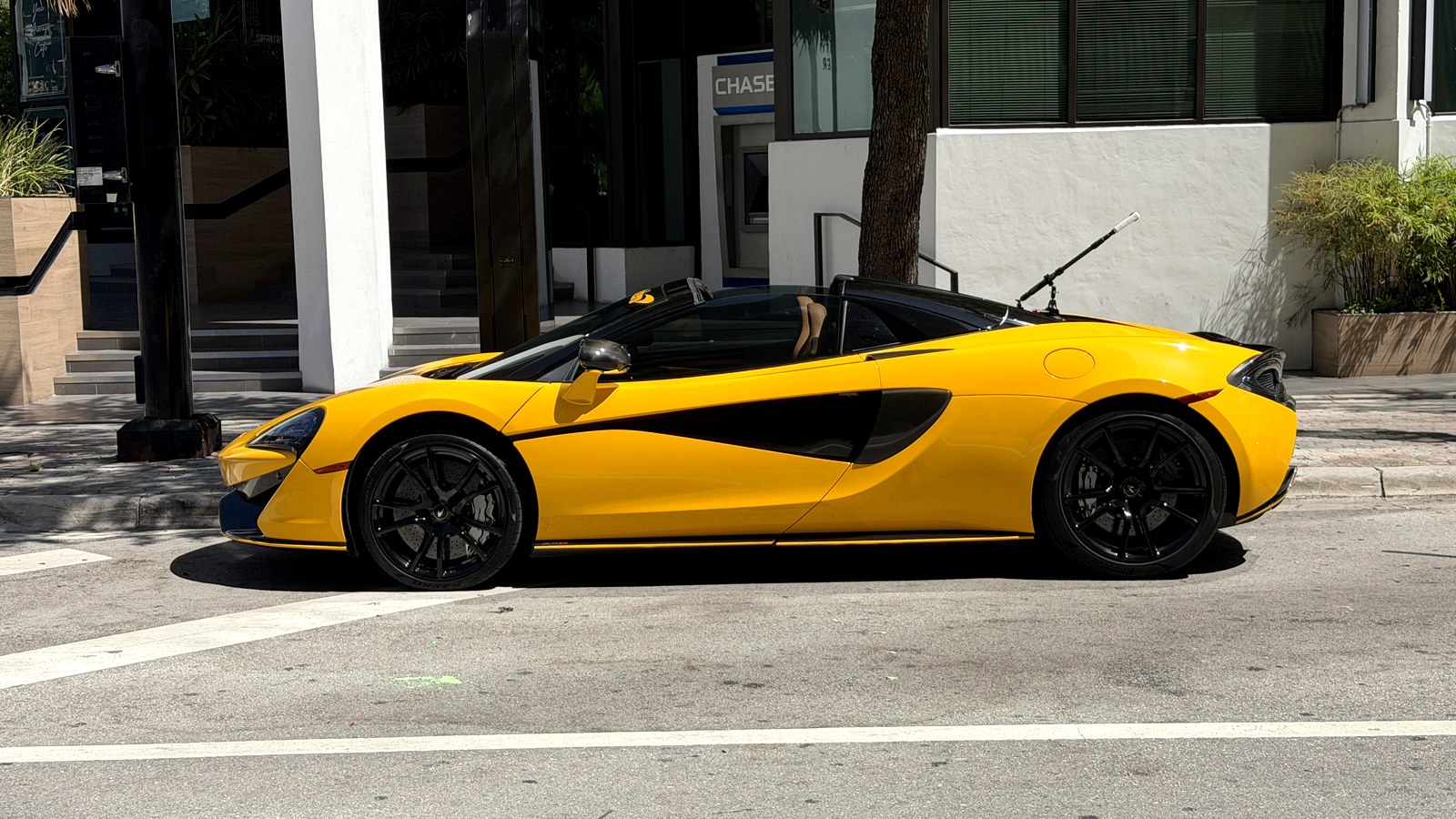
- Attribute search favors rare cars. A camera that indexes make, color, decals and racks narrows a search quickly when the target is one of a few of its kind in town. As the San Diego case shows, a lookalike can get caught in that net too.
- Unusual plates are where partial matches bite. Manufacturer, dealer, temporary and out-of-state plates use formats officers see less often. Both Range Rover stops involved manufacturer press plates, and the Institute for Justice lists a Kansas case in which a camera failed to distinguish temporary from permanent plates.
- Group drives produce repeat reads. A convoy passing the same intersections generates many plate reads in a short window. Leonardo markets SignalTrace's ability to reveal signatures "frequently traveling together," and its spec sheet's sample case begins with "a routine convoy analysis." We found no comparable Flock feature.
- Your car broadcasts too. Leonardo lists vehicle hotspots, infotainment systems and tire pressure sensors among the signals SignalTrace observes, and phones and watches ride along. How much a roadside sensor can capture from a moving car is disputed.
- Car culture is in the audio categories. Flock's acoustic sensors flag screeching tires and sideshows.
- The records are partly public. More than 1,500 agencies publish a Flock transparency portal listing their retention period, sharing partners and search activity, according to Flock.
Flock, Plymouth's police chief and New Hampshire's statute all point to the same safeguard: an alert is only a starting point, and an officer is expected to confirm it before acting. Whether that safeguard is enough is the question cities, legislatures and the Fourth Circuit are now weighing.
If you are planning time behind the wheel with other enthusiasts, Exotics Group's next rally is The Syndicate Run, a points-based team rally with clues and checkpoints, set for September 24 to 26, 2027. Entry is $1,995 per car for a driver and co-driver through the April 30 early-bird deadline. Members, registration is open. Create a free account to register.
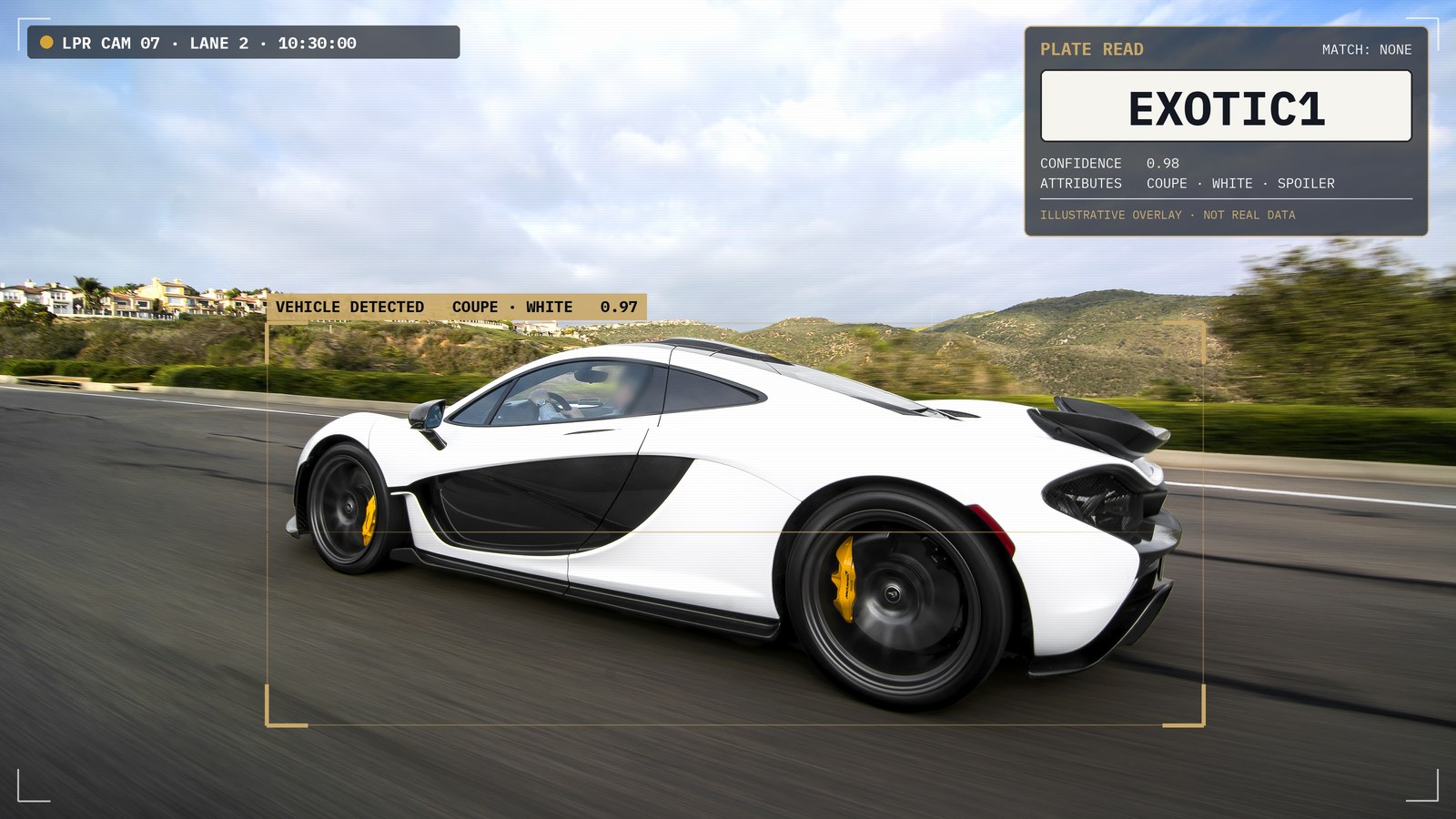
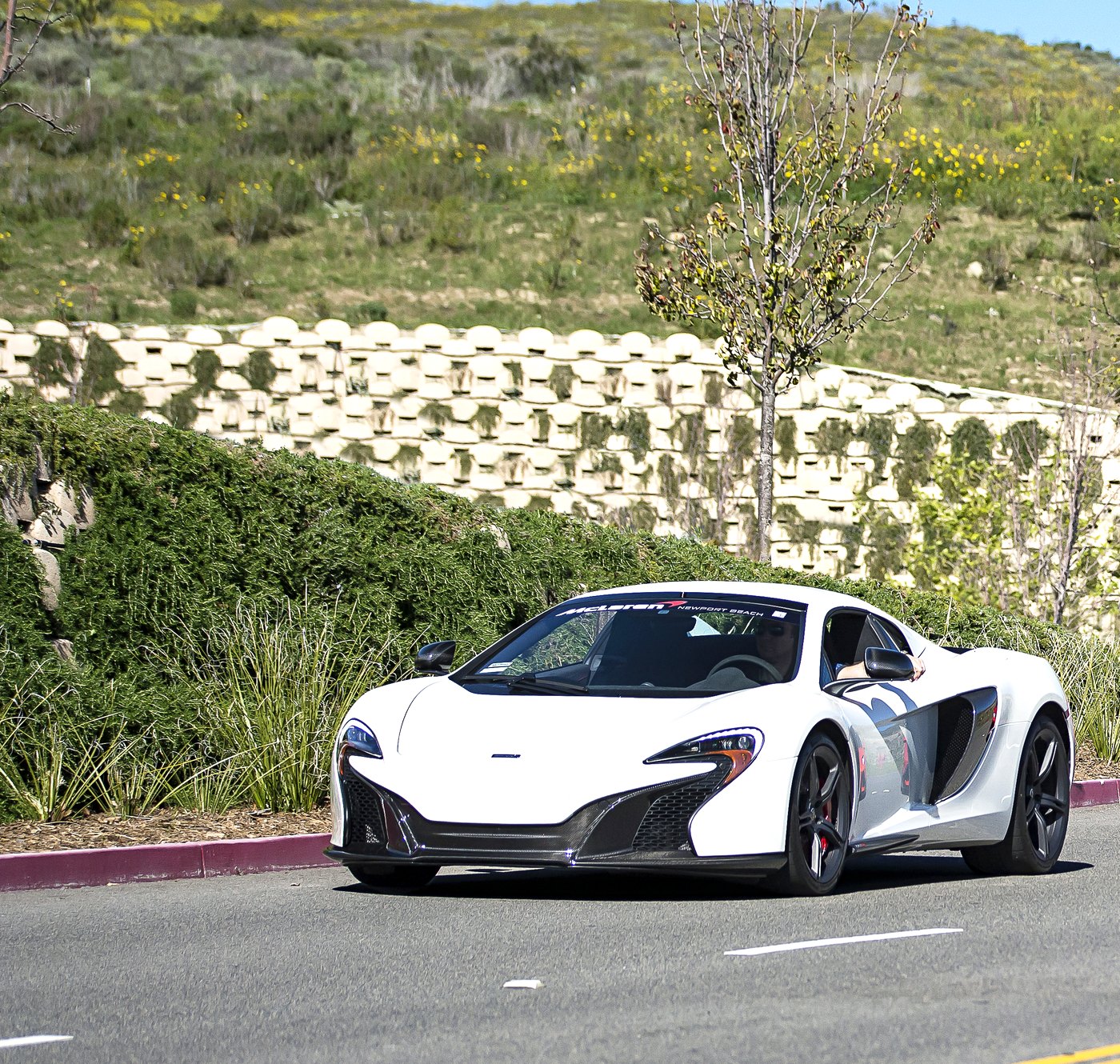
Lead photo: a McLaren P1 on the road in Newport Coast, California, February 2015, with an illustrative license plate reader overlay added by Exotics Group (the plate and readings are fictional, not real data). Photo: Axion23, CC BY 2.0, via Wikimedia Commons, cropped and adjusted, driver blurred, overlay added.
Related Reading
For the device-signal side of this story, read Alex Rivera's companion explainer, Radio Silence Not Included: How SignalTrace Listens to the Signals Your Car and Phone Give Off.
Color and finish are attributes plate cameras index. For how wraps, paint protection film and ceramic coatings change a car's look, see Wrapped, Not Stirred: The Science of Vinyl Wraps, PPF and Ceramic Coatings on Supercars. For a group drive done right, see Escape Velocity: A Daylight Drive Out of Las Vegas During SEMA Week.
#FlockSafety #LicensePlateReaders #Privacy #CarCulture #PlymouthMN
Sources
- The Drive: How Flock Cameras Wrongly Tracked Me for Days Over 'Stolen' Plates and Sent Police After Me
- The Drive: Flock Says Its Cameras Worked 'Correctly' When Police Tracked and Ambushed Me for No Reason
- The Drive: My City Just Banned Flock After My Wrongful Stop Made National News
- The Drive (YouTube): Flock sent police after us. So we went after Flock (November 12, 2026)
- FOX 9: Flock camera error leads to Minnesota car reviewer being swarmed by cops
- Flock Safety: Flock Updates Privacy, Accountability, Security, and Transparency Safeguards (August 13, 2026)
- Flock Safety: What Flock's Privacy and Security Updates Mean for Private Sector Customers
- Flock Safety: Vehicle Recognition Software for Investigation-grade LPR
- Flock Safety: How to Find a Car Without a License Plate Number
- Flock Safety LPR product sheet (City of Sweeny, Texas, council packet)
- Flock Safety: Answering Common Questions About Flock
- Flock Safety: How Flock's Gunshot Detection Works
- Flock Safety: Flock Nova Will Not Supply Dark Web Data
- Flock Safety: State-Specific Contractual Provisions
- Electronic Frontier Foundation (advocacy): Victory! Flock Ends Rollout of Audio "Distress Detection" of Human Voices
- Leonardo: ELSAG SignalTrace product page
- Leonardo U.S. Cyber & Security Solutions: press release introducing SignalTrace (dated July 15, 2026)
- Ryan O'Horo: Thinking Critically About SignalTrace
- Leonardo: ELSAG SignalTrace Intelligence System spec sheet
- Leonardo: SignalTrace: What It Is and What It Isn't (fact sheet)
- Business Wire: Leonardo US Cyber & Security Solutions Introduces SignalTrace (August 4, 2026)
- Leonardo: DIR-CPO-4756 price list, Texas Department of Information Resources (June 2025)
- Leonardo: Shareholders Base
- Leonardo U.S. Cyber & Security Solutions: ALPR About Us
- Police Magazine: ELSAG North America Formed by ELSAG Datamat's Acquisition of Remington ELSAG Law Enforcement Systems (April 4, 2008)
- Forbes: New Police Tech Can Detect Phones, Pet Trackers And Library Books In A Moving Car (May 14, 2024)
- 404 Media: This Company Will Add Phone, AirPod, and Smartwatch Trackers to License Plate Readers (June 8, 2026)
- The Conversation: New tech adds phone tracking to license plate readers, associating devices with identifiable cars (August 11, 2026)
- ACLU of Northern California (advocacy): License Plate Readers Were Already a Privacy Nightmare. Then Came SignalTrace. (August 13, 2026)
- Techdirt (opinion): Surveillance Tech Company Is Pitching An Unholy ALPR/Stingray Hybrid To Law Enforcement
- Apple Support: Use private Wi-Fi addresses on Apple devices
- Android Open Source Project: MAC randomization behavior
- Bluetooth SIG: Bluetooth technology protecting your privacy
- Supreme Court of the United States: Chatrie v. United States, No. 25-112 (June 29, 2026)
- WV News: Flock Safety officials face tough questions from West Virginia lawmakers (November 9, 2026)
- WSAZ: Lawmakers call Flock Safety representatives back for second meeting
- Ars Technica: Man jailed for a month despite Flock showing he was 5 miles from crime scene
- Times of San Diego: A Flock license plate reader linked a San Diego man to a violent crime. He was five miles away
- Institute for Justice (advocacy; counsel for the Norfolk plaintiffs): Dozens of Innocent Motorists Have Been Pulled Over, Detained at Gunpoint, or Jailed Due to AI License Plate Camera Errors
- Fox News: Hawley investigates Flock Safety (August 26, 2026)
- Boston Globe: Lowell city council reinstates Flock camera program (November 11, 2026)
- NBC News: Flock police cameras scan billions per month, sparking protests
- TechCrunch: Flock Safety raises $275M at $7.5B valuation (March 13, 2025)
- CNN: Flock rolls out new police auditing and accountability controls (August 13, 2026)
- The Verge: Flock CEO: 'We got this one wrong'
- 404 Media: ICE Taps into Nationwide AI-Enabled Camera Network, Data Shows
- 404 Media: Flock Removes States From National Lookup Tool After ICE and Abortion Searches Revealed
- Capitol News Illinois: Hundreds of police departments use camera company accused of breaking state law
- NBC Chicago: Flock violated Illinois law by sharing data with federal agency, Giannoulias says
- WTMJ: Woman demands answers after old MPD Flock camera alert leads to second gunpoint stop
- Washington State Legislature: RCW 10.130.040, Retention
- New Hampshire General Court: RSA 261:75-b, Use of Number Plate Scanning Devices Regulated
- U.S. District Court, E.D. Va.: Schmidt v. City of Norfolk, opinion and order (January 27, 2026), via Justia
- The Record: Judge dismisses case alleging use of Flock cameras in Virginia city is unconstitutional
- CourtListener: Lee Schmidt v. City of Norfolk, No. 26-1227 (4th Cir.) docket
- Recording Law: Federal Appeals Court Weighs Whether Norfolk's Flock License Plate Camera Network Violates the Fourth Amendment
- Axios Denver: Denver City Council rejects controversial license plate reader extension
- TechCrunch: At least 10 local governments have moved to drop Flock's surveillance cameras since summer (November 5, 2026)
- KVCR: Perris council votes to suspend a two year, $615,000 contract with Flock Safety (November 11, 2026)
- KPBS: San Diego City Council votes unanimously to end use of Flock (November 16, 2026)
- Los Angeles Times: Santa Ana suspends its Flock license plate reader camera system (November 18, 2026)
- Baltimore Sun, via WBFF Fox45: Beyond license plates: Maryland police eye tech that picks up Bluetooth, Wi-Fi (October 26, 2026)
- CyberGuy: SignalTrace can link device signals to your car
- Exotics Group (Alex Rivera): Radio Silence Not Included: How SignalTrace Listens to the Signals Your Car and Phone Give Off
- Wikimedia Commons: White McLaren P1 on the Road (16427919798).jpg (Axion23, CC BY 2.0)
- Wikimedia Commons: Flock ALPR in Hayward, CA, at B St & Foothill Blvd (June 2026).jpg (RailTypes, CC0)
- Wikimedia Commons: Flock Safety Raven gunshot detector.jpg (Kobenon, CC0)
- Wikimedia Commons: Flock Safety License Plate Reader in Edina, Minnesota (55558698287).jpg (Tony Webster, CC BY 4.0)
- Wikimedia Commons: Alexandria VA Dodge Charger Police Car ANPR.JPG (Something Original, CC BY-SA 3.0)
- Wikimedia Commons: Supercars (16778992545).jpg (Axion23, CC BY 2.0)