exoticsgroup.com
What Happens in Vegas Gets Tuned: How Supercar Turbo Tunes Work (and Why Some Go Bang)

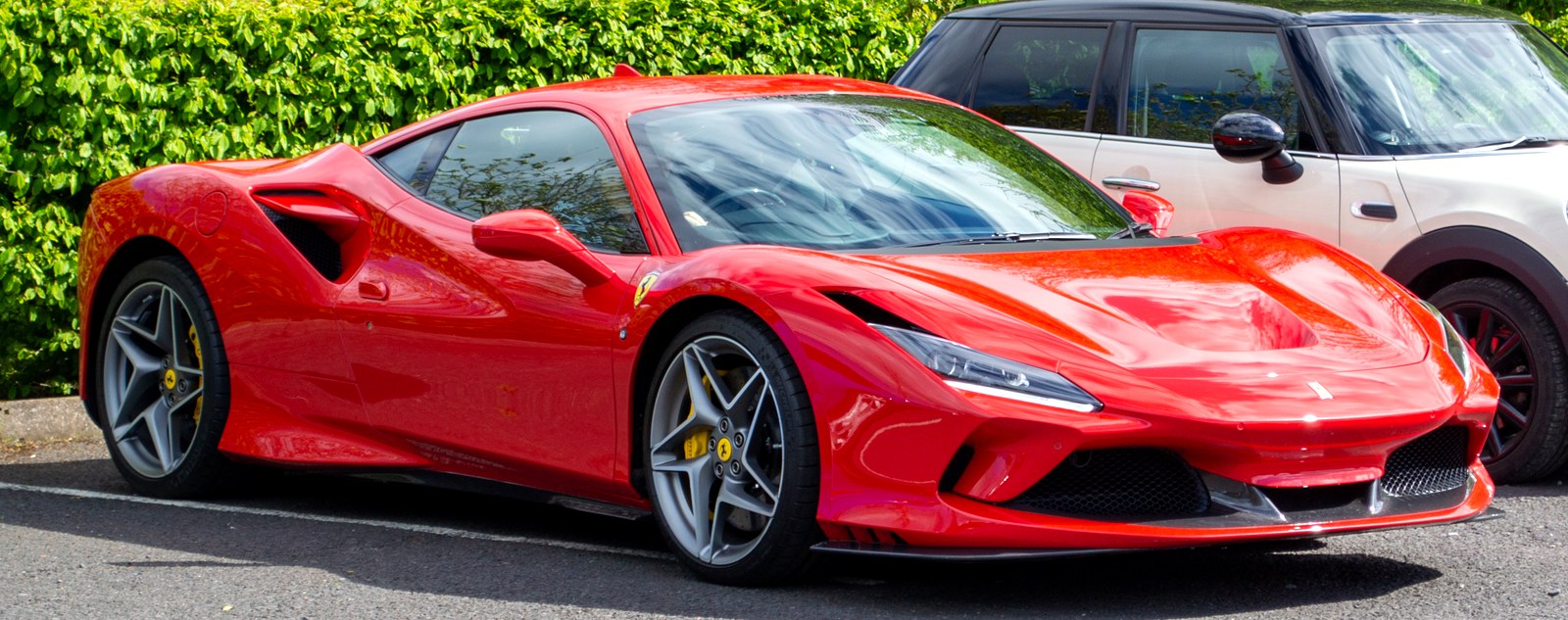
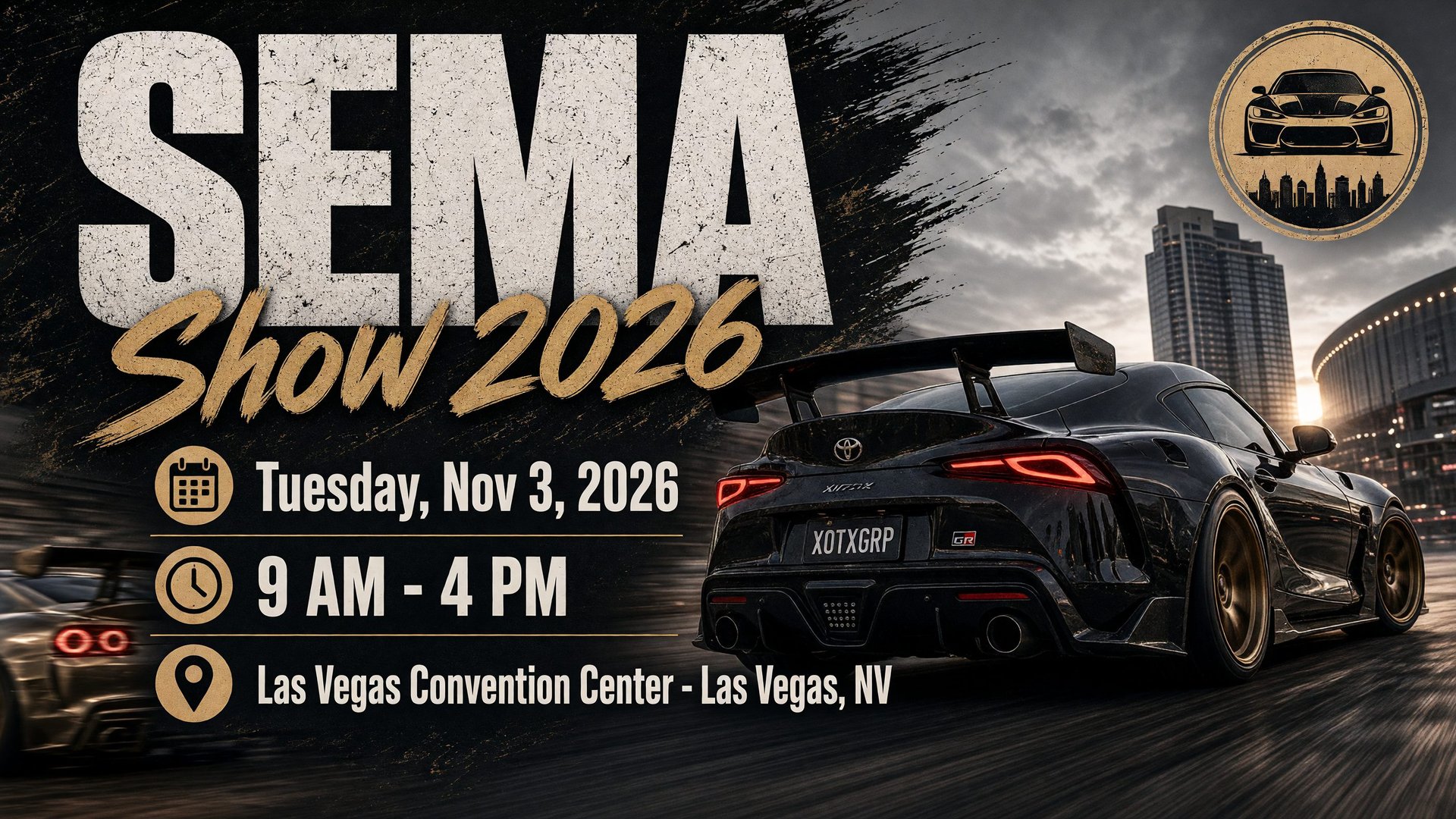
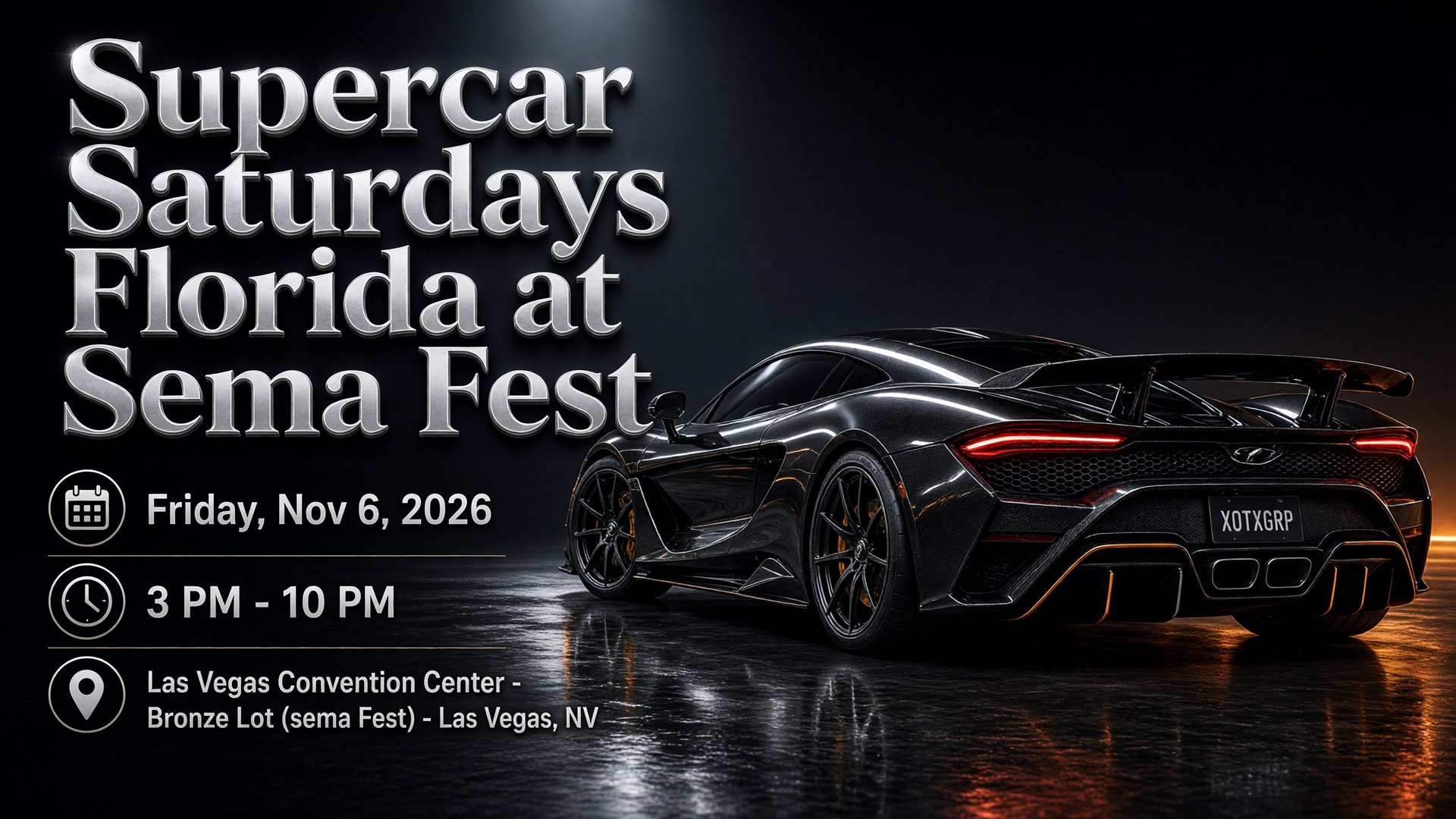
Next week the SEMA Show takes over the Las Vegas Convention Center (November 3-6), and for a few days the city will hold more boost gauges, laptops on dyno carts and "Stage 2" stickers than anywhere else on the planet. So let's talk about what a turbo tune actually does to a supercar, why it can feel like magic, and why, every so often, the magic ends with a tow truck.
Fair warning: this starts gentle and gets nerdy. Stick around for the "whose fault was it" section at the end.
The two-minute version (no engineering degree required)
An engine is basically an air pump that burns fuel. More air in means you can burn more fuel, and more fuel burned means more power. The trouble is that a normal engine can only breathe what the atmosphere pushes into it, about 14.7 psi at sea level.
A turbocharger cheats. Picture a pinwheel stuck in the exhaust pipe, spinning in the hot gas leaving the engine. That pinwheel is bolted by a shaft to a fan on the intake side, which shoves extra air into the engine. It is a bit like blowing on a campfire: the same logs, much bigger flames. The "extra" pressure it makes is called boost.
Your supercar's engine computer (the ECU) is the referee. It decides how much boost to make, how much fuel to squirt and exactly when to fire the spark plugs, thousands of times a minute, while watching temperatures and listening for trouble. A tune is simply a new rulebook for that referee. Most of the power in a modern "Stage 1" tune comes from telling the ECU it is allowed to ask for more.
That is also why tunes go wrong. The hardware was built and tested around the factory rulebook. Change the rules and some part, somewhere, gets less margin than it had before.
Boost: making the engine breathe harder
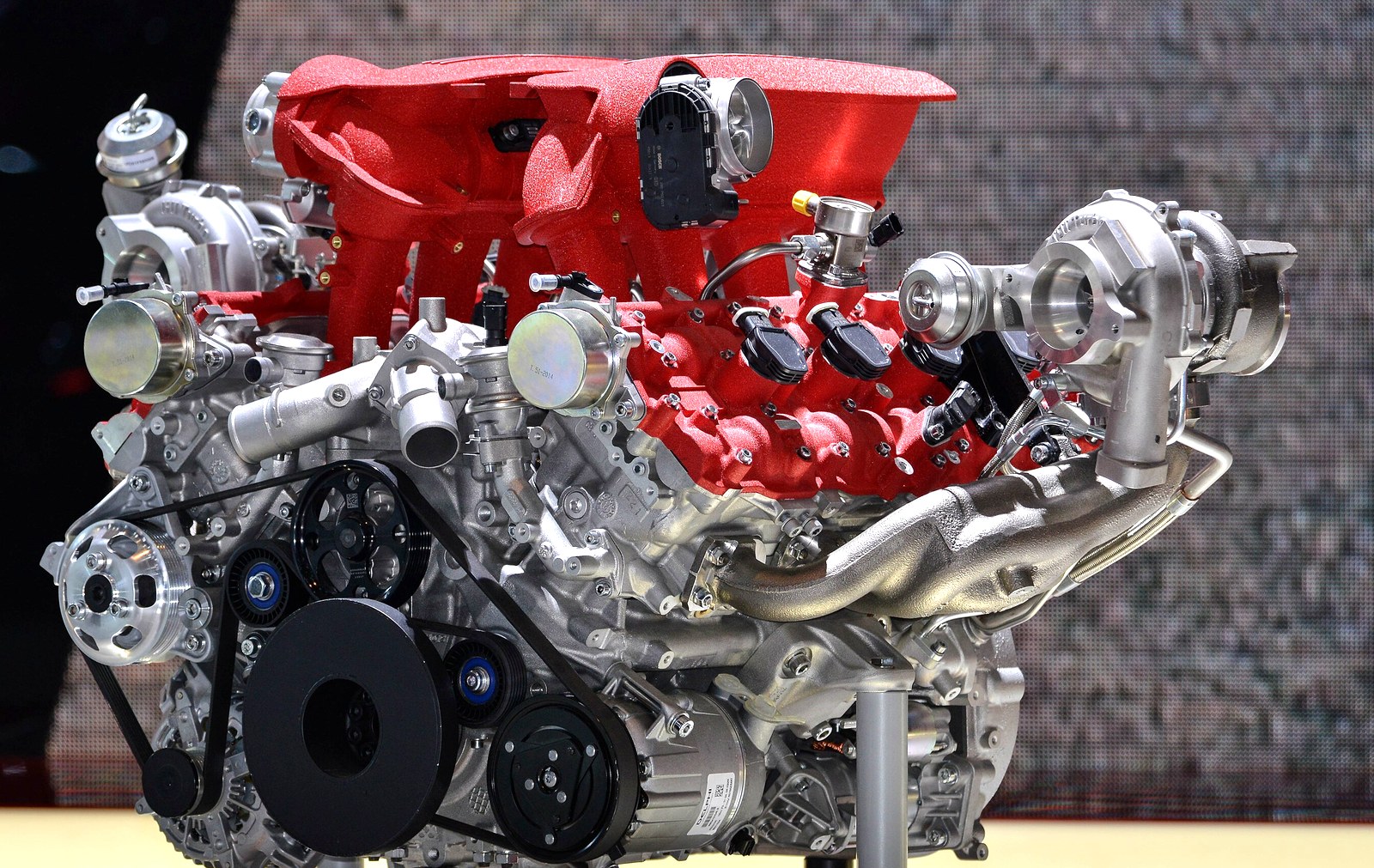
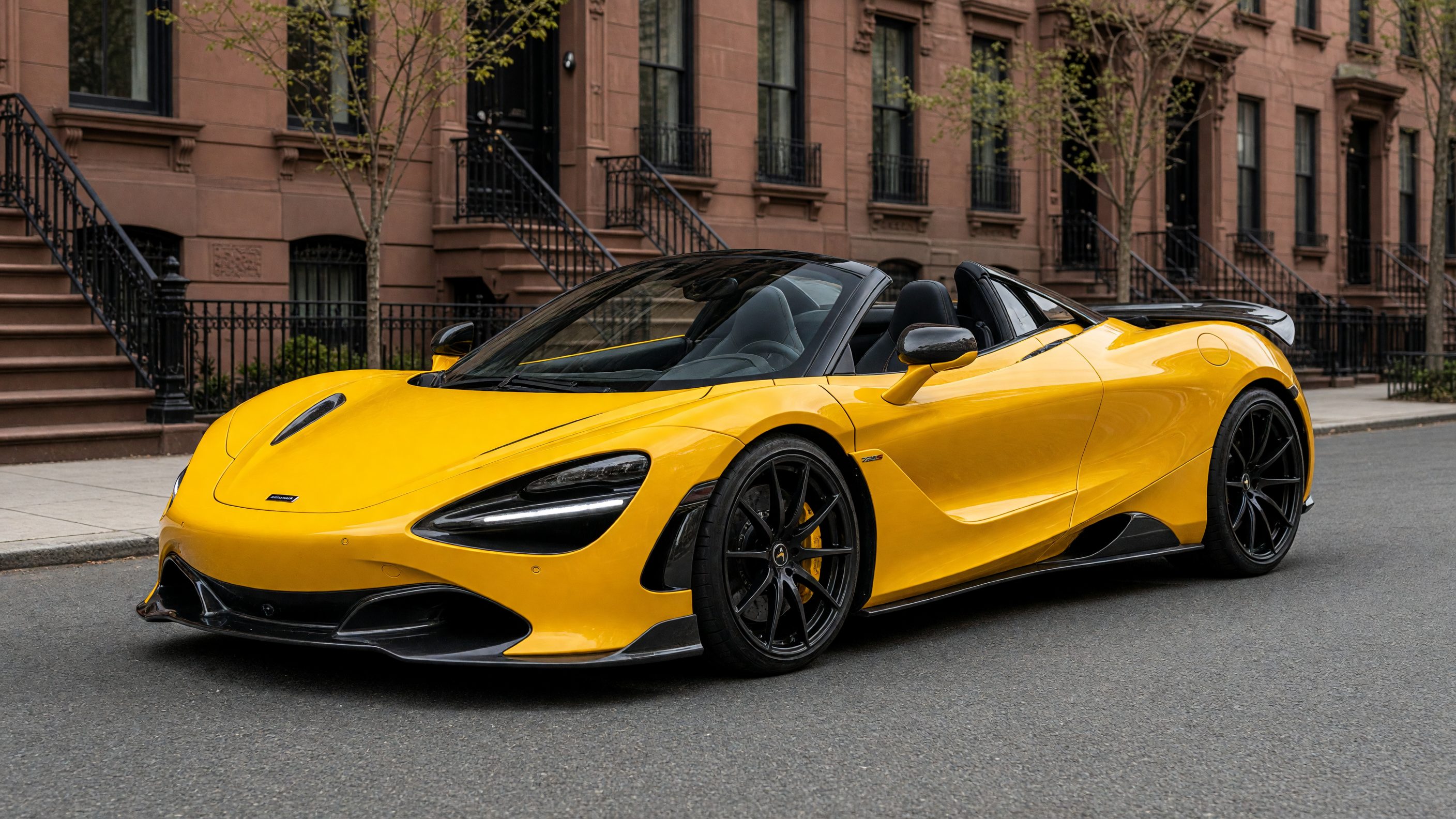
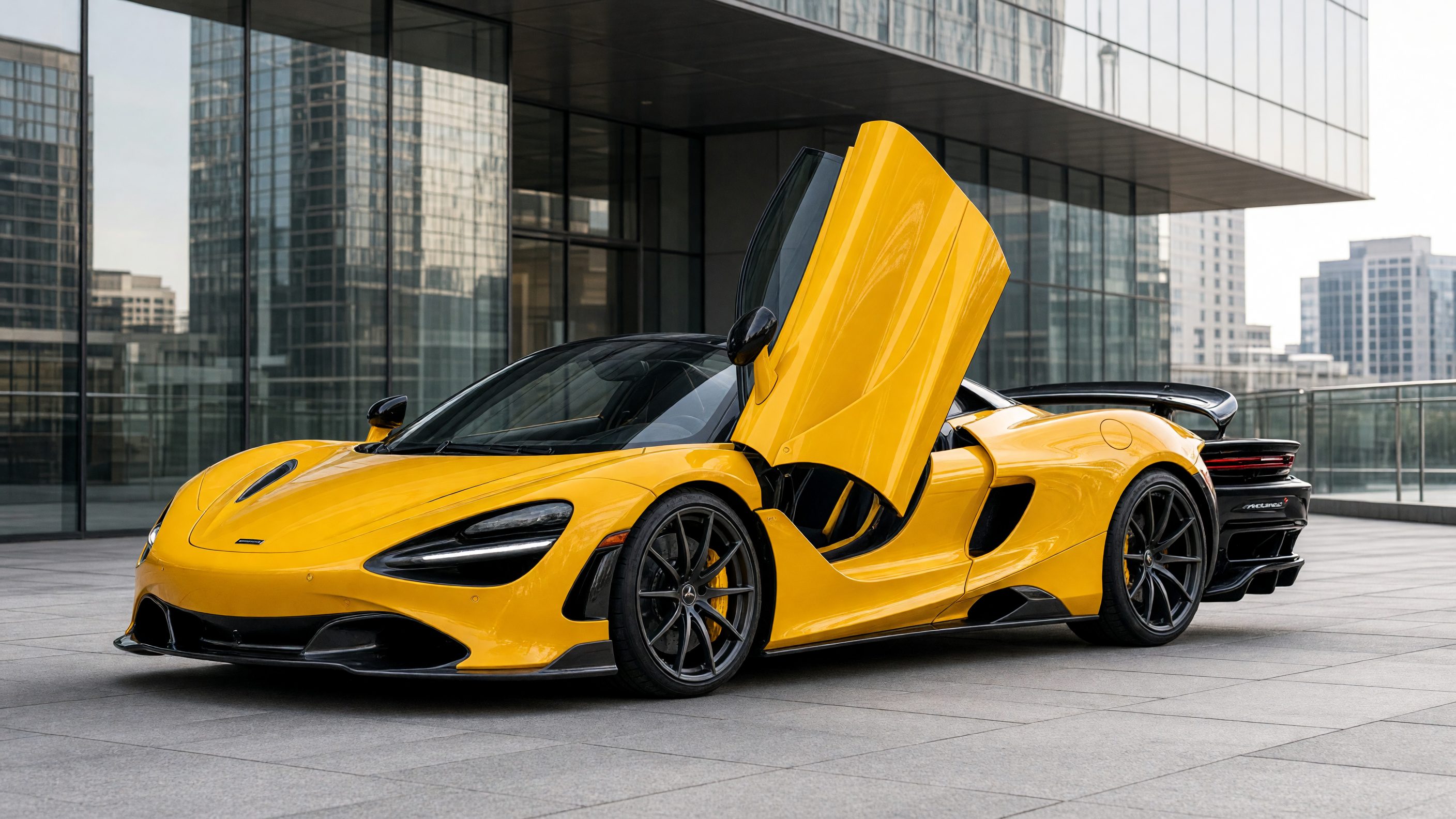
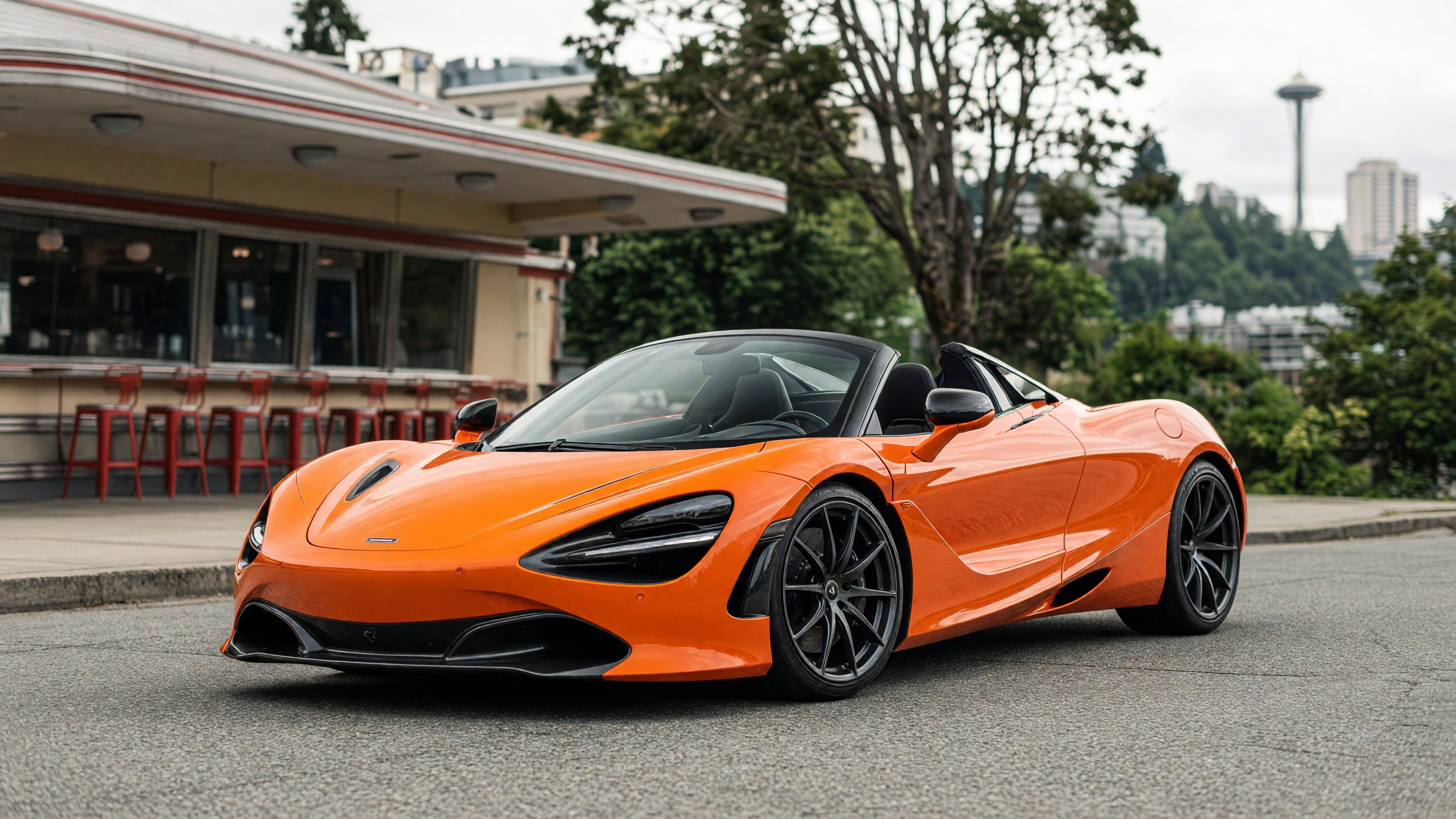
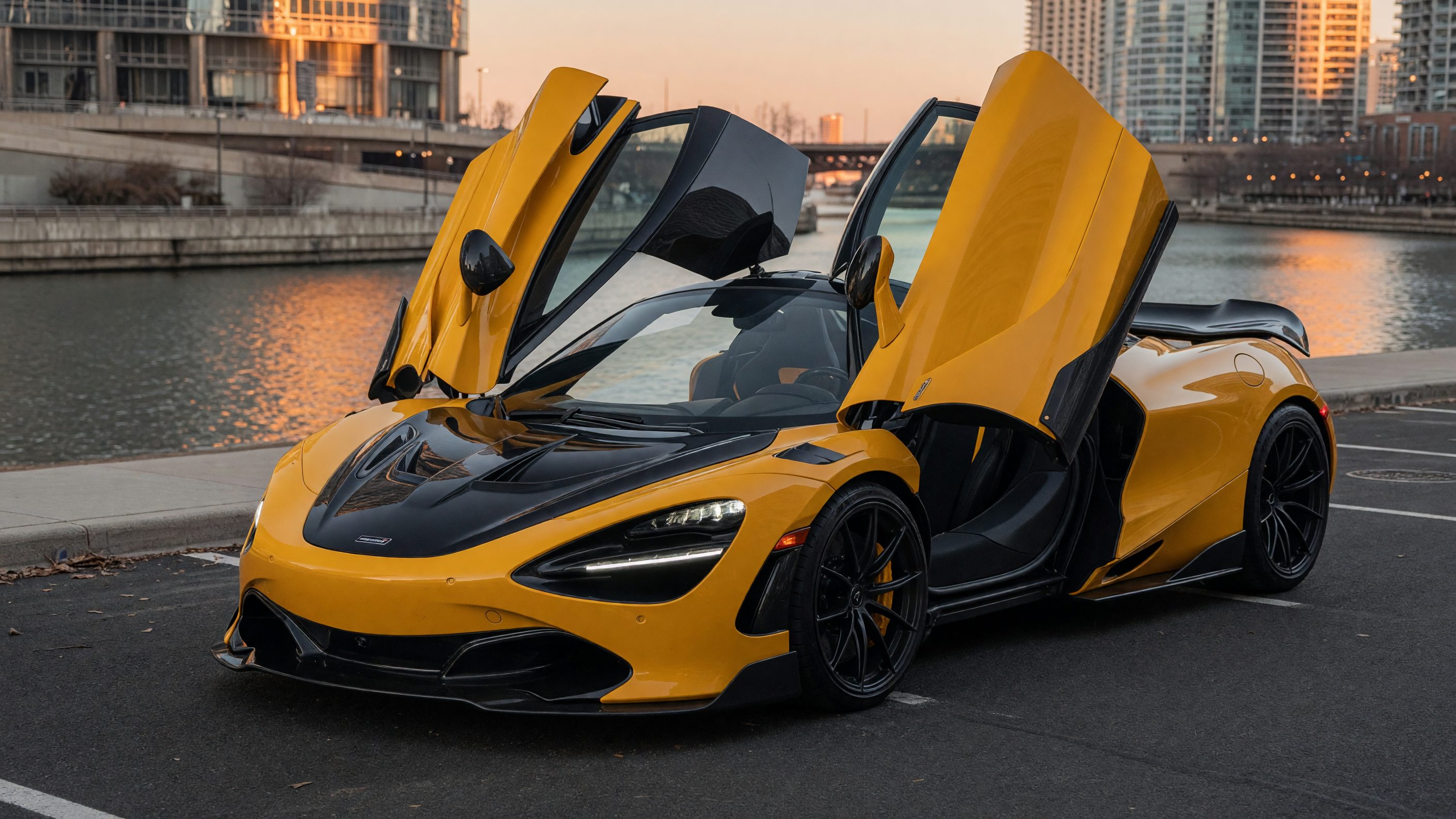
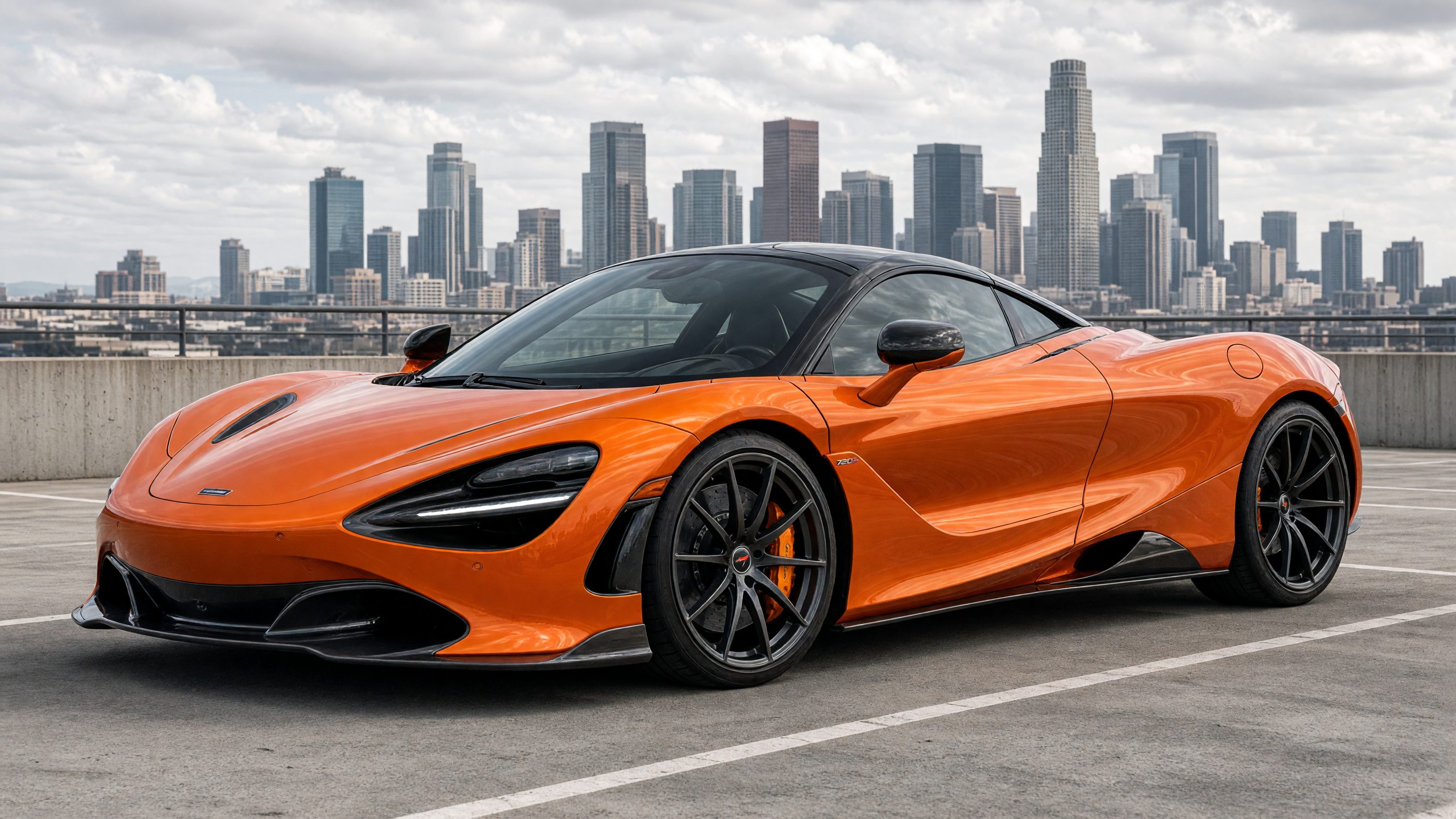
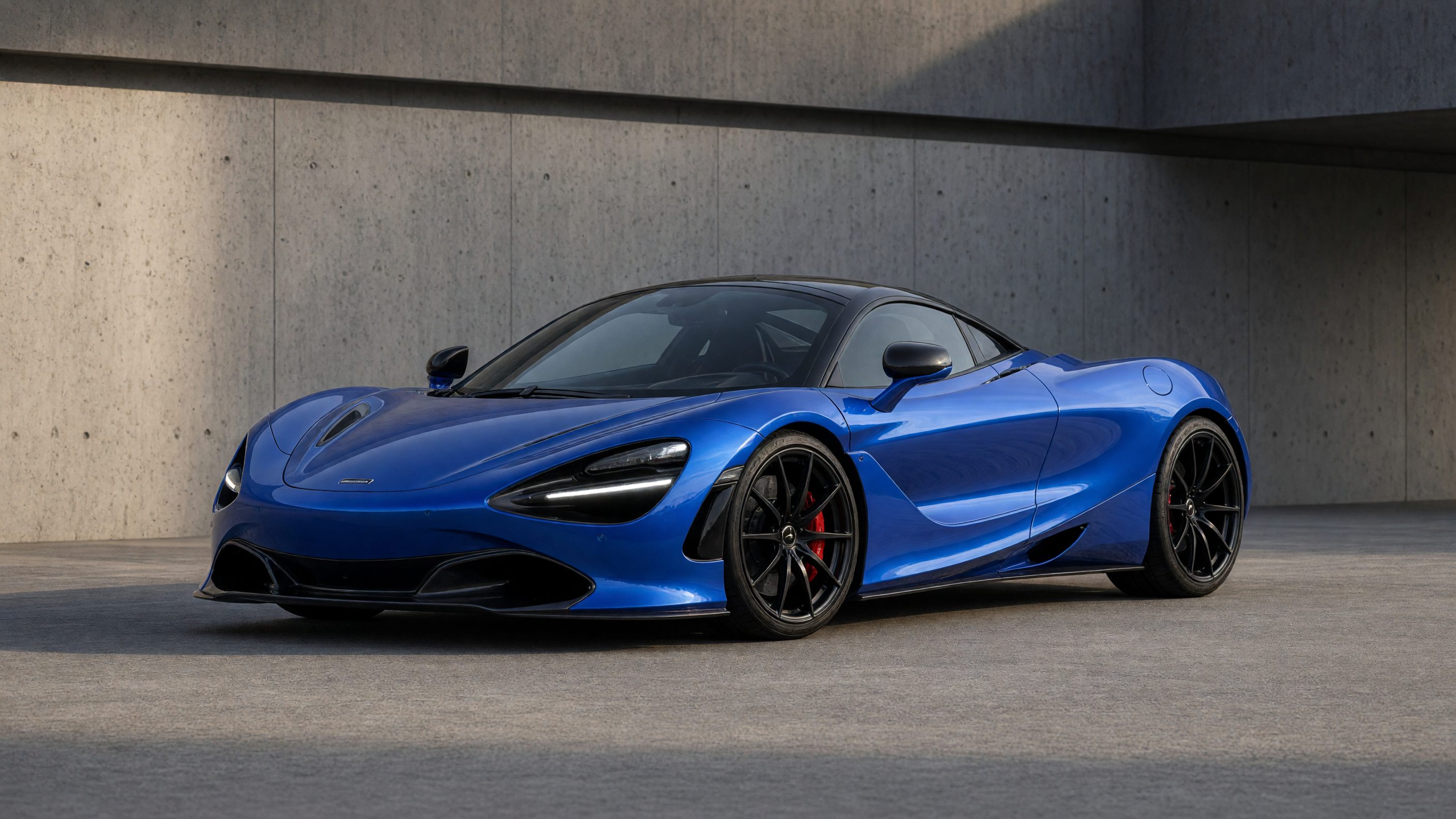
Here is the airflow loop in a little more detail. Exhaust gas spins the turbine; the turbine spins the compressor on the other end of a shared shaft; the compressor squeezes fresh air and pushes it through an intercooler and the throttle into the cylinders. A twin-turbo V8 like the one in a Ferrari 488 or a McLaren 720S runs one of these loops per bank of cylinders.
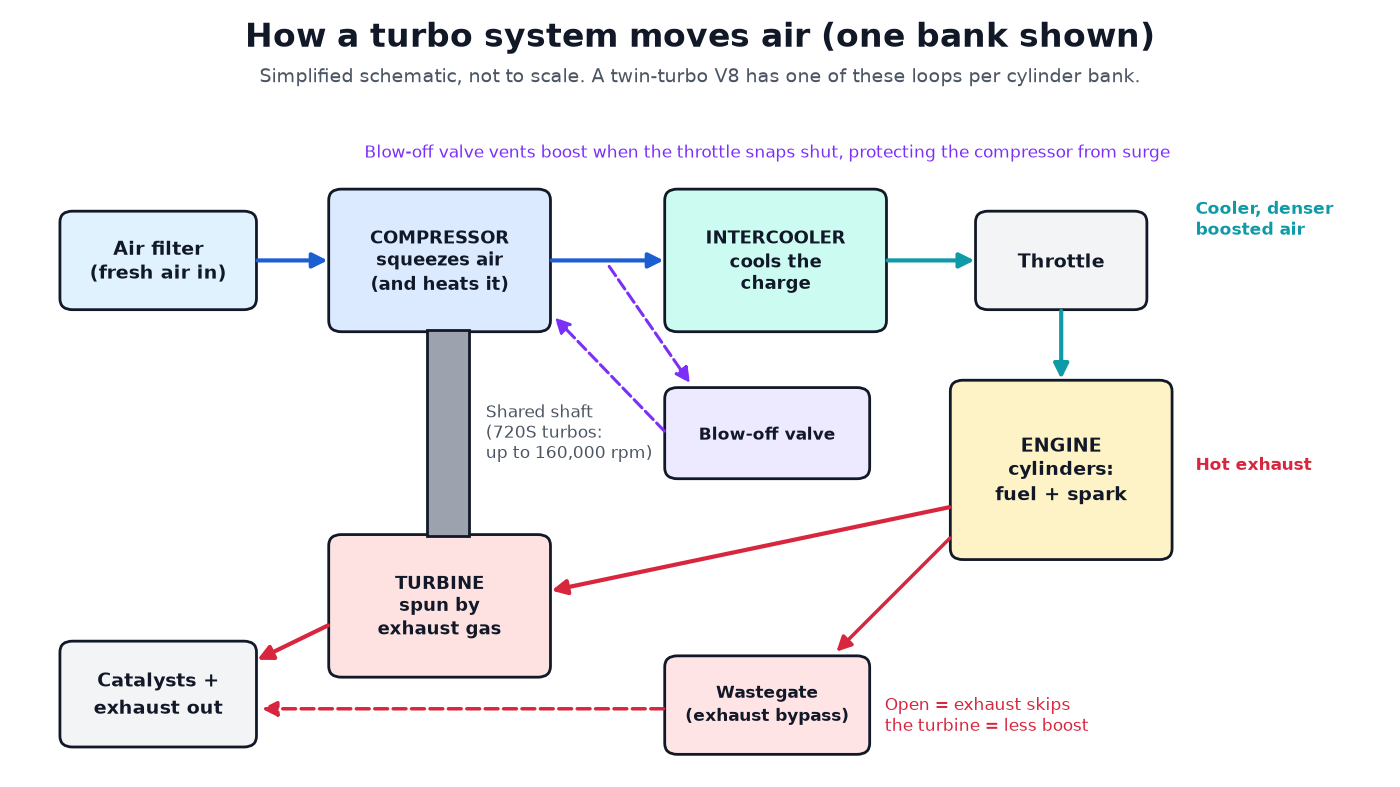
According to Garrett, typical boost levels run from about 8 psi (0.55 bar) to about 20 psi (1.38 bar), and higher in aftermarket builds. The shafts spin at absurd speeds: Garrett notes some of its turbos exceed 300,000 rpm, and McLaren specified the 720S's twin-scroll turbos with lightweight turbines capable of 160,000 rpm.
Two valves keep that whirlwind under control:
- The wastegate is an exhaust bypass. When it opens, some exhaust skips the turbine, the turbine slows and boost stops rising. Boost control is really wastegate control. (Porsche's newest 911 Turbo S is the interesting exception: its two electric "eTurbos" use their motors to regulate boost by recuperating energy, so Porsche says it needs no wastegates or variable turbine geometry at all.)
- The blow-off (dump) valve vents pressure when you snap off the throttle, so the compressor isn't suddenly trying to shove air into a closed door.
That closed-door scenario has a name: surge. Every compressor has a map of the flows and pressures where it works happily, and the edges of that map are where tunes get into trouble.
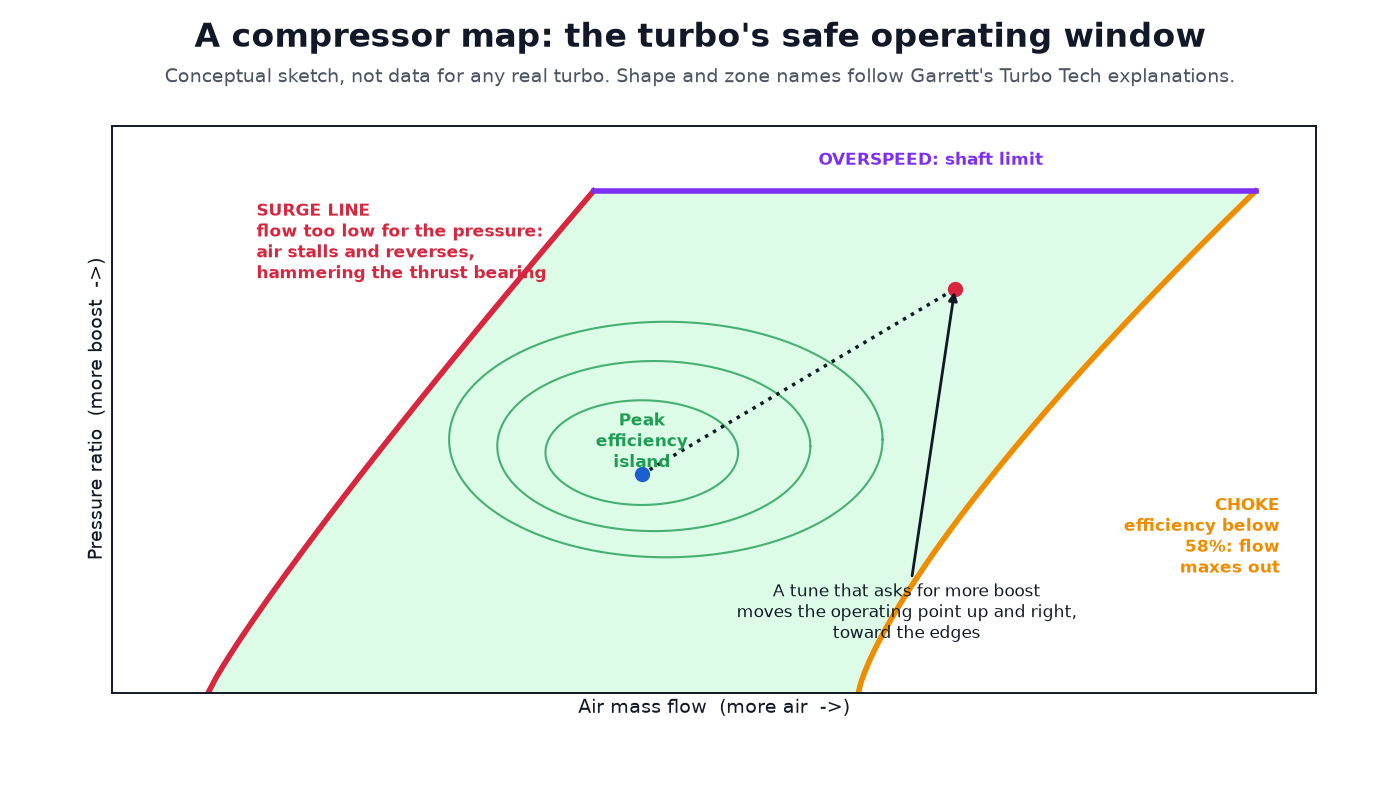
Garrett's turbo tech guides describe three edges. Off the left side is surge: too little flow for the pressure ratio, so the air stalls and reverses, and Garrett warns that this can lead to thrust bearing failure. Off the right side is choke, which Garrett defines as where compressor efficiency drops below 58 percent; past that point turbo speed climbs quickly and overspeed becomes likely. Across the top sits the speed limit of the shaft itself. Asking a stock turbo for a lot more boost pushes its operating point up and to the right, toward those edges.
Fuel: the cooling system you can't see
Gasoline burns most cleanly at 14.7 parts air to 1 part fuel by mass, the "stoichiometric" ratio that keeps catalytic converters happy. Tuners usually talk in lambda instead, which is just the measured ratio divided by the ideal one, so lambda 1.0 means "perfectly balanced" whatever the fuel (HP Tuners lists stoich as 14.1:1 for E10 and 9.7:1 for E85).
Under full throttle, engines run richer than that, and boosted engines run richer still:
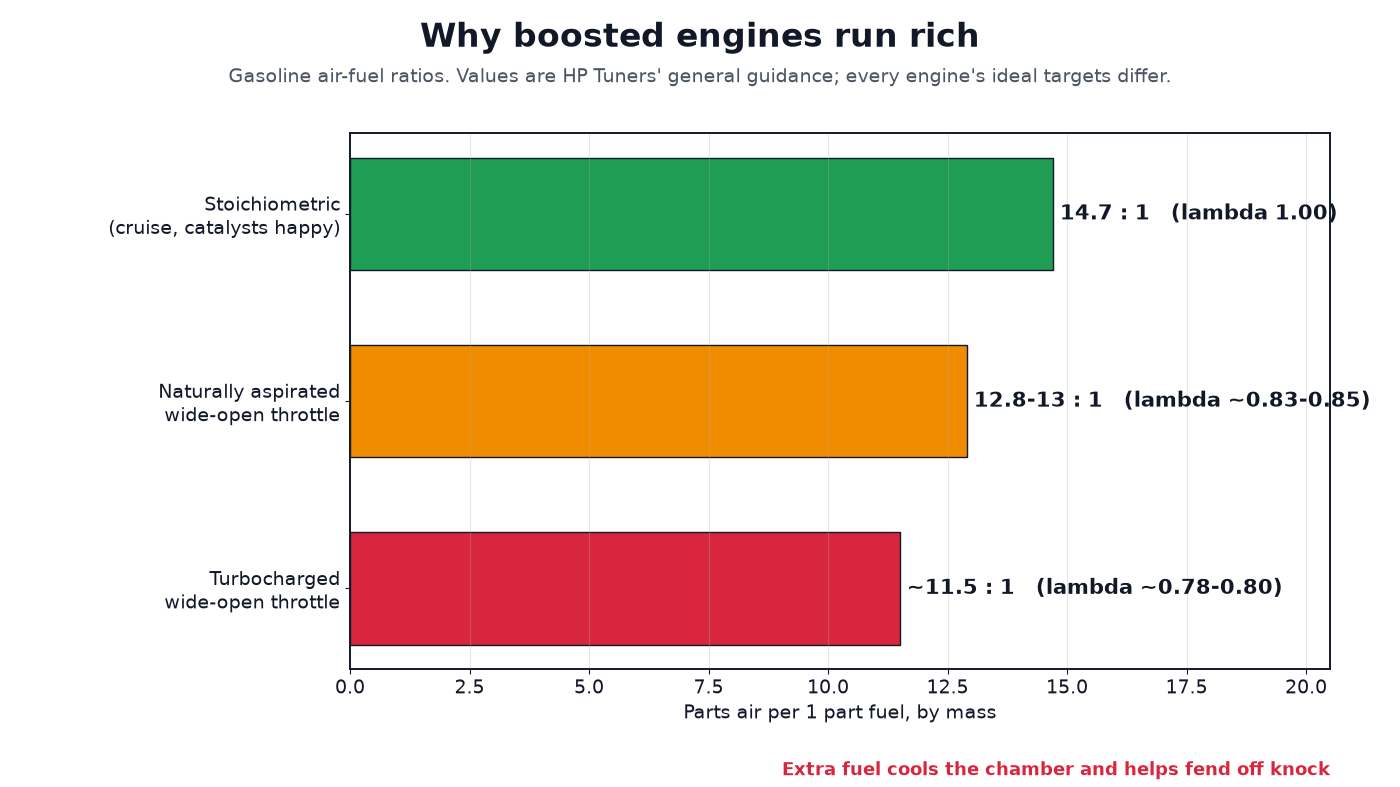
HP Tuners gives about 12.8-13:1 (lambda 0.83-0.85) as a general naturally aspirated performance target and around 11.5:1 (lambda 0.78-0.80) for forced induction, stressing that these are general values and every engine differs. That extra fuel isn't all being burned for power. A good part of its job is cooling the combustion chamber and fending off knock, which brings us to the scary part.
Ignition timing and knock: the line you never want to cross
The spark has to fire before the piston reaches the top of its stroke, because the flame takes time to spread. Fire it earlier (more "advance") and you generally get more push on the piston, up to a point. Go too far, or add enough heat and pressure, and the leftover mixture ahead of the flame explodes on its own instead of burning smoothly.
That is knock, also called detonation. Haltech compares it to hitting the top of the piston with a hammer, and lists the kind of damage it causes: crushed bearings, broken ringlands, holed or cracked pistons and bent connecting rods. Over-advanced timing causes it; richer mixtures help suppress it because they cool the chamber.
Modern engines listen for it. Knock sensors are essentially microphones (piezoelectric sensors) bolted to the block and tuned to the engine's knock frequency. When the ECU hears it, it reacts instantly:
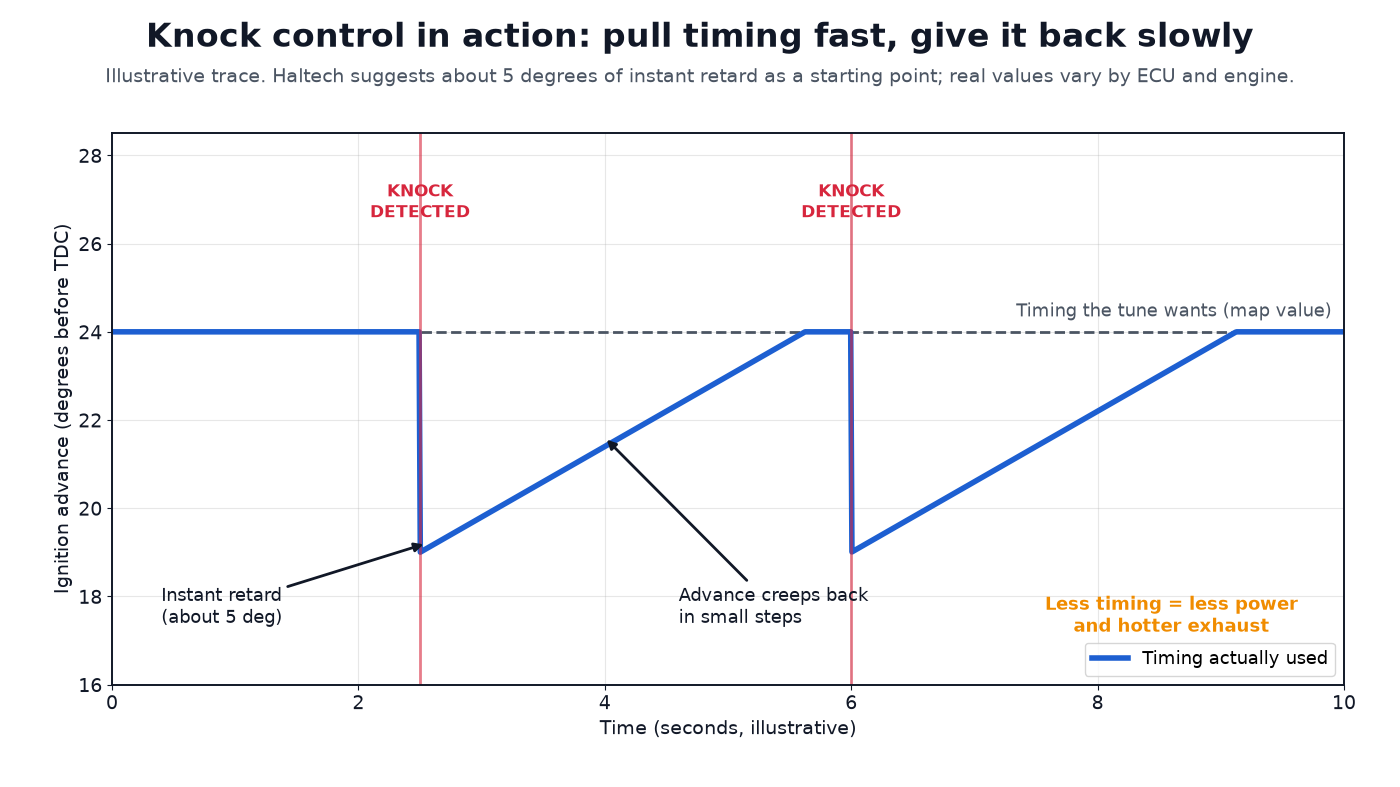
Haltech describes the typical strategy: an immediate short-term timing retard (it suggests about 5 degrees as a starting point), then a gradual return toward the original value, with long-term trims that remember trouble spots. This is a brilliant safety net, but notice what it means for a tune. If a map runs right on the edge, the car may be quietly pulling timing all the time, making less power and more heat than the dyno sheet promised. A safety net is not a substitute for margin.
Heat: the quiet power thief (hello, Las Vegas)
Squeezing air heats it. Garrett says air leaving a compressor can, in some cases, be well above 200 C (392 F). Hot air is less dense and much more prone to knock, so the intercooler's job is to pull that heat back out before the air reaches the cylinders.
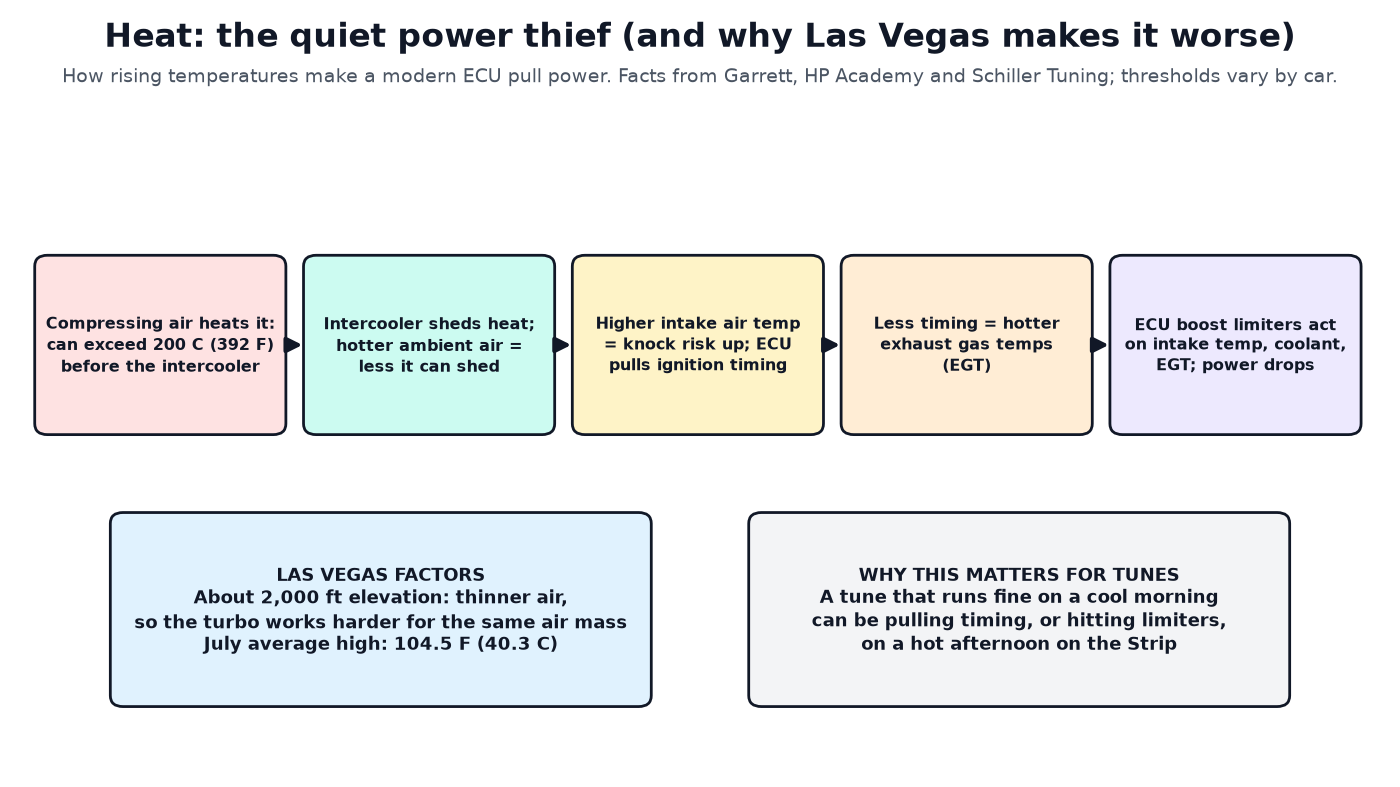
ECUs compensate when it gets hot anyway. HP Academy explains that an air-temperature compensation table removes timing as intake temperature climbs, and that compensations can stack: 3 degrees off for hot air plus 3 degrees for sustained load can leave the engine overly retarded. In a turbo engine, HP Academy notes, that can cause boost-control problems, because retarded timing sends more heat into the exhaust. Schiller Tuning's guide to Bosch ECUs lists boost limiters keyed to intake air temperature, coolant temperature, exhaust gas temperature, atmospheric pressure and turbo speed, and flags exhaust temperatures beyond roughly 900-950 C as a risk when boost is raised carelessly.
Now add Las Vegas. The city sits at roughly 2,000 feet, and Schiller points out that lower air density means the turbo has to make more boost to deliver the same air mass. Summers are brutal too: the average July high is 104.5 F (40.3 C). A tune that feels heroic on a cool October morning can be pulling timing and bumping into limiters on a July afternoon on the Strip.
How a tune actually changes the rules
Most modern supercar ECUs are torque-based. Schiller Tuning describes the Bosch logic like this: your pedal becomes a torque request; the ECU works out how much air that torque needs; it converts that air mass into a boost target; and it drives the wastegate to hit the target. Pressure-ratio maps keep the turbo out of surge, choke and overspeed along the way.
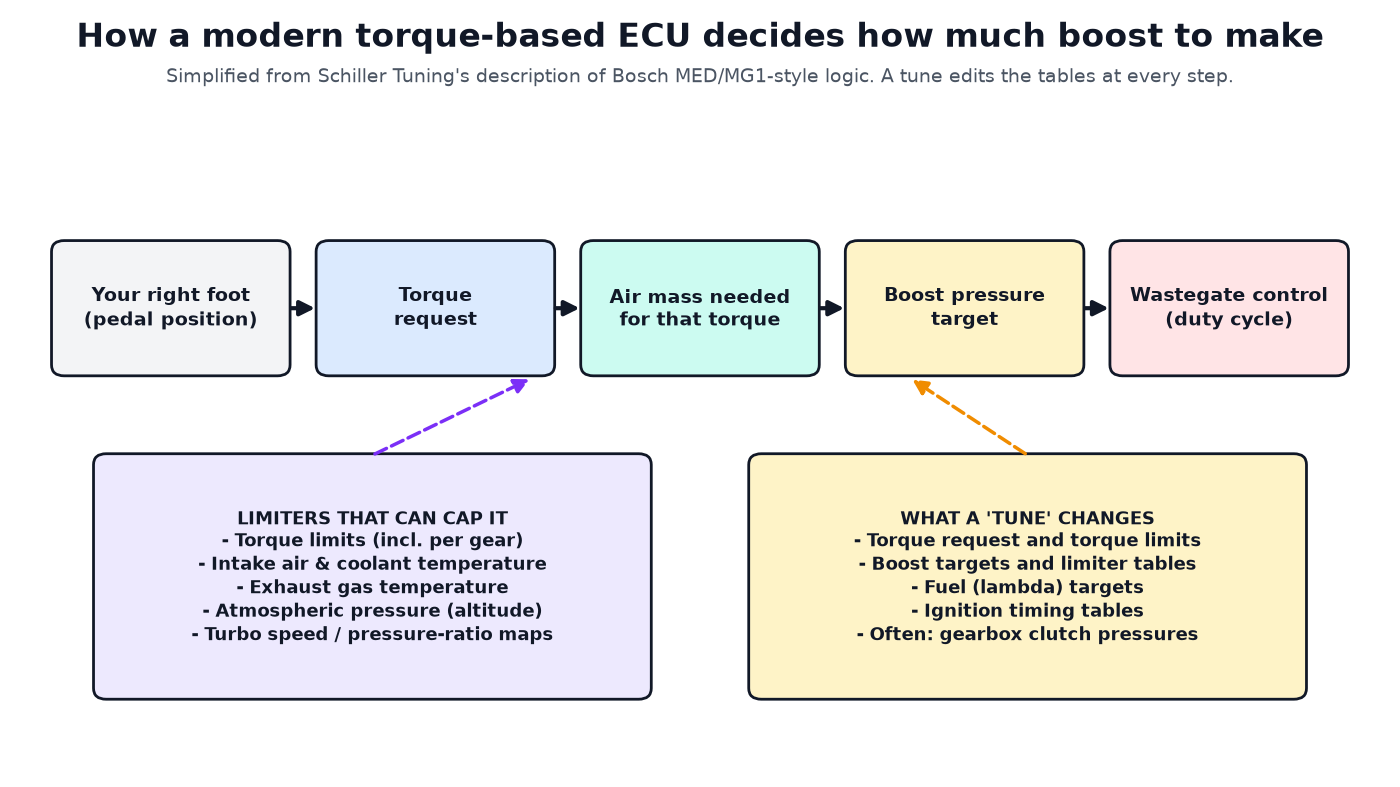
So a "tune" is rarely a single boost knob. A competent calibration revisits the torque request and torque limits, the boost targets and limiters, fuel (lambda) targets and ignition tables, and frequently the gearbox. Schiller is blunt that simply raising boost isn't enough: do it without the rest and you invite knock, excessive exhaust temperatures, turbo overspeed and limp mode.
Then there are stages. There is no industry standard, but generally Stage 1 means software only and Stage 2 adds supporting hardware such as downpipes. Here is how one well-known tuner, M-Engineering, defines its stages for the McLaren 720S and Senna:
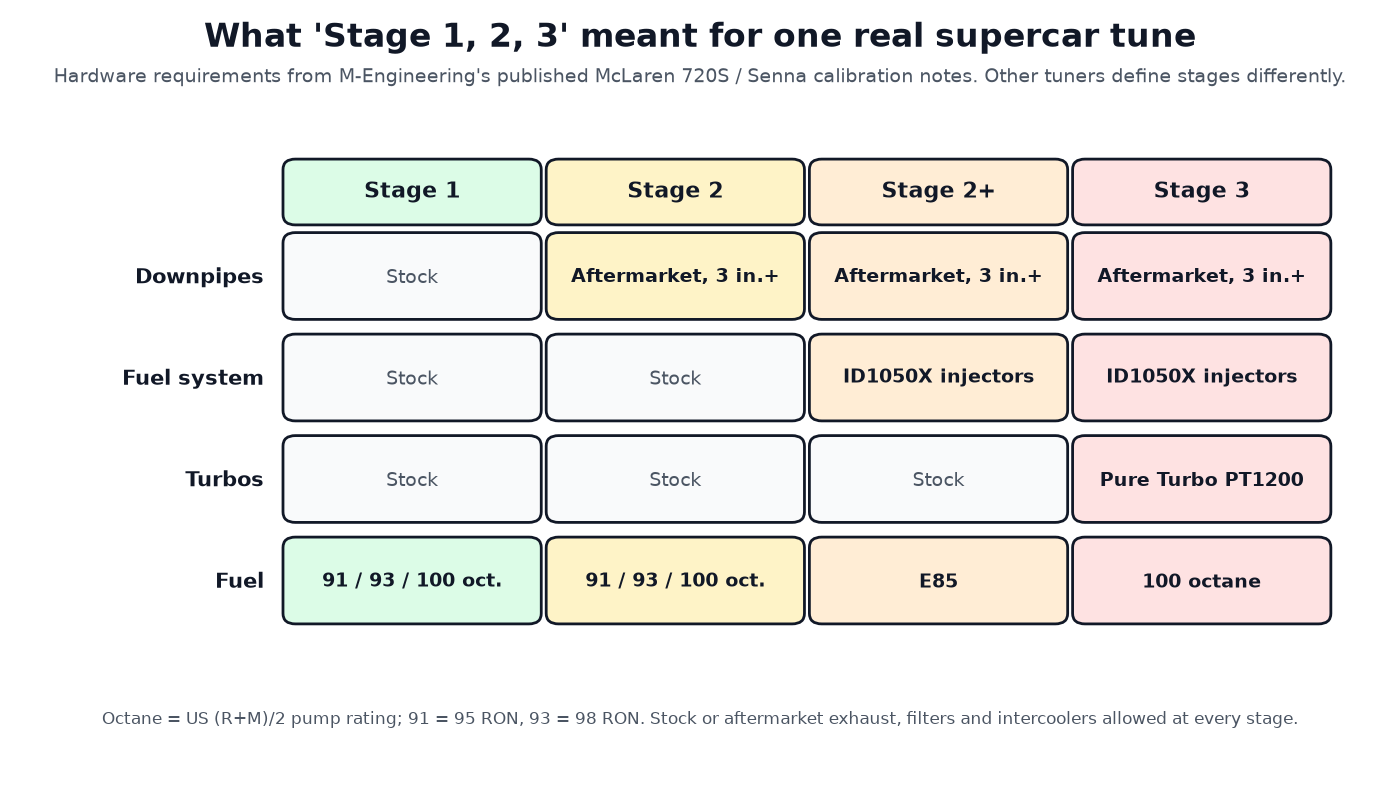
A few details from those calibration notes are worth stealing for any tuned car. Each map is tied to a minimum fuel quality, with a blunt warning never to run a map designed for high octane with low octane in the tank. Its maps include "boost by gear," with separate boost targets per gear because torque can easily overpower grip in the lower gears, plus its own engine safeties that gently close the throttle when a threshold is tripped.
What do those stages add up to on a real car? One McLaren Life owner reported a 720S on M-Engineering Stage 2 with aftermarket downpipes and intake piping making 853 whp and 740 lb-ft on a Mainline hub dyno with 99 RON fuel, versus 740 whp and 686 lb-ft on a stock-like map. Other forum members questioned that dyno setup, which is a useful reminder that dyno numbers only really compare well on the same machine, on the same day.
Why some go bang: design limits versus abuse
Here is the honest part. When a tuned supercar breaks, people tend to blame either "the tune" or "the driver." Usually it's one of two different stories: a part was asked for more than it was designed to take, or a reasonable setup was used in a way that ate its margin.
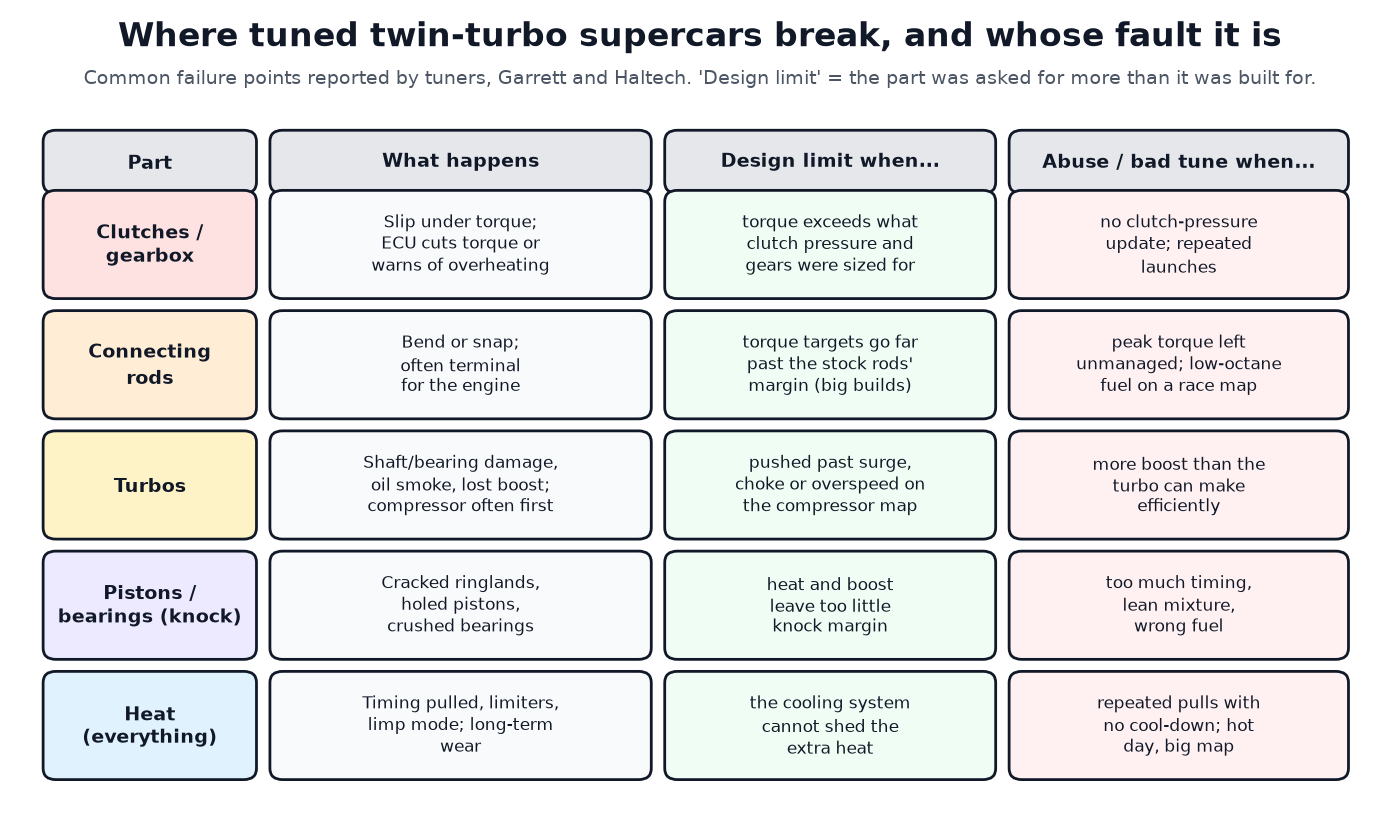
Clutches and gearboxes. The dual-clutch gearbox in most of these cars holds torque with hydraulic clamping force on its clutch packs. More engine torque with the same clamping force means slip, heat and, eventually, trouble. That is why tuners sell gearbox calibrations alongside engine tunes: M-Engineering's PDK2 calibration for the 992.1 911 Turbo and Turbo S raises clutch pressures and maximum clamping force specifically to prevent slip. The factories do the same thing in hardware. For the new 992.2 911 Turbo S, which makes 800 Nm, Porsche fitted a separate PDK with reinforced clutches, gear sets and bevel gear to handle the torque. Design limit, plain and simple.
Even Ferrari rations torque in the lower gears. On the 488 GTB, Ferrari's Variable Torque Management shaped the torque curve by gear: PistonHeads reported that gears one to three share a shallower curve, four to six are progressively steeper but capped at 516 lb-ft, and only seventh unlocks the full 560 lb-ft (760 Nm). Ferrari's stated goals were a progressive, naturally aspirated-like pick-up and optimised fuel consumption.
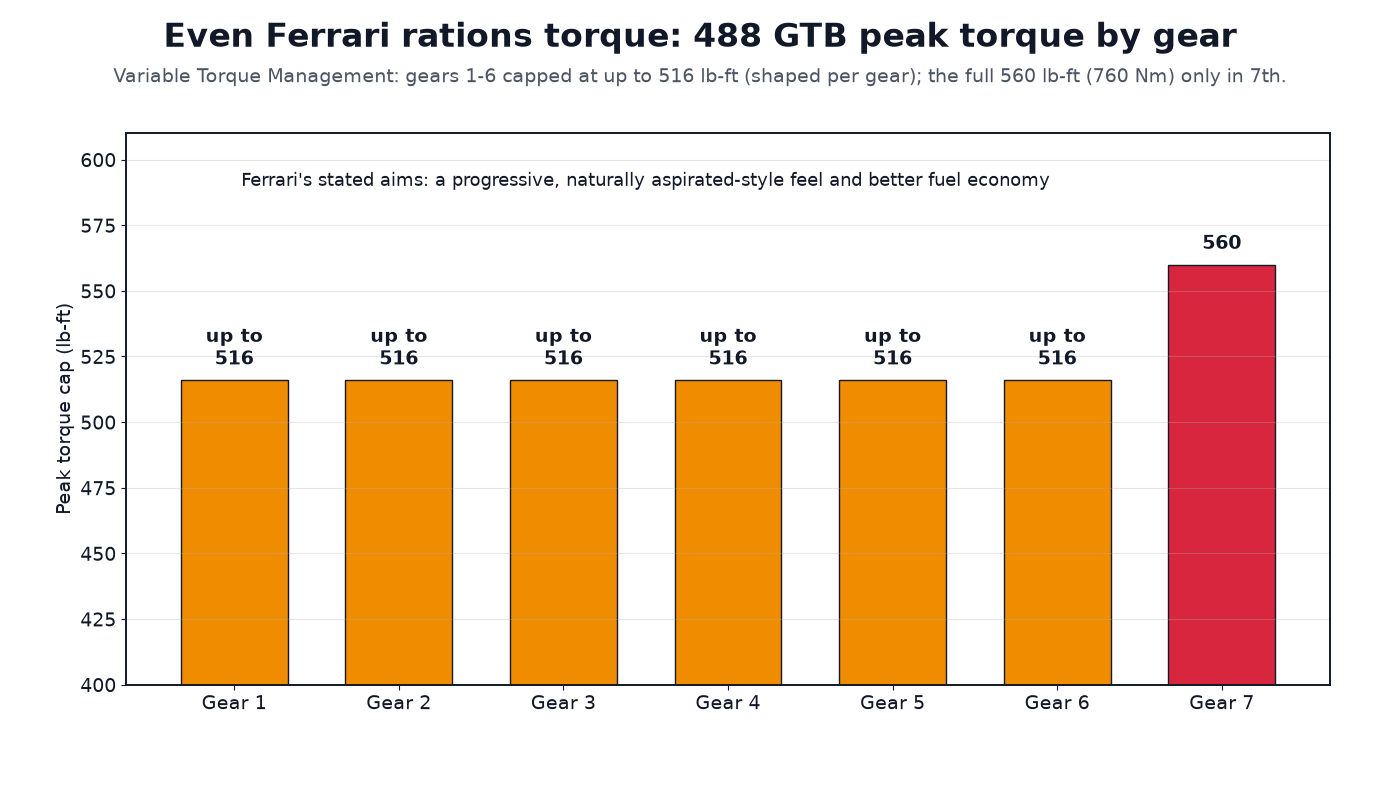
A tune that flattens all of that to "maximum, everywhere" is asking the gearbox and tires to take loads in first and second gear that the factory never let them see.
Connecting rods. Mega 3 Performance, which tunes McLarens, wrote this year that on the 720S, 750S and 765LT the primary mechanical limit isn't the turbos or the fuel system, it's the connecting rods. Its view: moderate tuning sits well within the safe range, aggressive tuning approaches the mechanical limits, and big-horsepower builds raise the risk unless the internals are upgraded with parts like forged rods, with boost and torque carefully controlled. Rods mostly care about torque, which is why good calibrators manage the torque curve, not just the peak horsepower number.
Turbos. Ask a stock turbo to live near surge, choke or its speed limit for long enough and its bearings and wheels pay the bill. One FerrariChat owner described losing boost and seeing smoke from the exhaust of his 488 just 60 miles after a tune, on a car with about 12,000 miles. One experienced forum member's take was that added boost loads both the compressor and turbine wheels, and that the compressor side often goes first. The owner also mentioned the car's earlier hard use, which is exactly the point: failures usually have more than one parent.
Pistons, bearings and knock. Too much timing, too lean a mixture or the wrong fuel for the map is the classic route to the hammer-blow damage Haltech describes. Running a race-fuel map on pump fuel falls squarely in the abuse column.
Heat. Repeated full-throttle pulls with no cool-down, on a hot day, with an aggressive map, stack every thermal problem above. Even M-Engineering builds a cool-down timer into its rolling anti-lag feature to avoid thermal fatigue from repeated attempts.
So how do you tune without the bang?
- Pick a tuner who logs, not just flashes. Ask what they monitor (knock, intake temperatures, lambda, exhaust temperatures) and how they adjust for your car and climate.
- Treat the octane rating like a law. The map and the fuel in the tank must match.
- Budget for the drivetrain. If torque goes up meaningfully, ask what happens to clutch pressures and torque limits in the gearbox.
- Respect the torque curve. Peak horsepower sells; controlled torque keeps the rods in the block.
- Mind the heat. Hot climates, altitude and back-to-back pulls all eat margin. A car that is fine in a cool coastal morning may behave very differently in a desert afternoon.
- Ask about warranty first. Aftermarket software can complicate warranty claims, so know where you stand before you flash.
Done well, a turbo tune is one of the most satisfying upgrades in the supercar world: more shove, sharper response, and a car that feels like it finally woke up. Done carelessly, it is an expensive way to learn what all those safety tables were for.
Tune cars, build turbo kits or run a performance shop? Get your business in front of the supercar owners who read pieces like this one: create a free Exotics Group account, then add your shop with Create Company in your account.
Sources
- Garrett Motion: How a turbo works, compressor map (Turbo Tech expert knowledge)
- Garrett Motion: Intercoolers, how do they work?
- HP Tuners: Air-fuel ratios, lambda and stoichiometry explained
- Haltech: What is knock and why you should control it
- HP Academy: Ignition compensation
- Schiller Tuning: Turbocharger and boost control strategy, Bosch ME/MED/MG ECUs
- M-Engineering: McLaren 720S / Senna calibration notes
- M-Engineering: Porsche 992.1 Turbo / Turbo S PDK2 calibration
- McLaren Life: McLaren 720S M-Engineering Stage 2 update and figures
- Mega 3 Performance: The limits of stock engine tuning on the McLaren 720S, 750S and 765LT
- McLaren 720S launch press release (full text)
- Porsche Newsroom: 911 Turbo S powertrain
- Ferrari: 40 years of Ferrari turbocharging technology explained
- PistonHeads: Ferrari 488 GTB driven
- FerrariChat: 488, blown up turbo
- SEMA Show
- Wikipedia: Las Vegas (elevation and climate)
- Wikimedia Commons: 2020 Ferrari F8 Tributo 3.9 (photo by Sam N, CC BY-SA 4.0)
- Wikimedia Commons: Ferrari 488 engine (photo by emperornie, CC BY-SA 2.0)
#LasVegas #SEMA #Turbo #ECUTuning #Supercars