 exoticsgroup.com
Twelve Cylinders, Three Motors, Zero Shame: How the Lamborghini Revuelto's Hybrid System Actually Works

 | By Alex Rivera, Technical Writer, Exotics Group |
For sixty years, the big Lamborghini V12 lived a gloriously single life. No batteries, no cables, no plug, just twelve cylinders, a lot of noise and a fuel bill that could make an accountant weep. Then, in March 2023, Sant'Agata announced that its flagship engine was entering an open relationship. The Revuelto pairs a brand-new naturally aspirated V12 with three electric motors and a battery you can plug into the wall, and Lamborghini calls it the first "HPEV" (High Performance Electrified Vehicle): a plug-in hybrid V12 super sports car.
If the word "hybrid" makes you picture a beige hatchback quietly saving the planet one school run at a time, relax. This is not that. Think of it more like a world-class tenor (the V12) who has hired three very strong, very quick stagehands (the electric motors). The tenor still does the singing. The stagehands make sure nothing ever drags, the set moves instantly, and the show can go on even when the tenor needs to stay quiet.
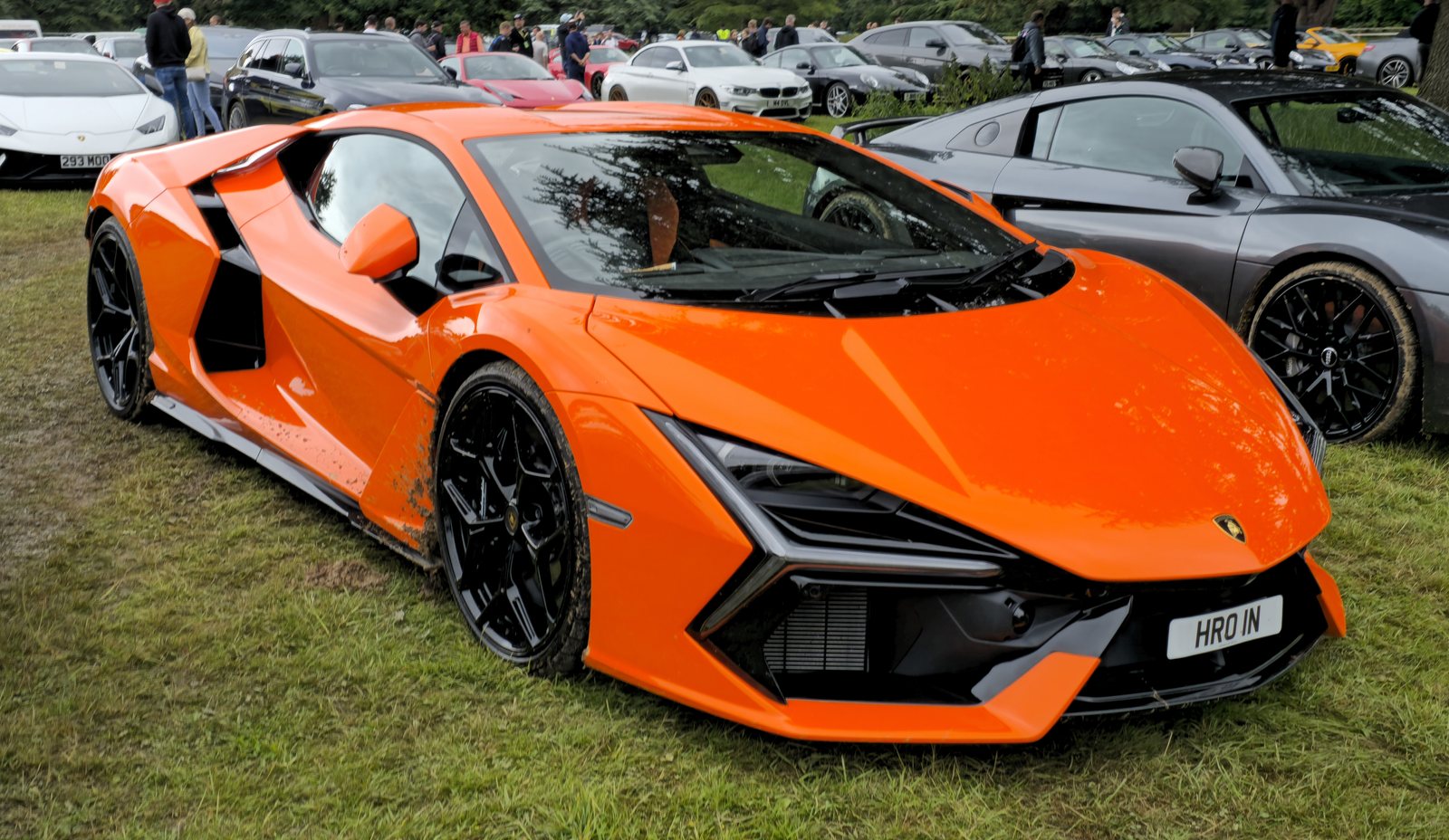
Here's the plan: first the simple version, then a proper look under the carbon fiber at how the pieces fit together, why Lamborghini built it this way, and what reviewers and real owners say it's like to live with.
The 30-second version
Every figure here comes from Lamborghini unless noted otherwise.
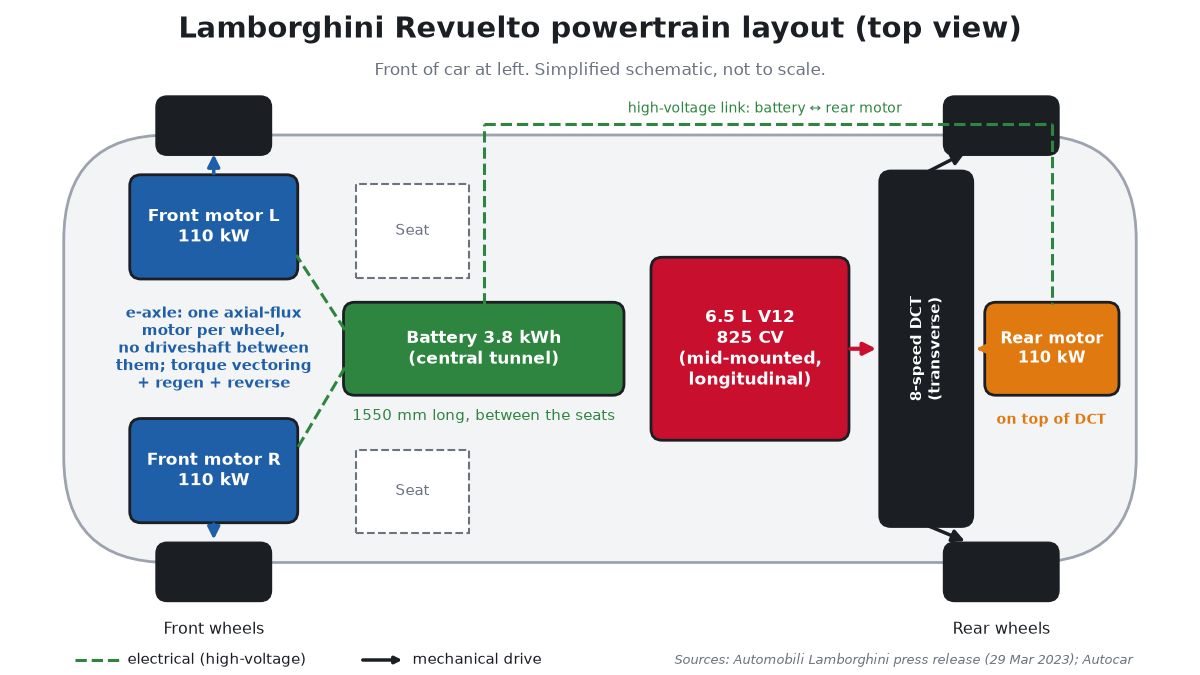
- The engine: a 6.5-liter naturally aspirated V12 (no turbos) making 825 CV (about 814 hp) at 9,250 rpm and 725 Nm of torque.
- The motors: two electric motors on the front axle, one per front wheel, plus a third sitting on top of the gearbox at the back.
- The battery: a small 3.8 kWh lithium-ion pack living in the center tunnel between the seats, where the gearbox used to be.
- The gearbox: a new eight-speed dual-clutch transmission, mounted sideways behind the engine. It has no reverse gear; the electric motors handle reversing.
- The total: 1,015 CV (about 1,001 hp) combined, 0–100 km/h in a claimed 2.5 seconds and a top speed of more than 350 km/h. Car and Driver measured 0–60 mph in 2.2 seconds.
- Electric-only range: tiny. The EPA rates it at 5 miles. That's enough to get out of your neighborhood quietly, and not much more.
A hybrid, explained like you're five (but you own a Lamborghini)
A hybrid has two kinds of muscle: a gasoline engine and electric motors, with the battery as the lunchbox the motors eat from. Electric motors shove hard the instant you ask, while a big naturally aspirated engine does its best work high in the revs. Together, you get punch everywhere instead of only near the redline.
The second trick: an electric motor can work as a generator. Spin it with the car's momentum as you slow down and it makes electricity, refilling the lunchbox. That's regenerative braking, or "regen," and it recycles energy you'd otherwise turn into hot brake dust.
Most hybrids use those tricks to save fuel. The Revuelto uses them mainly to go faster and corner harder, and to creep out of the garage at 7 a.m. without waking the street.
Meet the band
The V12: still the lead singer
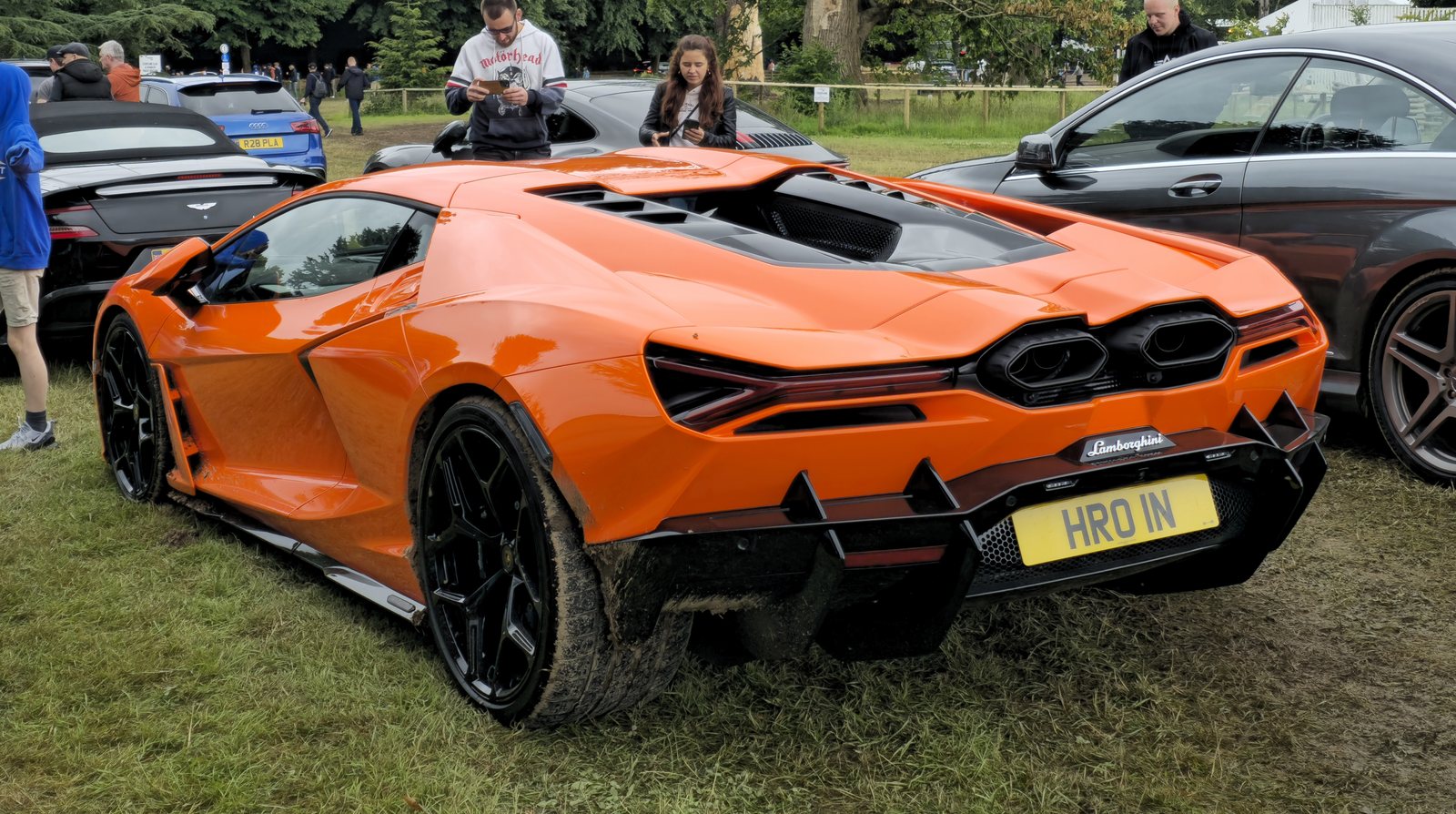
The engine, code-named L545, is new. Lamborghini says it's the lightest and most powerful 12-cylinder it has ever built: 218 kg, which is 17 kg less than the Aventador's V12. It makes 825 CV at 9,250 rpm, and the redesigned valvetrain lets it rev to 9,500 rpm. (Car and Driver quotes a 9,400 rpm redline.) That works out to 127 CV per liter, the highest specific output of any Lamborghini V12. The compression ratio has gone up from the Aventador Ultimae's 11.8:1 to 12.6:1, and the intake and exhaust have been reworked to breathe better at high revs.
One detail people miss: the engine is turned 180 degrees compared with the Aventador's. The old car's gearbox sat ahead of the engine, poking into the cabin; in the Revuelto it moved to the back, and the battery took its old space.
The front e-axle: two pancakes doing heavy lifting
Up front, each wheel gets its own electric motor. These are axial-flux motors, a design shaped more like a thick pancake than the usual tin can. Lamborghini rates each one at 110 kW and quotes 350 Nm of torque per motor, at a weight of 18.5 kg each. The motors come from British specialist YASA, and the supplier's own figures are a little different: 300 Nm peak and 17.3 kg per unit. The sources don't match, so treat those as approximate figures.
Why pancakes? Axial-flux motors pack a lot of torque into a slim package. Car and Driver points out that their compactness leaves room for a front trunk big enough for a carry-on suitcase, and that they're good at regenerating electricity. Lamborghini Chief Technical Officer Rouven Mohr told Autoweek that the engineers use that torque for three jobs: "people are always thinking acceleration, which is true, but we also use it for torque vectoring and energy recuperation."
Key point for beginners: there's no mechanical connection between the V12 and the front wheels. Older Lamborghini all-wheel-drive systems sent engine power forward through a driveshaft. Here the front wheels run purely on electricity, and the two front motors aren't connected to each other either.
The rear motor: the multitasker on top of the gearbox
The third motor is a more conventional radial-flux unit sitting on top of the gearbox, rated at 110 kW and 150 Nm. It has the most varied job in the car. It's the V12's starter motor, it's a generator that charges the battery (and through it, the front motors), and it can drive the rear wheels by itself, which is what gives the Revuelto electric all-wheel drive.
The battery: the lunchbox in the tunnel
The 3.8 kWh lithium-ion pack uses pouch cells and sits in the central tunnel, the strip between the seats that has carried a Lamborghini V12's transmission since the Countach. It measures 1,550 mm long, 301 mm high and 240 mm wide. Lamborghini highlights its "high specific power" of 4,500 W/kg. In plain English, it's built to dump and absorb energy very quickly rather than to store a lot of it. Mohr told Autoweek that the cells are Volkswagen Group cells usually meant for 48-volt systems, not typical plug-in hybrid cells, chosen because they're "the highest power-density cells available."
One wrinkle: Car and Driver's test spec sheet lists the pack as 3.4 kWh without explanation, while Lamborghini says 3.8 kWh. We're going with the manufacturer.
Charging is simple. Lamborghini says you can plug into household AC or a public charger at up to 7 kW for a full charge in about 30 minutes, or let the V12 recharge it on the move in about six minutes. Mohr gave Ars Technica a slightly different real-world figure: five to eight minutes in Recharge mode to get back to 80 percent, "depending on your driving profile."
The great gearbox flip
This is the clever bit, and it's what makes the whole layout work.
Lamborghini designed a new eight-speed wet dual-clutch transmission (DCT) and mounted it transversely, meaning sideways across the car, behind the longitudinal V12. Autocar calls it a "T-drive." According to Lamborghini, only two other V12 Lamborghinis have used a transverse rear gearbox: the 1966 Miura and the track-only Essenza SCV12.
Why bother? The battery needed a home that was low and central, and moving the gearbox from the tunnel to the tail freed exactly that space, while keeping the wheelbase in check and adding cabin room behind the seats. Lamborghini quotes a 44:56 front-to-rear weight distribution.
The gearbox itself is compact: 560 mm long, 750 mm wide and 580 mm high, weighing 193 kg including the rear electric motor. Lamborghini says that even without the electrical parts it's lighter and quicker-shifting than the seven-speed dual-clutch in the Huracán. Inside are just two shafts, one carrying the odd gears and one the even gears, each with its own clutch. While you're in third, fourth is already lined up and waiting, so a shift is just one clutch letting go as the other grabs. There's also a party trick called "continuous downshifting": hold the left paddle under braking and it drops several gears in a row.
Aventador owners will appreciate this most. Car and Driver calls the old car's single-clutch automated manual "often maligned and always jarring," and says the new DCT is smooth whether you're "puttering around town" or "making a quarter-mile pass."
Reverse? There's no gear for that
A fun one for your next cars-and-coffee: the Revuelto's gearbox has no reverse gear. To back up, the two front motors simply spin backward. If you need more shove, the rear motor joins in, so the car can reverse with all four wheels driven in low grip. Dropping the reverse gear saves weight and space.
P2, P3 and the tiny clutch that changes everything
Engineers label hybrid motors by where they sit in the driveline: P0 at the front of the engine, P2 between the engine and gearbox, P3 after the gearbox, and so on. The Revuelto's rear motor gets to be two of these, thanks to a decoupling mechanism with its own synchronizer:
- In the P2 position, the motor is connected to the engine side. That's how it starts the V12, and how the engine spins it to recharge the battery at low speeds or when parked.
- In the P3 position, it's separated from the engine side and acts on the output, adding power to the rear wheels. In electric mode it can drive the rear wheels with the V12 switched off, which together with the front motors gives you electric all-wheel drive.
In pure electric driving, Lamborghini says the car stays front-wheel drive to save energy and calls on the rear motor only when needed.
Why three 110 kW motors don't add up to 330 kW
Hybrid math trips people up here. Three motors rated at 110 kW each sounds like 330 kW of electric power, or about 449 CV. Add that to the V12's 825 CV and you'd expect more than 1,270 CV. Yet the official combined figure is 1,015 CV.
That's because a motor can only deliver what the battery can feed it at that instant. The electric share of peak output is 1,015 minus 825, which is 190 CV (about 140 kW). Car and Driver says the pack's peak flow is equivalent to 187 hp, "making that the peak electrical output." The motors aren't the limit. The lunchbox is.
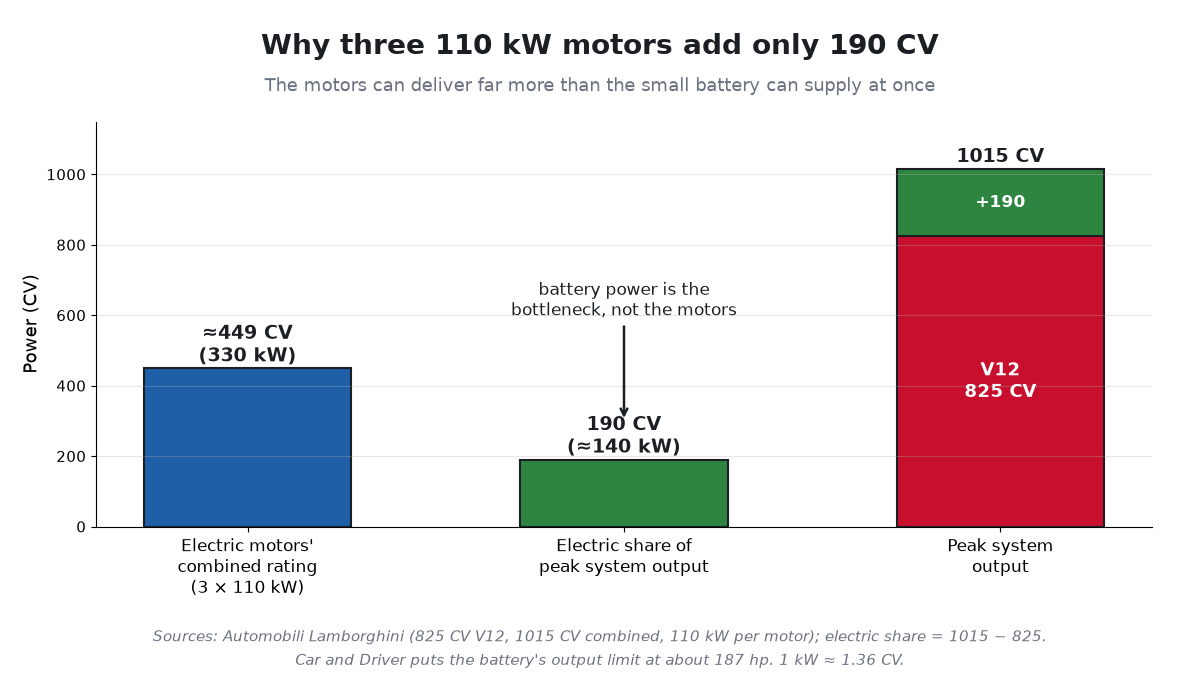
That's deliberate. Mohr told Autoweek he doesn't want more than about 20 percent of total output coming from electricity, "because otherwise there is a perception of a kind of different driving behavior that would be significant." In other words, Lamborghini wanted the electric shove to feel like extra engine, not like a different car bolted on.
The newest proof of this bottleneck is the Revuelto SV. According to Road & Track, it gets a larger 7.3 kWh battery that "can deliver more current" to the same trio of motors, raising electric output to 255 hp and total output to 1,050 hp, while the V12's figure stays the same. Bigger lunchbox, more lunch.
Thirteen personalities: the drive modes
The Revuelto's steering wheel carries two rotary dials. The left one picks the driving character: Città (city), Strada (road), Sport or Corsa (track). The right one picks the hybrid strategy: Recharge, Hybrid or Performance. Lamborghini counts 13 dynamic settings in total, and Car and Driver notes that Performance is only offered in some driving modes. Here's what Lamborghini says each driving mode does:
| Mode | What it's for | Max power (Lamborghini) | What the hybrid system does |
|---|---|---|---|
| Città | Town, quiet running, emission zones | 180 CV | Can run on electricity alone; most efficient mode; if the battery is empty, Recharge lets the V12 refill it |
| Strada | Everyday driving, long trips | 886 CV | V12 always running and keeping the battery charged; front e-axle torque vectoring active |
| Sport | Fun on a good road | 907 CV | V12 active with hybrid assist; available with Recharge, Hybrid or Performance |
| Corsa | Track | 1,015 CV (Performance) | Full output, e-axle tuned for maximum torque vectoring and AWD; Corsa Recharge prioritizes charging |
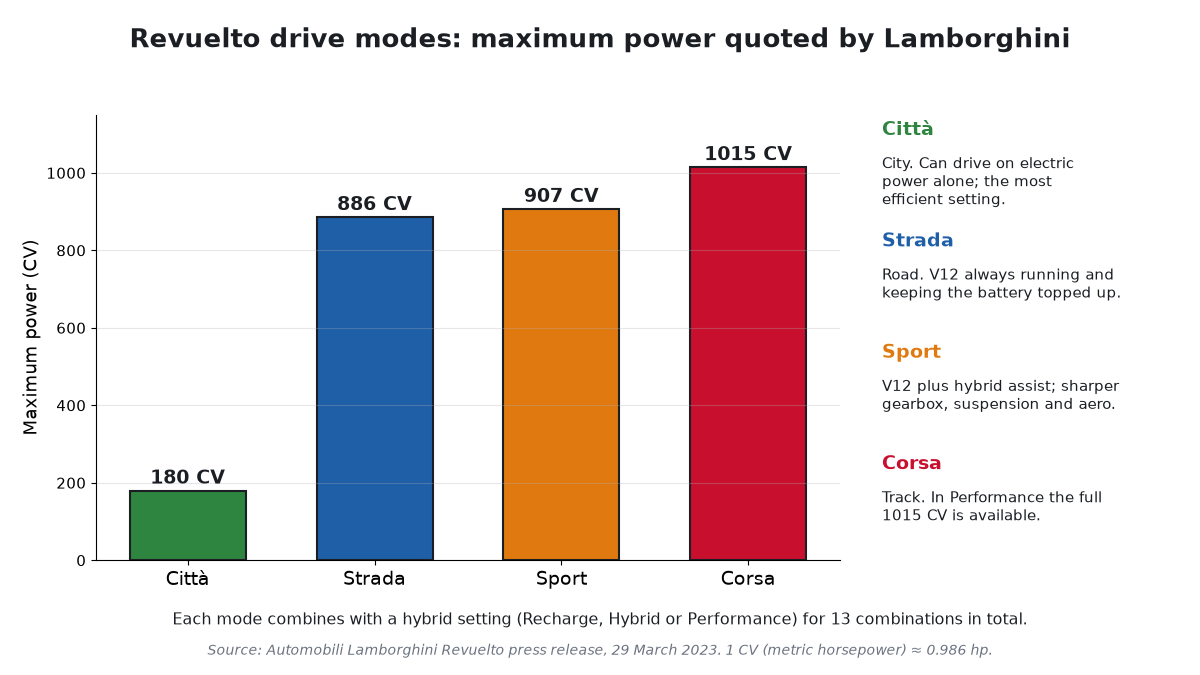
Recharge tells the car to use the V12, through the rear motor acting as a generator, to refill the battery as a priority. Lamborghini pitches it as the way to arrive at a historic city center with enough charge to roll through its low-emission zone silently. Lamborghini doesn't publish a full breakdown of all 13 combinations, so any detailed table you see online is somebody's interpretation.
How do these feel in practice? Car and Driver found Città "novel but unexciting," a silent, slow Lamborghini that felt "about as quick as a first-generation Nissan Leaf." Top Gear's advice is refreshingly lazy: "Go for Sport mode, let the hybrid sort itself out, keep the dampers soft."
Regen: braking that pays you back
Every time you lift off or brake, the front motors (and the rear motor) can act as generators, slowing the car while charging the battery. Lamborghini says the e-axle and rear motor both contribute to deceleration, which also takes some of the load off the carbon-ceramic brakes.
Mohr described a sneakier source of energy to Ars Technica. Normally, when traction control steps in, the car simply cuts engine power and the energy is wasted. In the Revuelto, "we brake the engine with the electric motor and also regain energy." The goal, he said, is that the battery "is more or less never empty," even on a track. As he told Autoweek, Lamborghini didn't want a system "that sounds good on paper but that, in reality, is empty after one lap on the racetrack."
The hard part of regen is the handover between electric braking and the pads and discs. Get it wrong and the pedal feels vague. Top Gear noted that "even Porsche has struggled with this," but said that in the Revuelto "not once did we give it a second thought." Their one caveat: the brakes were "too sharp at the top of their travel."
Torque vectoring: how the front wheels drag you around corners
This changes the driving experience most. With a motor per front wheel, the car can push one wheel harder than the other, or drive one while the other regenerates, twisting the nose into a corner the way a canoeist steers by paddling harder on one side. Lamborghini calls it its first electric torque vectoring system, part of its new "Lamborghini Dinamica Veicolo 2.0" controls, and it works together with four-wheel steering. Lamborghini also says that, unlike conventional systems, it uses the brakes only when strictly necessary.
Car and Driver puts numbers on it: up to 508 lb-ft of cross-axle difference, with +254 lb-ft on one side and -254 lb-ft on the other, "as one side essentially powers the other." On a skidpad their test car pulled 1.10 g, compared with 1.04 g for the Aventador SV. Top Gear describes feeling the front motors "haul the front wheels to negate understeer and keep the line tight," with electric shove filling the gap until the V12 is fully awake, "by 3,000rpm the handover seems complete."
The weight problem (because physics doesn't care about your feelings)
Here's the bill for all this hardware. Lamborghini quotes a dry weight of 1,772 kg (Top Gear and evo both cite it) and a weight-to-power ratio of 1.75 kg per CV, which it calls the best in its history. Add fluids and the rest and Top Gear says it's "over 1,900kg." Car and Driver weighed its test car at 4,290 lb, or roughly 1,946 kg.
Lamborghini fought back: the carbon "monofuselage" chassis is 10 percent lighter than the Aventador's and 25 percent stiffer, the engine lost 17 kg, and the battery sits low and central. But, as Mohr told Ars Technica, "You cannot avoid it completely because it's physics."
Where do you feel it? Under braking, mostly. Top Gear: "Traction is phenomenal, braking is where you detect the mass," adding that it "doesn't slow and change direction as well as a McLaren." Most of the rest of the time, the torque vectoring hides it. evo says the motors make the car feel "far, far lighter" than its dry weight.
So why keep a V12 at all?
Fair question. Ferrari and McLaren went with smaller turbocharged engines for hybrids like the 296 and the Artura. Why did Lamborghini keep a huge, thirsty, naturally aspirated twelve?
Mohr's answer to Ars Technica was blunt. Priority number one: "We wanted to preserve and even improve the emotions of our natural aspirated V12." Priority two was a big performance step up. A bigger engine made no sense ("we already have 6.5 liters"), and turbos or superchargers were out because "we would completely lose the character of this car, [and that] was not an option." He told Autoweek that revving a V12 toward 12,000 rpm for more power would bring a lot of maintenance on a road car. That left electrification, used, in his words, as a "real performance hybrid, not a downsizing range-oriented hybrid."
The motors also cover the old V12's one weakness: no turbo lag, but no big low-rev shove either. Car and Driver noted that while the Aventador "lacked the low-down urge of its turbocharged rivals, the Revuelto's electric motors give it instant punch even at lower engine speeds."
The less romantic reason: Lamborghini says the hybrid system cuts CO2 emissions by 30 percent compared with the Aventador Ultimae, and electric running lets the car into city centers with emissions restrictions.
What it's actually like to live with
What the reviewers say
The verdicts have been close to unanimous. Top Gear called it "possibly the best Lambo since the Miura" and concluded that "the hybrid is only there to support and encourage the best from that masterpiece of a V12." evo named it its Car of the Year for 2025, and Road & Track gave it its 2025 Performance Car of the Year title. After nearly 1,000 miles of using one as his only car, evo's Yousuf Ashraf wrote that the hybrid system "enhances your every input without feeling unnatural, or diluting its character," with the three motors acting with the V12 "without feeling like separate power sources."
The criticisms are mostly the ones you'd guess:
- The electric range is a party trick. Five miles from the EPA. Top Gear's list of bad points leads with "Tiny battery means tiny electric range." evo used electric mode for leaving home without "disturbing the neighbours, although I'm told the fire-up can still be heard from a mile away."
- The car has to warm up first. Car and Driver noted the engine stays asleep until the transmission is warm, even in Strada, Sport or Corsa, and listed "Transmission needs to warm up before switching from EV mode" among its lows.
- Front motors, meet a steep driveway. evo reported that pulling into and out of a driveway, the electrically driven front wheels "would sometimes catch air and spin helplessly, and judder heavily across the road at full lock."
- Button overload. Car and Driver disliked the turn-signal buttons on the wheel, and Top Gear found the hidden controls on the back of the wheel took learning.
- It bites in the wet. evo warned that with the stability control off, "when the rear breaks loose it does so very quickly," and even in the halfway ESC Sport setting it will "light up the rears in fourth with very little provocation."
What owners say
Owners on the Lamborghini-Talk forum flag something more mundane: the small 12-volt battery, separate from the hybrid pack, can go flat. One owner's died twice, once with the doors open for days during a paint-protection-film job and once after three hours of kids sitting in it at a show. Another said his dealer advised switching the car on in EV mode when using doors, screens or audio while parked, so the high-voltage system carries the load; he reported 20 minutes of air conditioning and music with the battery "barely" dropping. The original poster stresses that plugging in the hybrid battery does not keep the 12-volt topped up, so use a trickle charger (not included, he notes) if the car will sit for a week or more. Ask your dealer for specifics.
Speaking of dealers, the Exotics Group Partners & Vendors directory lists Lamborghini dealerships across the U.S. if you need to find your nearest one.
The bottom line
The Revuelto's hybrid system isn't about saving fuel or pretending to be an EV. It's a carefully limited dose of electricity, about 190 CV of 1,015, so a high-revving V12 can stay the star. The front motors pull you out of corners and handle reversing, the rear motor starts, charges and boosts, the battery hides in the old tunnel, and a sideways gearbox makes it all fit.
The cost is weight, complexity and an electric range measured in driveways. The reward, if the reviewers are right, is the best-driving V12 Lamborghini yet. Not bad for an engine that spent sixty years insisting it didn't need anybody.
Sources
- Automobili Lamborghini, "Lamborghini Revuelto: the first super sports V12 hybrid HPEV" (press release, 29 March 2023)
- Full text of the Lamborghini press release as republished by UK Lamborghini dealer Ryland
- Automobili Lamborghini, Revuelto digital brochure (technical specifications)
- Car and Driver, "2024 Lamborghini Revuelto Tested: The Mad Scramble"
- Car and Driver, "2024 Lamborghini Revuelto: Plug-In-Hybrid V-12 Supercar Links Past and Future"
- Car and Driver, Lamborghini Revuelto review, pricing and specs
- Autocar, "Under the skin: The genius of the Lamborghini Revuelto's gearbox"
- Top Gear, Lamborghini Revuelto review
- Top Gear, Lamborghini Revuelto driving, engines and performance
- evo, "I daily drove a Lamborghini Revuelto, and I'm convinced it's the world's best supercar"
- Ars Technica, "The most important part of the new Lamborghini Revuelto? Character."
- Autoweek, "Lamborghini CTO Says Revuelto's Electric Power Capped at 20%"
- Road & Track, "Lamborghini Turns the Revuelto Up to 11 with the New SV"
- YASA, Lamborghini Revuelto front e-axle application
- Lamborghini-Talk forum, "Stupid 12V battery" (owner thread)
- Wikimedia Commons, "Lamborghini Revuelto Opera Unica 001.jpg" (JustAnotherCarDesigner, CC0)
- Wikimedia Commons, "2024 Lamborghini Revuelto 18.jpg" (Calreyn88, CC BY-SA 4.0)
- Wikimedia Commons, "2024 Lamborghini Revuelto 19.jpg" (Calreyn88, CC BY-SA 4.0)


