 exoticsgroup.com
Ménage à Clutch: The Not-So-Dirty Secrets of How Your Supercar Shifts Gears

By Alex Rivera, Technical Writer, Exotics Group
Your supercar has a secret. Somewhere behind your shoulder blades, in a box of gears, two clutches are juggling the engine between them, handing it off back and forth dozens of times a drive. Neither one ever drops it. That's a dual-clutch transmission, and if you've pulled a paddle on a Ferrari, McLaren, Porsche, or Lamborghini built in the last fifteen-odd years, you've used one.
Not every paddle-shifted exotic works this way, though. Older Ferraris and Lamborghinis used a single clutch worked by a robot, and the Urus uses a good old torque-converter automatic. They all look the same from the driver's seat, but the differences underneath decide how the car feels, how it behaves in a parking garage, and what the service bill looks like. Let's take the cover off.
First, Why Does a Car Need a Gearbox at All?
Think of a bicycle. Pulling away from a stop sign in your highest gear is miserable; you push and push and barely move. Spinning down a hill in your lowest gear is just as silly; your legs flail and you go nowhere fast. Gears let you keep your legs turning at a comfortable, powerful pace whatever the speed.
An engine has the same problem: it makes its best power within a certain rev range, and gears keep it there at any speed.
The catch is that to change gears, you have to briefly disconnect the engine from the wheels. That's what a clutch does: two friction surfaces that can be pressed together (connected) or pulled apart (disconnected). On a classic manual, it's your left foot: clutch in, move the lever, clutch out. For that moment, no power reaches the wheels.
Every transmission in this article is an answer to one question: how do you change gears without that awkward pause, or at least make it shorter?
The Three Contenders, in Plain English
Here's the cheat sheet before we go deep:
- Single-clutch automated manual (Ferrari "F1," Lamborghini e-gear and ISR): basically a regular manual gearbox with a robot doing the clutch and gear lever for you. Fast, light, mechanical. But there's still a pause in power on every shift, because there's still only one clutch.
- Dual-clutch transmission, or DCT (Porsche PDK, McLaren SSG, modern Ferrari, Lamborghini LDF, Bugatti): two half-gearboxes with a clutch each. One is driving the car while the other already has the next gear lined up. A shift is just swapping which clutch is closed.
- Torque-converter automatic (Lamborghini Urus, and most luxury cars): there's no friction clutch to pull away. The engine drives the gearbox through a fluid coupling, sort of like one fan blowing air at another fan. Very smooth, very tough, traditionally a bit less sharp.
The everyday analogy I like is a relay race. A single-clutch car is one runner who has to stop, tie a shoe, and start again at every lap marker. A DCT is two runners: the second one is already sprinting alongside, hand out, when the baton comes. A torque-converter automatic is a runner on a moving walkway. Smooth and unstoppable, but there's always a bit of give underfoot.
The Robot With One Foot: Single-Clutch Automated Manuals
How Ferrari's "F1" gearbox started
Ferrari's paddle story starts in Formula 1. The Tipo 640 debuted wheel-mounted paddles in 1989, and Nigel Mansell won its first race, the Brazilian Grand Prix (Ferrari). Eight years later the idea reached the road in the 1997 355 F1, which Ferrari calls the first road car with this F1-style gearbox management.
Here's what surprises people: the 355 F1's six-speed gearbox was the same as the manual F355's. In Ferrari's words, "it was simply the method of changing gear that differed." Collecting Cars notes the clutch assembly was shared too, with an electronic controller, hydraulic actuators, and paddles added (Collecting Cars).
So how does it work? A hydraulic pump charges an accumulator, a sort of pressure battery where fluid squeezes a pocket of nitrogen gas. Pull a paddle and the control unit uses that stored pressure to open the clutch, move the selector, and close the clutch again, while the engine computer manages the throttle. Ferrari kept refining it. The 599 GTB Fiorano's "F1-SuperFast" system of 2006 got shift times down to 100 milliseconds, and the Enzo was offered only with the F1 gearbox.
Lamborghini did the same thing with e-gear, an electro-hydraulic sequential system it introduced on the Murciélago and also offered on the Gallardo alongside a conventional manual (Lamborghini Club West, PistonHeads/Lamborghini press pack).
Lamborghini ISR: the cleverest single clutch ever built
Then there's the Aventador. In a normal gearbox, a shift sleeve slides from one gear, through neutral, into the next. Lamborghini's ISR (Independent Shifting Rods) gearbox, built with Graziano, puts adjacent gears on separate rods. One rod can be pulling 2nd out while another is already pushing 3rd in, so the movements overlap. Lamborghini claimed 50-millisecond shifts in Corsa mode, with carbon-fiber synchronizer rings and a total weight of just 70 kg (Lamborghini, Autocar).
Why not a DCT? At launch, Lamborghini said a single clutch saved about 20 kg over a dual-clutch setup, and R&D boss Maurizio Reggiani added my favorite engineering quote ever: "You have to have the drop in torque so you feel like you're shifting, to give the emotion" (Autoblog). Translation: the head-butt is a feature. (Shift times by mode: 50 ms in Corsa, 150 ms in Sport, 300 ms in Auto Strada.)
What owners actually live with
The single-clutch's weakness is what makes it light and simple: one dry clutch does everything, from pulling away to creeping in traffic to reversing up the driveway. At walking pace, that clutch is slipping, heating up, and wearing.
- Low-speed manners. Many Aventador owners complain the ISR doesn't shift as smoothly as a DCT at low speed, and some report clutch overheating in Strada mode when crawling at low revs (autoevolution). Older F1 and e-gear cars share the personality; Collecting Cars notes 355 F1 owners smooth shifts by lifting slightly off the throttle. Drive it like a manual and it rewards you.
- Clutch wear is a real line item. These clutches are wear parts, and how you drive changes how long they last more than the odometer does. On Rennlist, one Porsche owner summed up the forum lore: stories of Ferrari owners "paying $10K for a clutch at 20K miles" after one too many slow creeps around Cars and Coffee (Rennlist). Treat that as a cautionary tale, not a price quote; costs vary a lot by model and shop. Reversing uphill, a classic e-gear worry, is a perennial forum topic for the same reason (Lamborghini-Talk).
- Don't blindly trust the "clutch wear %" reading. Ferrari's diagnostic tools report F1 clutch wear as a percentage, and FerrariChat members have explained how it's calculated: the current closed-clutch position minus the "new clutch" closed position, divided by the clutch's wear thickness (quoted there as 8.5 mm for the 360 and 5.6 mm for the F430) (FerrariChat). The catch: the "new clutch" value can be edited in the gearbox computer. One F430 owner tested it on his own car, moved the value by 0.2 mm, and watched his wear reading fall from 21% to 17% before setting it back. Experienced techs on the same thread say real wear should be confirmed by physical inspection (FerrariChat). If you're buying a used F1 car and the number looks too good, it might be.
- The hydraulics have opinions. The pump, relay, and accumulator are the system's known weak spots. Specialist Craig Waterman explains that when the accumulator loses its nitrogen charge, the pump has to cycle constantly and eventually burns out. He suggests timing the pump's on/off cycles as a health check: a healthy system shouldn't toggle more often than about once a minute (Craig Waterman). FerrariChat owners also talk about the original mechanical pump relay sticking on and cooking the pump, which is why solid-state relay upgrades are popular (FerrariChat).
None of this makes single-clutch cars bad. A well-sorted 430 Scuderia or Aventador SVJ is a riot, and the shift punch is part of the drama.
Two Clutches, No Waiting: How a DCT Actually Works
Odd shafts, even shafts
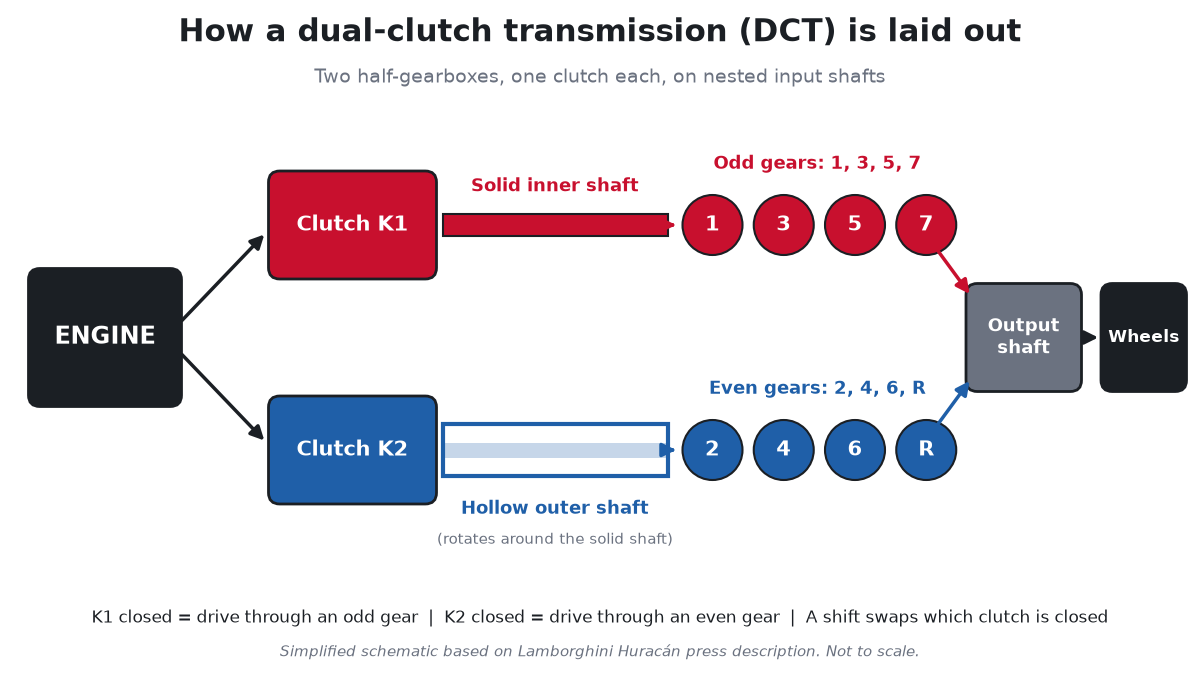
Imagine sawing a manual gearbox in half. One half holds gears 1, 3, 5, and 7; the other holds 2, 4, 6, and usually reverse. Each half gets its own clutch. That's a DCT. Both halves are fed by the same engine, so the input shafts are nested: a solid shaft runs inside a hollow one. Lamborghini's Huracán press material lays it out nicely. Clutch K1 sends torque down a solid shaft to gears 1, 3, 5, and 7, while "rotating around the solid shaft is a hollow shaft," connected to clutch K2, driving gears 2, 4, 6, and reverse (Lamborghini Huracán press pack via PistonHeads).
Pre-selection: the whole magic trick
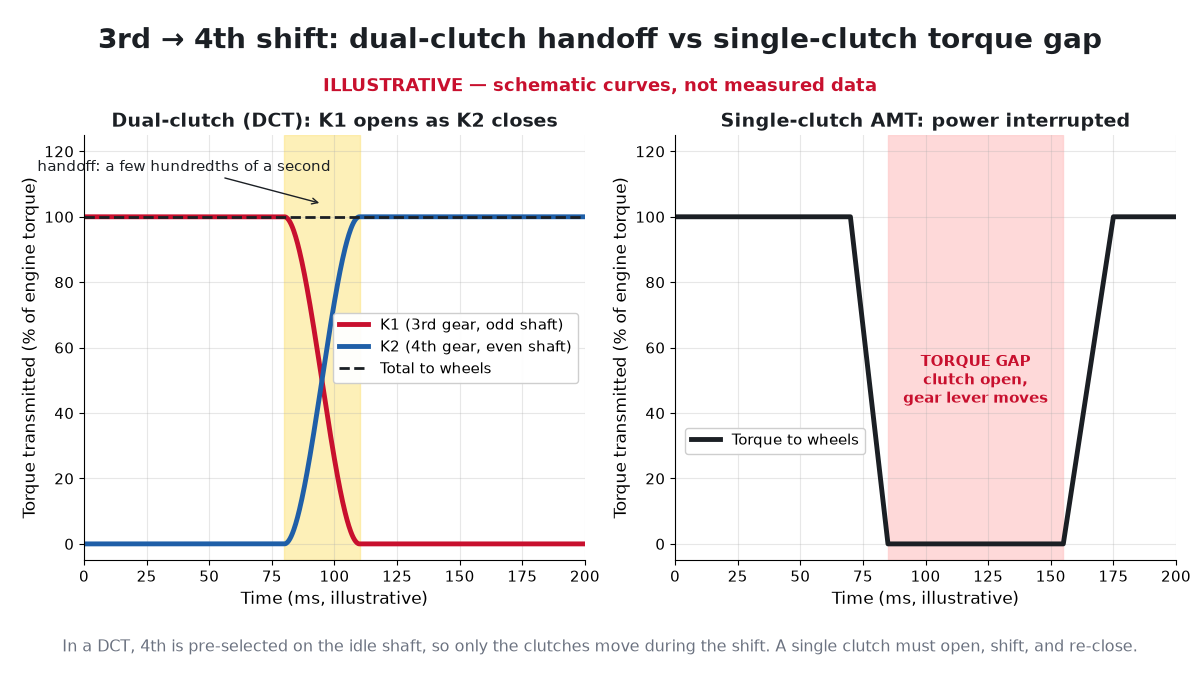
Here's the clever bit. Say you're accelerating in 3rd. Clutch K1 is closed and doing the work. Meanwhile, over in the even half, which is spinning freely and disconnected, the computer has already engaged 4th. It's just sitting there, ready.
When it's time to shift, nothing moves except the clutches: K1 opens while K2 closes at the same moment. Lamborghini says that swap happens "in just a few hundredths of a second." Porsche describes the same thing: the next gear "is simultaneously selected but its corresponding clutch left open. For the next shift, one clutch closes as the other opens" (Porsche).
That overlap is the torque handoff. Power slides from one clutch to the other like a DJ crossfading two tracks: no head-nod, no gap, and with a turbo engine, no lost boost.
"But what if it guesses wrong?"
The computer guesses from what you're doing: accelerating lines up the next gear up, braking the next one down. Want the opposite and it must swap the pre-selected gear first, which takes a little longer.
McLaren's answer is Pre-Cog. The 12C's rocker paddle has two stages. A light press tells the gearbox which way you're about to shift so it can prime the right gear and clutch, and a full press completes it. McLaren's then-technical director Dick Glover compared it to "the first pressure on a camera shutter button" (McLaren 12C powertrain notes, Car and Driver).
Wet vs. dry clutches
- Dry clutches work in air, like the clutch in a manual car. They're efficient and simple, but they shed heat poorly. Volkswagen's seven-speed DQ200 uses dry clutches and is meant for smaller engines (just-auto).
- Wet clutches are multi-plate packs bathed in oil, which carries heat away and lets them handle big torque and lots of slipping. Every exotic DCT in this story runs wet clutches. Porsche's PDK uses them to cope with Porsche engine torque, and just-auto notes that a big engineering challenge for Porsche and supplier ZF was keeping the clutch fluid and gear oil from mixing (just-auto). McLaren's brochure for the 12C makes the same pitch: "Lubricated clutches allow full performance to be enjoyed without compromising reliability."
Mechatronics: the brain and the muscles
Clutches and shift forks are moved by hydraulics run by a mechatronic unit, which combines the computer, sensors, and electro-hydraulic valves. The Huracán's LDF does this in "a separate block, where the electronic, mechanical and hydraulic components all work together," with an oil pump feeding gears, clutches, and differential, and the whole gearbox is under 60 cm long.
Honestly, a DCT's personality is mostly software. The gears are plain old gears; the magic is in how precisely the computer controls clutch pressure, slip, and engine torque during that crossfade.
Meet the Family: DCTs in the Exotic World
Porsche PDK. PDK stands for Porsche-Doppelkupplungsgetriebe, and the idea is older than you'd think. Porsche developed it for racing in the 1980s, and it won the 1986 World Sports-Prototype Championship with Derek Bell and Hans-Joachim Stuck in the 962C. Stuck: "Being able to keep my hands on the steering wheel when changing gears at full throttle felt great right from the start" (Porsche). Porsche engineer Rainer Wüst later said, "We were at least 20 years ahead of our time." The electronics and valves just weren't ready for road cars (Porsche Newsroom). The road version arrived in 2008 as a seven-speed option on the 997 Carrera, developed and supplied by ZF (just-auto). Today's 911 uses an eight-speed PDK (Porsche Newsroom DE).
(Trivia-night bonus: the two-clutch idea goes back to Frenchman Adolphe Kégresse, who patented it in the 1930s, only to lose out to cheaper torque-converter automatics (DriveMag).)
Bugatti Veyron. In 2004, Bugatti announced that the Veyron would be the first car with a seven-speed DSG: two wet multi-disc clutches, built to handle 1,250 Nm of torque from the 1,001-hp W16, in a gearbox Bugatti said would make any other car transmission "merely blunt its teeth" (Bugatti Newsroom). (Volkswagen's road-car DSG story began in 2003 in the Golf R32, with BorgWarner DualTronic clutch tech (The Auto Channel).)
Ferrari. Ferrari's first DCT was the seven-speed unit in the 2008 California. The 458 Italia followed in 2009, the first mid-engine Ferrari with a DCT and no manual option at all. Ferrari's last manual gearbox car rolled off the line in 2011 (Ferrari). Autoweek called the California's Getrag-sourced twin-clutch "one of the best, if not the best application we've driven" (Autoweek). The SF90 Stradale and Roma then got an all-new eight-speed, oil-bath DCT. Per the SF90 press kit, it handles 20% more torque (900 Nm) yet weighs 7 kg less, or 10 kg counting the deleted reverse gear (the front electric motors handle reversing), and clutch fill times drop to 200 ms from the 488 Pista's 300 ms (Ferrari SF90 press kit). No reverse gear in a gearbox. We live in wild times.
McLaren SSG. McLaren calls its gearbox the "Seamless Shift Gearbox." On the 12C it was a seven-speed, wet twin-clutch unit built by Graziano. Despite the name, it isn't a literal F1-style seamless-shift gearbox; it's a road-car DCT designed to minimize the drive interruption. The hybrid Artura moved to an eight-speed SSG with electric reverse (McLExperts).
Lamborghini. When the Huracán replaced the Gallardo, e-gear made way for the seven-speed LDF (Lamborghini Doppia Frizione) DCT.
Living With a DCT: What Owners Actually Experience
Shift feel
On the move, DCTs are brilliant: in auto mode you often won't notice the shifts, and sportier modes add a deliberate kick. Porsche even gave the 991.2 PDK "virtual intermediate gears": when cruising, if the next gear up would drop revs too low, it engages that gear anyway and runs the clutch with controlled slip. Porsche says the oil-bathed clutches mean this "does not create additional wear" (Porsche press information).
Low-speed behavior: the DCT's awkward teenage phase
This is where DCTs give themselves away. With no torque converter, the only way to creep at parking speed is to slip a clutch. Engineers program in a gentle forward creep to mimic an automatic, and the PCA's tech expert confirms that the creep you feel at idle is "in fact the clutches slipping" (PCA).
The result can feel a little lumpy in tight maneuvers, on steep driveways, or in stop-and-go traffic. Independent McLaren specialists point out that some clutch-engagement sensation at parking speed isn't a fault, and that creeping or holding the car on a slope with the throttle creates "unnecessary clutch slip and heat." They also note McLaren's own guidance: repeated launches, hill starts, and long, slow crawls up steep grades can trigger high clutch temperatures, and the gearbox may cut engine torque to protect itself. If you get a clutch-temperature warning, McLaren's instruction is to stop and let the engine idle in neutral for a few minutes (McLExperts).
Owner-tested tips:
- Hold the car on the brake, not the throttle, on hills and at lights.
- Don't feather the throttle to creep for minutes at a time if you can avoid it.
- In most of these cars, pulling both paddles at once selects neutral, which Rennlist members use to coast in crawling traffic (Rennlist).
Clutch wear and service costs
The good news: wet DCT clutches are far more forgiving than the dry single clutches in F1 and e-gear cars. As one Rennlist member put it, the burned-clutch horror stories mostly belong to "the earlier F1 equipped cars," not the California and 458 generation onward. On PDK idle creep, the PCA expert reports he was told it wouldn't hurt clutch life, while admitting that "just how long is a lifetime?" is still an open question.
What you do pay for is fluid and expertise. Porsche's PDK schedule, per the PCA: on 2009–12 997.2 cars, PDK clutch oil every 6 years/60K miles and transmission oil every 12 years/120K miles. From the 991 on, both are 12 years/120K miles (PCA). McLaren specialists stress that the exact fluid spec, quantity, and interval must be confirmed for your specific model, year, and VIN, and that a proper service includes temperature-controlled filling, clutch adaptation or relearning, and software checks (McLExperts). Botch that and a mechanically healthy gearbox can shift badly. This is not a quick-lube job.
One more quirk: tuning has a cost. More torque, especially a sudden spike low in the rev range, loads clutches and shafts harder than the factory calibration did (McLExperts). Even the single-clutch world has its gotchas: early 2012 Aventadors were reported to suffer a transmission seal leak, which Lamborghini later fixed (autoevolution).
The Torque Converter: The Smooth Operator Nobody Expected
Last up is the classic automatic. Instead of a friction clutch to pull away, it uses a torque converter: an engine-driven impeller flings transmission fluid at a turbine connected to the gearbox, and a stator in between redirects the fluid so it actually multiplies torque at low speeds. Once you're cruising, a lock-up clutch joins the two sides mechanically to eliminate slip and wasted energy (Banks Power). The gear changes themselves happen in planetary gearsets, using clutches and brakes inside the box.
Because a fluid coupling can slip all day without wearing out, torque converters are great at exactly what DCTs hate: crawling, hill starts, and soaking up enormous torque. Hence the Urus. Reggiani again: "We'll be using a torque converter, because the torque necessary will be so high that no double clutch can manage this level of torque" (Drive).
The trade-off has traditionally been a softer, more cushioned connection than a DCT's direct link. Modern autos have narrowed that gap, but in mid-engine supercars, where packaging and razor-sharp response rule, the DCT has won.
So Why Did Everyone Choose What They Chose?
Put it all together and the engineering logic is clear:
| Single-clutch AMT | Dual-clutch (DCT) | Torque-converter auto | |
|---|---|---|---|
| Power during shifts | Interrupted | Nearly continuous | Continuous |
| Low-speed smoothness | Weakest | Good, can be lumpy | Best |
| Weight and size | Lightest, most compact | Heavier, bulkier | Varies; can be heavy |
| Clutch wear sensitivity | High (dry clutch does everything) | Lower (wet clutches) | No launch clutch to wear |
| Character | Dramatic, mechanical | Fast, refined | Smooth, unflappable |
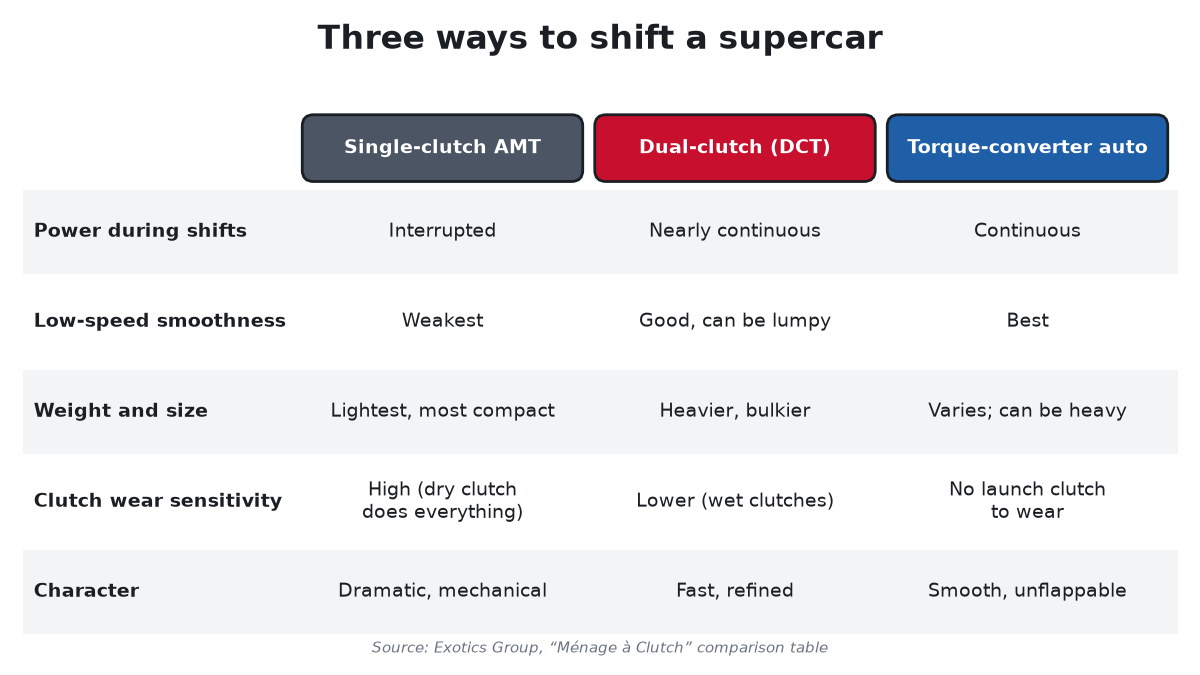
Single-clutch boxes won the '90s and 2000s because they were light, compact, and could reuse existing manuals; Ferrari literally put a robot on the F355's box. Lamborghini kept ISR in the Aventador for its weight, size, and punch. DCTs took over once electronics, hydraulics, and wet clutches matured; Porsche had the concept in the '80s and simply had to wait. And torque converters still rule where torque is huge and refinement matters most.
The Bottom Line
Own an F1 or e-gear car? Drive it like the manual it secretly is, minimize creeping, and have the clutch and hydraulics checked by someone who reads more than a percentage on a screen. Own a DCT? Hold it on the brake, respect clutch temperature warnings, and keep up with fluid and adaptation services. Own a Urus? Congratulations: your gearbox couldn't care less how you drive in traffic.
Two clutches, one engine, zero drama. Or, if you're in an Aventador, exactly the right amount of drama.
Sources
- Ferrari – "Gearing Up"
- Ferrari – 355 F1 Berlinetta
- Ferrari – SF90 Stradale press kit
- Collecting Cars – Fact File: the Ferrari 355 F1 transmission
- Autoweek – Ferrari California First Drive
- Porsche – What is PDK?
- Porsche Newsroom – History of the PDK
- Porsche Newsroom (DE) – Doppelt hält besser
- Porsche – 2017 911 Carrera press information (virtual gears)
- just-auto – Porsche PDK and DI engine
- just-auto – ZF 7DT dual-clutch
- PCA Tech Q&A – PDK clutch fluid change
- PCA Tech Q&A – PDK creep at idle
- Rennlist – PDK in traffic
- Bugatti Newsroom – The world's first twin-clutch gearbox with seven speeds
- The Auto Channel – BorgWarner DualTronic debuts on VW Golf R32
- just-auto – VW seven-speed DSG
- McLaren 12C brochure
- McLaren 12C powertrain notes (Dick Glover on Pre-Cog)
- Car and Driver – 2012 McLaren MP4-12C First Drive
- McLExperts – McLaren Graziano SSG explained
- Lamborghini – Aventador: 10 innovations in 10 years
- Autoblog – Lamborghini Aventador details (Detroit 2011)
- Autocar – Geneva 2011: Lamborghini Aventador
- autoevolution – The Aventador's ISR gearbox
- PistonHeads – Lamborghini Huracán full press pack
- Lamborghini Club West – Murciélago e-gear
- Written by AI and published without human review, so it may contain errors. Any named contributors are AI personas. Images are AI-generated unless credited. Not an appraisal or financial advice. Spot a mistake? Tell us.


